



Cleaved-Caspase 8 Antibody (YA792)
(Synonyms: CASP8; MCH5; Caspase-8; CASP-8; Apoptotic cysteine protease; Apoptotic protease Mch-5; CAP4; FADD-homologous ICE/ced-3-like protease; FADD-like ICE; FLICE; ICE-like apoptotic protease 5; MORT1-associated ced-3 homolog; MACH)Based on 2 publication(s) in Google Scholar
Cleaved-Caspase 8 Antibody (YA792) is a Mouse-derived and non-conjugated IgG1 monoclonal antibody, targeting to Cleaved-Caspase 8.
-
Host:
Mouse
-
Isotype:
IgG
-
Application:
WB, IHC-F, IHC-P, ICC/IF
-
Reactivity :
Human, Mouse, Rat
-
Formulation:
Supplied in 1*PBS (pH 7.3), 50% glycerol and 0.5% BSA. Preservative: 0.02% sodium azide.
-
Conjugation:
Non-conjugated


To place orders, for customer services and technical support, please contact: MedChemExpress USA
Tel: 609-228-6898 E-mail: [email protected] [email protected]



-

HY-P80623
Cleaved-Caspase 3 p12 Antibody (YA499) -
HY-P80049
Caspase-8 Antibody (YA554) -
HY-P80964
Cleaved-Caspase 9 Antibody (YA852) -

HY-K0601
JC-1 Mitochondrial Membrane Potential Assay Kit -
HY-P86370
Cleaved Caspase-3 (Asp175) Antibody (YA6062) -
HY-P80566
Bcl-2 Antibody (YA590) -
HY-P80183
HMGB1 Antibody (YA361) -
HY-P80046
Caspase-3 Antibody (YA557) -
HY-P80468
Phospho-MLKL (Ser345) Antibody (YA174) -
HY-P80102
Cytochrome C Antibody (YA479)
Publications Citing Use of MedChemExpress (MCE) Cleaved-Caspase 8 Antibody (YA792)
More

Applications
| Application |
WB

WB: Western Blot
|
IHC-P
IHC-P: Immunohistochemistry-Paraffin
|
IHC-F
IHC-F: Immunohistochemistry-Frozen
|
ICC/IF
ICC/IF: Immunocytochemistry/
Immunofluorescence |
|---|---|---|---|---|
| Dilution Ratio | 1:500-1:1000 | 1:50-1:100 | 1:50-1:100 | 1:50-1:200 |


Product Details
Cleaved-Caspase 8 Antibody (YA792) is a Mouse-derived and non-conjugated IgG1 monoclonal antibody, targeting to Cleaved-Caspase 8.
-
Host Mouse

-
Clonality Monoclonal

-
Species ReactivityHuman, Mouse, Rat
-
Observed Molecular WeightObserved band size: 18, 43-55 kDa
Note: Due to possible protein modifications or aggregation, the molecular weight should be confirmed by actual measurement, and the predicted value is for reference only.

-
Calculated Molecular Weight Predicted band size: 43-55 kDa

Entrez Gene: 841 Human ; 12370 Mouse ; 64044 Rat
SwissProt: Q14790 Human ; O89110 Mouse ; Q9JHX4 Rat
OMIM: 607271 Human
Synthetic peptide corresponding to Caspase-8.The exact sequence is proprietary to MCE.
Endogenous
affinity purified
Non-conjugated
Unmodified
IgG


Product Properties
-
Appearance
Solution
-
Formulation
Supplied in 1*PBS (pH 7.3), 50% glycerol and 0.5% BSA. Preservative: 0.02% sodium azide.
-
Concentration
Batch-dependent, Please check the COA for the concentration of each lot. Check Lot Concentration
-
Storage & Stability
Stored at -20°C for 1 year. Avoid repeated freeze / thaw cycles.
-
Shipping
Shipping with blue ice.


Publications (2)
-
Journal Impact Factor
-
Most Recent
-
FASEB J
Rufy3 Knockdown Induces PANoptosis Through MAP4/CDK1 Axis to Inhibit Colorectal Cancer Growth: Evidence From In Vitro and In Vivo Models. [Abstract]2025 Sep 15;39(17):e70988. PMID: 40879686 -
J Biochem Mol Toxicol
Kynurenine 3-hydroxylase Inhibitor RO 61-8048 Alleviates Nonalcoholic Fatty Liver Disease in High-Fat Diet-Induced Obese Mice. [Abstract]2025 Sep;39(9):e70511. PMID: 40952780


Verification Images
-
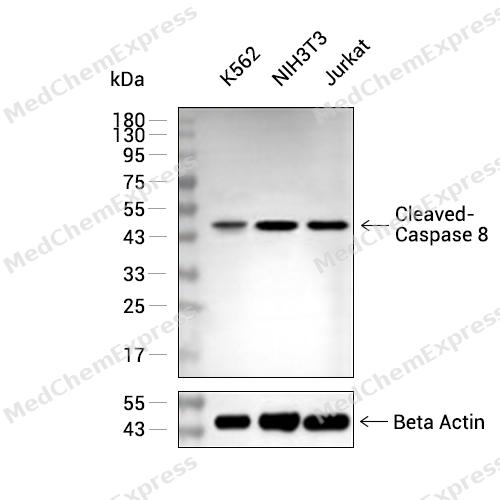 Western blot analysis of extracts from K562 (lane 2(20μg), NIH3T3 (lane 3(20μg) and Jurkat (lane 4(20μg) using Cleaved-Caspase 8 (HY-P80624) Mouse mAb. Proteins were transferred to a PVDF membrane and blocked with 5% non-fat milk in TBST for 2 hour at room temperature. The primary antibody (1/1000) and Loading control antibody (Beta Actin, HY-P80438, 1/10000) was used in 5% non-fat milk in TBST at 4°C overnight. Goat Anti-Mouse IgG-HRP Secondary Antibody (1/10000) was used for 1 hour at room temperature.
 -
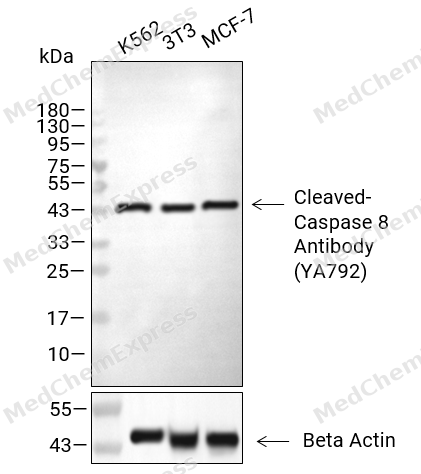 Western blot analysis of extracts from K562 (lane 2(40μg), 3T3 (lane 3(40μg), MCF-7 (lane 4(40μg)using Cleaved-Caspase 8 Antibody (YA792). Proteins were transferred to a PVDF membrane and blocked with 5% BSA in TBST for 2 hour at room temperature. The primary antibody and Loading control antibody (Beta Actin, HY-P80438, 1/3000) was used in 5% BSA in TBST at 4°C overnight. Goat Anti-Mouse/Rabbit IgG-HRP Secondary Antibody (HY-P8004/HY-P8001, 1/10,000) was used for 1 hour at room temperature.
 -
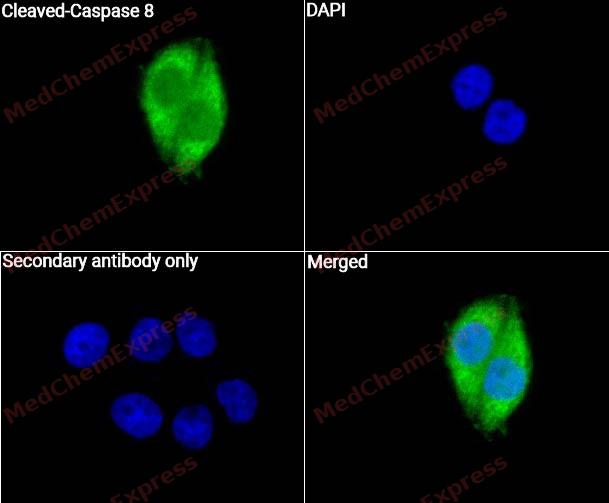 Immunocytochemistry analysis of Hela cells labeling Cleaved-Caspase 8 with Cleaved-Caspase 8 Antibody (HY-P80624)at 1/50 dilution. Cells were fixed in 4% paraformaldehyde for 15 minutes at room temperature, permeabilized with 0.1% Triton X-100 for 10 minutes at room temperature, then blocked with QuickBlock™ Blocking Buffer for Immunol Staining for 10 min at room temperature. Cells were then incubated with Cleaved-Caspase 8 Antibody (HY-P80624) at 1/50 dilution in QuickBlock™ Blocking Buffer for Immunol Staining at 4 ℃. Alexa Fluor® 488-conjugated AffiniPure Goat Anti-Mouse IgG H&L(HY-P8005, Green) was used as the secondary antibody at 1/1,000 dilution. PBS instead of the primary antibody was used as the secondary antibody only control. The Nuclear counterstain was DAPI (Blue).
 -
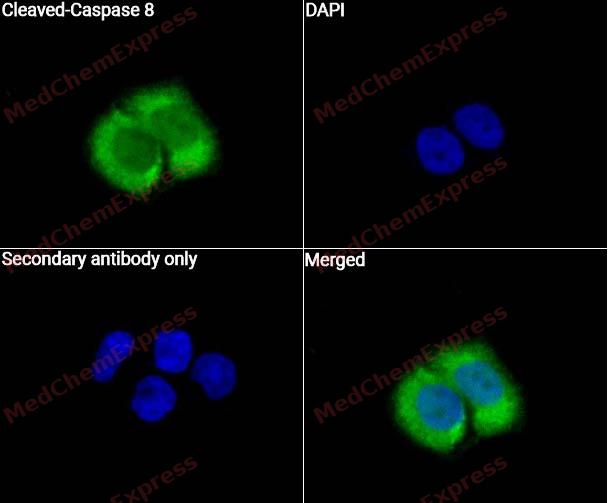 Immunocytochemistry analysis of Hela cells labeling Cleaved-Caspase 8 with Cleaved-Caspase 8 Antibody (HY-P80624) at 1/100 dilution. Cells were fixed in 4% paraformaldehyde for 15 minutes at room temperature, permeabilized with 0.1% Triton X-100 for 10 minutes at room temperature, then blocked with QuickBlock™ Blocking Buffer for Immunol Staining for 10 min at room temperature. Cells were then incubated with Cleaved-Caspase 8 Antibody (HY-P80624) at 1/100 dilution in QuickBlock™ Blocking Buffer for Immunol Staining at 4 ℃. Alexa Fluor® 488-conjugated AffiniPure Goat Anti-Mouse IgG H&L(HY-P8005, Green) was used as the secondary antibody at 1/1,000 dilution. PBS instead of the primary antibody was used as the secondary antibody only control. The Nuclear counterstain was DAPI (Blue).
 -
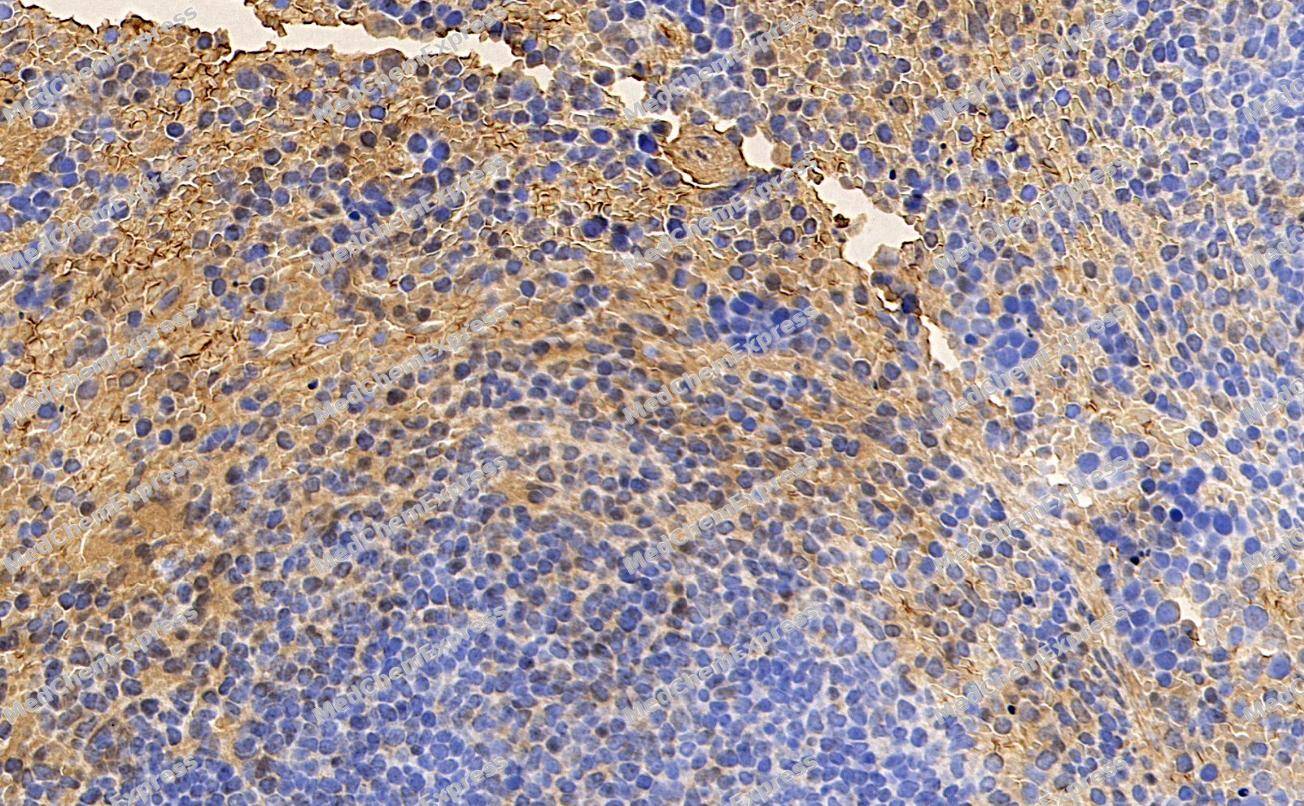 Immunohistochemical analysis of paraffin-embedded Mouse spleen tissue using Cleaved-Caspase 8 Antibody. The section was pre-treated using heat mediated antigen retrieval with sodium citrate buffer (pH 6.0) for 8 minutes. The tissues were blocked in QuickBlock for 20 minutes at room temperature, washed with ddH2O and PBS, and then probed with the primary antibody (HY-P80624, 1/100) in 4℃ overnight. The detection was performed using an HRP conjugated compact polymer system. DAB was used as the chromogen. Tissues were counterstained with hematoxylin and mounted with DPX.
 -
Immunohistochemical analysis of paraffin-embedded Mouse spleen tissue using Cleaved-Caspase 8 Antibody. The section was pre-treated using heat mediated antigen retrieval with sodium citrate buffer (pH 6.0) for 8 minutes. The tissues were blocked in QuickBlock for 20 minutes at room temperature, washed with ddH2O and PBS, and then probed with the primary antibody (HY-P80624, 1/100) in 4℃ overnight. The detection was performed using an HRP conjugated compact polymer system. DAB was used as the chromogen. Tissues were counterstained with hematoxylin and mounted with DPX.


Background
-
Function
Cleaved-Caspase 8 is a Thiol protease that plays a key role in programmed cell death by acting as a molecular switch for apoptosis, necroptosis and pyroptosis, and is required to prevent tissue damage during embryonic development and adulthood. Initiator protease that induces extrinsic apoptosis by mediating cleavage and activation of effector caspases responsible for FAS/CD95-mediated and TNFRSF1A-induced cell death. Cleaves and activates effector caspases CASP3, CASP4, CASP6, CASP7, CASP9 and CASP10. Binding to the adapter molecule FADD recruits it to either receptor FAS/TNFRSF6 or TNFRSF1A. The resulting aggregate called the death-inducing signaling complex (DISC) performs CASP8 proteolytic activation. The active dimeric enzyme is then liberated from the DISC and free to activate downstream apoptotic proteases. Proteolytic fragments of the N-terminal propeptide (termed CAP3, CAP5 and CAP6) are likely retained in the DISC. In addition to extrinsic apoptosis, also acts as a negative regulator of necroptosis: acts by cleaving RIPK1 at 'Asp-324', which is crucial to inhibit RIPK1 kinase activity, limiting TNF-induced apoptosis, necroptosis and inflammatory response. Also able to initiate pyroptosis by mediating cleavage and activation of gasdermin-C and -D (GSDMC and GSDMD, respectively): gasdermin cleavage promotes release of the N-terminal moiety that binds to membranes and forms pores, triggering pyroptosis. Initiates pyroptosis following inactivation of MAP3K7/TAK1. Also acts as a regulator of innate immunity by mediating cleavage and inactivation of N4BP1 downstream of TLR3 or TLR4, thereby promoting cytokine production. May participate in the Granzyme B (GZMB) cell death pathways. Cleaves PARP1 and PARP2. Independent of its protease activity, promotes cell migration following phosphorylation at Tyr-380; Lacks the catalytic site and may interfere with the pro-apoptotic activity of the complex; Lacks the catalytic site and may interfere with the pro-apoptotic activity of the complex; Lacks the catalytic site and may interfere with the pro-apoptotic activity of the complex (Probable). Acts as an inhibitor of the caspase cascade; Lacks the catalytic site and may interfere with the pro-apoptotic activity of the complex[1][2][3][4][5][6][7][8][9][10][11][12][13][14][15][16][17].
-
Subcellular Localization
Cytoplasm; Nucleus; Cell projection, lamellipodium
-
Expression
Tissue_specificity:Isomers 1, 5, and 7 are expressed in a variety of tissues. They are most highly expressed in peripheral blood leukocytes, spleen, thymus, and liver. They are almost undetectable in the brain, testes, and skeletal muscle. -
Isoforms & Post-Translational Modification
Q14790 has 9 isomers: Q14790-1: 55391 Da (predicted); Q14790-2: 53768 Da (predicted); Q14790-3: 45929 Da (predicted); Q14790-4: 57701 Da (predicted); Q14790-5: 27484 Da (predicted); Q14790-6: 25862 Da (predicted); Q14790-7: 32330 Da (predicted); Q14790-8: 30707 Da (predicted); Q14790-9: 61836 Da (predicted).
Generation of the p10 and p18 subunits requires association with the death-inducing signaling complex (DISC), whereas additional processing is likely due to the autocatalytic activity of the activated protease. GZMB and CASP10 can be involved in these processing events;Phosphorylation on Ser-387 during mitosis by CDK1 inhibits activation by proteolysis and prevents apoptosis (PubMed:20937773). Phosphorylation on Tyr-380 by SRC is mediated by interaction with the SRC SH2 domain and does not affect dimerization or recruitment to the death-inducing signaling complex (DISC) but negatively regulates DISC-mediated processing and activation of CASP8, down-regulating its proapoptotic function (PubMed:16619028, PubMed:27109099). Phosphorylation on Tyr-380 also enhances localization to lamellipodia in migrating cells (PubMed:18216014);(Microbial infection) ADP-riboxanation by C.violaceum CopC blocks CASP8 processing, preventing CASP8 activation and ability to mediate extrinsic apoptosis;(Microbial infection) Proteolytically cleaved by the cowpox virus CRMA death inhibitory protein -
Subunit
Heterotetramer that consists of two anti-parallel arranged heterodimers, each one formed by a 18 kDa (p18) and a 10 kDa (p10) subunit (PubMed:10508784). Component of the death-induced signaling complex (DISC) composed of cell surface receptor FAS/CD95 or TNFRSF1A, adapter protein FADD and the CASP8 protease; recruitment of CASP8 to the complex is required for processing of CASP8 into the p18 and p10 subunits (PubMed:8681376, PubMed:8681377, PubMed:9184224). Component of the AIM2 PANoptosome complex, a multiprotein complex that drives inflammatory cell death (PANoptosis) (By similarity). Interacts with CFLAR and PEA15 (PubMed:10442631). Interacts with TNFAIP8L2 (By similarity). Interacts with CASP8AP2 (PubMed:16378960). Interacts with RFFL and RNF34; negatively regulate CASP8 through proteasomal degradation (PubMed:15069192). Interacts with NOL3; decreases CASP8 activity in a mitochondria localization- and phosphorylation-dependent manner and this interaction is dissociated by calcium (PubMed:15509781). Interacts with UBR2ca (PubMed:28602583). Interacts with RIPK1 (By similarity). Interacts with stimulated TNFRSF10B; this interaction is followed by CASP8 proteolytic cleavage and activation (PubMed:18846110). Interacts (phosphorylated on Tyr-380) with PIK3R1 (PubMed:27109099)
-
SwissProt ID
-
Synonyms
CASP8; MCH5; Caspase-8; CASP-8; Apoptotic cysteine protease; Apoptotic protease Mch-5; CAP4; FADD-homologous ICE/ced-3-like protease; FADD-like ICE; FLICE; ICE-like apoptotic protease 5; MORT1-associated ced-3 homolog; MACH
-
Research Field
Cell Biology
Documentation
-
Data Sheet (264 KB)
-
SDS (252 KB)
- English - EN (252 KB)
- Français - FR (252 KB)
- Deutsch - DE (252 KB)
- Norwegian - NO (252 KB)
- Español - ES (252 KB)
- Swedish - SV (252 KB)
- Italian - IT (252 KB)
- Korean - KR (252 KB)
- Portuguese - PT (252 KB)
-
User Guide for Antibodies (1077 KB)
References
[1]. Blasche S, et al. The E. coli effector protein NleF is a caspase inhibitor. PLoS One. 2013;8(3):e58937. [Content Brief]
[2]. Peng T, et al. Pathogen hijacks programmed cell death signaling by arginine ADPR-deacylization of caspases. Mol Cell. 2022 May 19;82(10):1806-1820.e8. [Content Brief]
[3]. Liu Y, et al. Calmodulin Binding Activates Chromobacterium CopC Effector to ADP-Riboxanate Host Apoptotic Caspases. mBio. 2022 Jun 28;13(3):e0069022. [Content Brief]
[4]. Boldin MP, et al. Involvement of MACH, a novel MORT1/FADD-interacting protease, in Fas/APO-1- and TNF receptor-induced cell death. Cell. 1996 Jun 14;85(6):803-15. [Content Brief]
[5]. Muzio M, et al. FLICE, a novel FADD-homologous ICE/CED-3-like protease, is recruited to the CD95 (Fas/APO-1) death--inducing signaling complex. Cell. 1996 Jun 14;85(6):817-27. [Content Brief]
[6]. Srinivasula SM, et al. Molecular ordering of the Fas-apoptotic pathway: the Fas/APO-1 protease Mch5 is a CrmA-inhibitable protease that activates multiple Ced-3/ICE-like cysteine proteases. Proc Natl Acad Sci U S A. 1996 Dec 10;93(25):14486-91. [Content Brief]
[7]. Muzio M, et al. FLICE induced apoptosis in a cell-free system. Cleavage of caspase zymogens. J Biol Chem. 1997 Jan 31;272(5):2952-6. [Content Brief]
[8]. Medema JP, et al. FLICE is activated by association with the CD95 death-inducing signaling complex (DISC). EMBO J. 1997 May 15;16(10):2794-804. [Content Brief]
[9]. Denault JB, et al. Engineered hybrid dimers: tracking the activation pathway of caspase-7. Mol Cell. 2006 Aug;23(4):523-33. [Content Brief]
[10]. Tao P, et al. A dominant autoinflammatory disease caused by non-cleavable variants of RIPK1. Nature. 2020 Jan;577(7788):109-114. [Content Brief]
[11]. Lalaoui N, et al. Mutations that prevent caspase cleavage of RIPK1 cause autoinflammatory disease. Nature. 2020 Jan;577(7788):103-108. [Content Brief]
[12]. Hou J, et al. PD-L1-mediated gasdermin C expression switches apoptosis to pyroptosis in cancer cells and facilitates tumour necrosis. Nat Cell Biol. 2020 Oct;22(10):1264-1275. [Content Brief]
[13]. Zhang JY, et al. The metabolite α-KG induces GSDMC-dependent pyroptosis through death receptor 6-activated caspase-8. Cell Res. 2021 Sep;31(9):980-997. [Content Brief]
[14]. Fernandes-Alnemri T, et al. In vitro activation of CPP32 and Mch3 by Mch4, a novel human apoptotic cysteine protease containing two FADD-like domains. Proc Natl Acad Sci U S A. 1996 Jul 23;93(15):7464-9. [Content Brief]
[15]. Barbero S, et al. Identification of a critical tyrosine residue in caspase 8 that promotes cell migration. J Biol Chem. 2008 May 9;283(19):13031-4. [Content Brief]
[16]. Powley IR, et al. Caspase-8 tyrosine-380 phosphorylation inhibits CD95 DISC function by preventing procaspase-8 maturation and cycling within the complex. Oncogene. 2016 Oct 27;35(43):5629-5640. [Content Brief]
[17]. Himeji D, et al. Characterization of caspase-8L: a novel isoform of caspase-8 that behaves as an inhibitor of the caspase cascade. Blood. 2002 Jun 1;99(11):4070-8. [Content Brief]

 Powered by Bioz
