



Cytokeratin Antibody (YA5630)
(Synonyms: pan cytokeRatin; wide spectrum CytokeRatin; AE1; AE3)
Based on 1 Customer Validation
Cytokeratin Antibody (YA5630) is a Mouse-derived and non-conjugated IgG1 monoclonal antibody, targeting to Cytokeratin.
-
Host:
Mouse
-
Isotype:
IgG1
-
Application:
IHC-P, WB, ICC/IF, ELISA
-
Reactivity :
Human, Mouse, Rat
-
Formulation:
Supplied in PBS, 50% glycerol, 0.05% Proclin 300, 0.05%BSA
-
Conjugation:
Non-conjugated


To place orders, for customer services and technical support, please contact: MedChemExpress USA
Tel: 609-228-6898 E-mail: [email protected] [email protected]





Applications
| Application |
IHC-P

IHC-P: Immunohistochemistry-Paraffin
|
WB
WB: Western Blot
|
ICC/IF
ICC/IF: Immunocytochemistry/
Immunofluorescence |
ELISA
ELISA: Enzyme Linked Immunosorbent Assay
|
|---|---|---|---|---|
| Dilution Ratio | 1:200-1000 | 1:500-2000 | 1:100-500 | 1:1000-5000 |


Product Details
Cytokeratin Antibody (YA5630) is a Mouse-derived and non-conjugated IgG1 monoclonal antibody, targeting to Cytokeratin.
-
Host Mouse

-
Clonality Monoclonal

-
Species ReactivityHuman, Mouse, Rat
-
Observed Molecular WeightObserved band size: 52 kDa,55 kDa
Note: Due to possible protein modifications or aggregation, the molecular weight should be confirmed by actual measurement, and the predicted value is for reference only.

Synthesized peptide derived from human Cytokeratin Pan AA range:100-200
Protein G
Non-conjugated
Unmodified
IgG1


Product Properties
-
Appearance
Liquid
-
Formulation
Supplied in PBS, 50% glycerol, 0.05% Proclin 300, 0.05%BSA
-
Concentration
Batch-dependent, Please check the COA for the concentration of each lot. Check Lot Concentration
-
Storage & Stability
Stored at -20°C for 1 year. Avoid repeated freeze / thaw cycles.
-
Shipping
Shipping with blue ice.


Verification Images
-
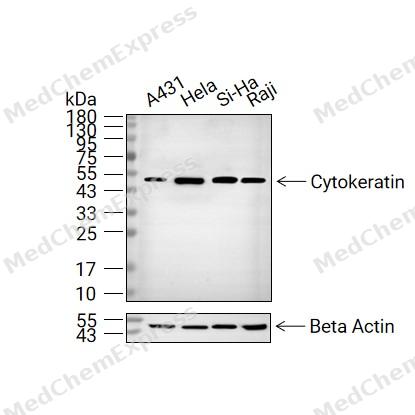 Western blot analysis of extracts from A431 (lane 2(20μg), Hela (lane 3(20μg), Si-Ha (lane 4(20μg) and Raji (lane 5(20μg) using Cytokeratin Antibody (HY-P85938) Mouse mAb. Proteins were transferred to a PVDF membrane and blocked with 5% non-fat milk in TBST for 2 hour at room temperature. The primary antibody (1/1000) and Loading control antibody (Beta Actin, HY-P80993, 1/10000) was used in 5% non-fat milk in TBST at 4°C overnight. Goat Anti-Mouse IgG-HRP Secondary Antibody (1/10000) was used for 1 hour at room temperature.
 -
 Immunocytochemistry analysis of HepG2 cells labeling Cytokeratin with Cytokeratin Antibody (HY-P85938) at 1/100 dilution. Cells were fixed in 4% paraformaldehyde for 15 minutes at room temperature, permeabilized with 0.1% Triton X-100 in PBS for 15 minutes at room temperature, then blocked with quick block buffer for 10 minutes at room temperature. Cells were then incubated with Cytokeratin Antibody (HY-P85938) at 1/100 dilution in quick block buffer overnight at 4 ℃.AF488-conjugated Goat Anti-Mouse IgG H&L (HY-P8005, Green) was used as the secondary antibody at 1/1,000 dilution. PBS instead of the primary antibody was used as the secondary antibody only control. The Nuclear counterstain was DAPI (Blue).
 -
 Immunocytochemistry analysis of HepG2 cells labeling Cytokeratin with Cytokeratin Antibody (HY-P85938) at 1/200 dilution. Cells were fixed in 4% paraformaldehyde for 15 minutes at room temperature, permeabilized with 0.1% Triton X-100 in PBS for 15 minutes at room temperature, then blocked with quick block buffer for 10 minutes at room temperature. Cells were then incubated with Cytokeratin Antibody (HY-P85938) at 1/200 dilution in quick block buffer overnight at 4 ℃.AF488-conjugated Goat Anti-Mouse IgG H&L (HY-P8005, Green) was used as the secondary antibody at 1/1,000 dilution. PBS instead of the primary antibody was used as the secondary antibody only control. The Nuclear counterstain was DAPI (Blue).


Background
-
Function
Cytokeratin is a P13645: Plays a role in the establishment of the epidermal barrier on plantar skin. Involved in the maintenance of cell layer development and keratin filament bundles in suprabasal cells of the epithelium; (Microbial infection) Acts as a mediator of S.aureus adherence to desquamated nasal epithelial cells via clfB, and hence may play a role in nasal colonization; (Microbial infection) Binds S.pneumoniae PsrP, mediating adherence of the bacteria to lung cell lines. Reduction of levels of KRT10 keratin decrease adherence, overexpression increases adherence. Neither protein has to be glycosylated for the interaction to occur
P13646: Type 1 keratin (Probable). Maintains postnatal tongue mucosal cell homeostasis and tissue organization in response to mechanical stress, potentially via regulation of the G1/S phase cyclins CCNE1 and CCNE2
P02533: The nonhelical tail domain is involved in promoting KRT5-KRT14 filaments to self-organize into large bundles and enhances the mechanical properties involved in resilience of keratin intermediate filaments in vitro
P08779: Epidermis-specific type I keratin that plays a key role in skin. Acts as a regulator of innate immunity in response to skin barrier breach: required for some inflammatory checkpoint for the skin barrier maintenance
P08727: Involved in the organization of myofibers. Together with KRT8, helps to link the contractile apparatus to dystrophin at the costameres of striated muscle -
Subcellular Localization
P13645: Secreted, extracellular space; Cell surface; Cytoplasm
P02533: Cytoplasm; Nucleus -
Expression
Tissue_specificity: P13645: Seen in all suprabasal cell layers including stratum corneum. Expressed on the surface of lung cell lines (PubMed:19627498). Localized on the surface of desquamated nasal epithelial cells (at protein level) (PubMed:12427098)
P13646: Expressed in some epidermal sweat gland ducts (at protein level) and in exocervix, esophagus and placenta
P02533: Expressed in the corneal epithelium (at protein level) (PubMed:26758872). Detected in the basal layer, lowered within the more apically located layers specifically in the stratum spinosum, stratum granulosum but is not detected in stratum corneum.
P19012: Expressed in a discontinuous manner in the basal cell layer of adult skin epidermis, but continuously in the basal layer of fetal skin epidermis and nail. Also expressed in the outer root sheath above the hair bulb in hair follicle (at protein level). Expressed homogeneously in all cell layers of the esophagus and exocervix, but detected in the basal cell layer only of oral mucosa, skin and in the basal plus the next two layers of the suprabasal epithelium of the palate
P08779: Expressed in the corneal epithelium (at protein level)
P08727: Expressed in a defined zone of basal keratinocytes in the deep outer root sheath of hair follicles. Also observed in sweat gland and mammary gland ductal and secretory cells, bile ducts, gastrointestinal tract, bladder urothelium, oral epithelia, esophagus, ectocervical epithelium (at protein level).
Induction: P13645: Repressed in keratinocytes by all-trans retinoic acid (ATRA) , via reduction of mRNA stability -
Isoforms & Post-Translational Modification
P13646 has 3 isomers: P13646-1: 49588 Da (predicted); P13646-2: 38581 Da (predicted); P13646-3: 45867 Da (predicted).
O-glycosylated; glycans consist of single N-acetylglucosamine residues -
Subunit
P13645: Heterotetramer of two type I and two type II keratins. Heterodimer with KRT1 (PubMed:24940650, PubMed:27595935). Two heterodimers of KRT1 and KRT10 form a heterotetramer (PubMed:27595935). The KRT10 subunit in the heterotetramer is probably disulfide-linked (PubMed:27595935). Interacts with PLEC isoform 1C, when in a heterodimer with KRT1 (PubMed:24940650)
P13646: Heterotetramer of two type I and two type II keratins
P02533: Forms a disulfide-linked heterodimer (via 2B domains) with KRT5 (via 2B domains) (PubMed:22705788, PubMed:24940650).
P19012: Heterotetramer of two type I and two type II keratins (By similarity). Forms a heterodimer with KRT14 (PubMed:24940650). Interacts with PLEC isoform 1C, when in a heterodimer with KRT14 (PubMed:24940650). Interacts with NOD2 (PubMed:27812135)
P08779: Heterodimer of a type I and a type II keratin. KRT16 associates with KRT6 isomers (KRT6A or KRT6B) (By similarity). Interacts with TCHP (PubMed:15731013). Interacts with TRADD (By similarity)
P08727: Heterotetramer of two type I and two type II keratins. Interacts with PNN and the actin-binding domain of DMD. Interacts with HCV core protein -
Synonyms
pan cytokeRatin; wide spectrum CytokeRatin; AE1; AE3


Documentation
-
Data Sheet (234 KB)
-
SDS (251 KB)
- English - EN (251 KB)
- Français - FR (251 KB)
- Deutsch - DE (251 KB)
- Norwegian - NO (251 KB)
- Español - ES (251 KB)
- Swedish - SV (251 KB)
- Italian - IT (251 KB)
- Korean - KR (251 KB)
- Portuguese - PT (251 KB)
-
User Guide for Antibodies (1077 KB)

 Powered by Bioz
