



ERK1/2 Antibody (YA453)
(Synonyms: MAP kinase 3; MAPK 3; ERK-1; p44-MAPK; MAP kinase 1; MAPK 1; ERK-2; p42-MAPK)Based on 6 publication(s) in Google Scholar
ERK1/2 Antibody (YA453) is a Rabbit-derived and non-conjugated IgG monoclonal antibody, targeting to ERK1/2.
-
Host:
Rabbit
-
Isotype:
IgG
-
Application:
WB, ICC/IF, IP, FC
-
Reactivity :
Human, Mouse, Rat
-
Formulation:
Supplied in 1*TBS (pH7.4), 0.05% BSA and 40% Glycerol. Preservative: 0.05% Sodium Azide.
-
Conjugation:
Non-conjugated


To place orders, for customer services and technical support, please contact: MedChemExpress USA
Tel: 609-228-6898 E-mail: [email protected] [email protected]



-

HY-P80814
Phospho-ERK1/2 (Thr202/Tyr204)/(Thr185/Tyr187) Antibody -
HY-P80392
Phospho-ERK1/2 (Thr202/Tyr204)/(Thr185/Tyr187) Antibody (YA455) -
HY-P80815
Phospho-ERK1/2 (Tyr204/Tyr187) Antibody -
HY-P8001
HRP-conjugated Goat Anti-Rabbit IgG H&L -
HY-P80218
MEK1/2 Antibody (YA299) -
HY-P80813
Phospho-ERK1/2 (Thr202/Thr185) Antibody (YA200) -
HY-P80535
AKT1+AKT2+AKT3 Antibody (YA635) -
HY-P80276
Phospho-AKT1(Ser473) Antibody (YA227) -
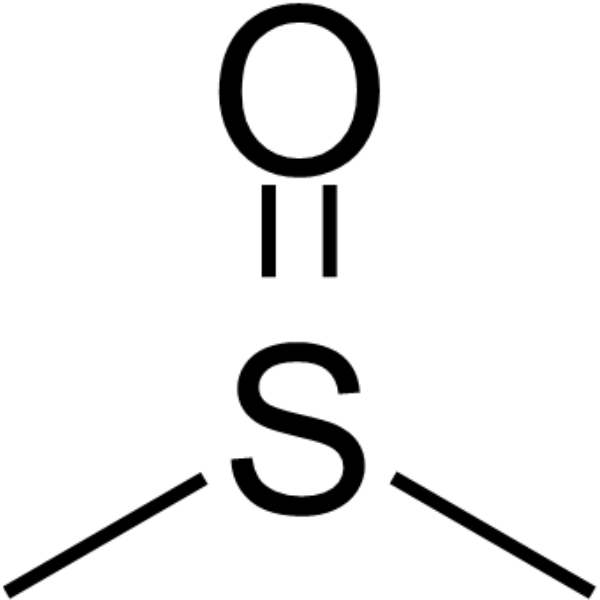
HY-Y0320
Dimethyl sulfoxide, meets analytical specification of Ch.P. -
HY-P80728
JNK1/2/3 Antibody (YA329) -
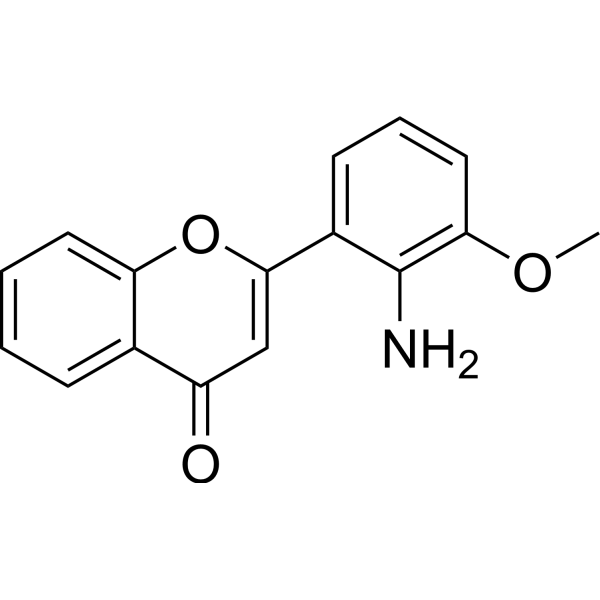
HY-12028
PD98059 -
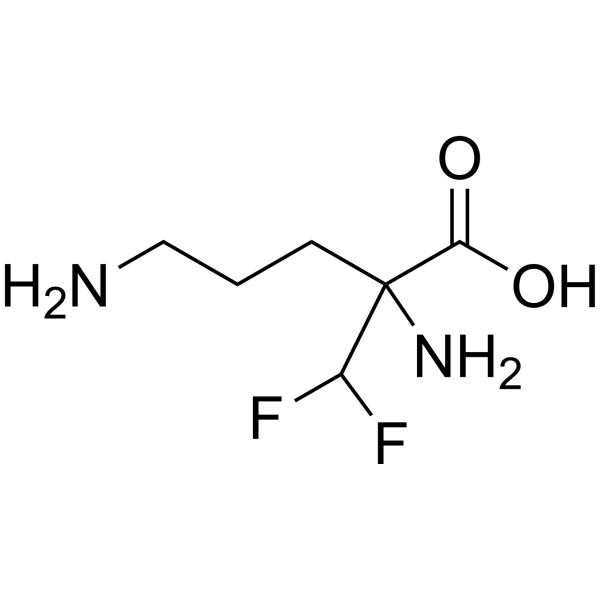
HY-B0744
Eflornithine
Publications Citing Use of MedChemExpress (MCE) ERK1/2 Antibody (YA453)
More
 6 Publications Citing Use of MCE ERK1/2 Antibody (YA453) (3)
-
WB

-
WB

-
WB


Applications
| Application |
WB

WB: Western Blot
|
ICC/IF
ICC/IF: Immunocytochemistry/
Immunofluorescence |
FC
FC: Flow Cytometry
|
IP
IP: Immunoprecipitation
|
|---|---|---|---|---|
| Dilution Ratio | 1:500-1:1000 | 1:50 | 1:50 | Use at an assay dependent concentration. |


Product Details
ERK1/2 Antibody (YA453) is a Rabbit-derived and non-conjugated IgG monoclonal antibody, targeting to ERK1/2.
-
Host Rabbit

-
Clonality Recombinant,Monoclonal

-
Species ReactivityHuman, Mouse, Rat
-
Observed Molecular WeightObserved band size: 43/41 kDa
Note: Due to possible protein modifications or aggregation, the molecular weight should be confirmed by actual measurement, and the predicted value is for reference only.

-
Calculated Molecular Weight Predicted band size: 43/41 kDa

Entrez Gene: 5594 Human ; 5595 Human ; 26413 Mouse ; 26417 Mouse ; 116590 Rat 50689
SwissProt: P27361 Human ; P28482 Human ; P63085 Mouse ; Q63844 Mouse ; P21708 Rat ; P63086 Rat
OMIM: 601795 Human
Synthetic peptide corresponding to Human ERK2.AA range:180-379.
Endogenous
Protein A affinity purified.
Non-conjugated
Unmodified
IgG


Product Properties
-
Appearance
Solution
-
Formulation
Supplied in 1*TBS (pH7.4), 0.05% BSA and 40% Glycerol. Preservative: 0.05% Sodium Azide.
-
Concentration
Batch-dependent, Please check the COA for the concentration of each lot. Check Lot Concentration
-
Storage & Stability
Stored at -20°C for 1 year. Avoid repeated freeze / thaw cycles.
-
Shipping
Shipping with blue ice.


Publications (6)
-
Journal Impact Factor
-
Most Recent
-
Adv Sci (Weinh)
Pathophysiology-Directed Engineering of a Combination Nanoanalgesic for Neuropathic Pain. [Abstract]2025 Feb;12(8):e2405483. PMID: 39716944
ERK1/2 Antibody (YA453) purchased from MedChemExpress. Usage Cited in: Adv Sci (Weinh). 2025 Feb;12(8):e2405483. [Abstract]
Western blot analysis of proteins associated with MAPK/NF-κB signaling pathways and macrophage polarization in myelin debris-phagocytosed BMDMs with or without APTN treatment, using rabbit anti-ERK1/2 (ERK1/2 Antibody (YA453); 1:1000) for ERK1/2 detection.
-
Biol Direct
L-741626 inhibits hepatocellular carcinoma progression by targeting Ref-1 to suppress MAPK/ERK signalling pathway activity. [Abstract]2025 Apr 16;20(1):54. PMID: 40241114
ERK1/2 Antibody (YA453) purchased from MedChemExpress. Usage Cited in: Biol Direct. 2025 Apr 16;20(1):54. [Abstract]
Western blot analysis of ERK1/2 and p-ERK1/2 protein levels in Huh7 and HepG2 cells treated with or without L-741626 using ERK1/2 Antibody (YA453) for ERK1/2 detection.
-
Int J Antimicrob Agents
Regorafenib, a multitargeted kinase inhibitor, inhibits enterovirus 71 infection by suppressing the MAPK pathway. [Abstract]2026 Feb;67(2):107711. PMID: 41490665 -
J Inflamm Res
CCL20 Expression via AKT-ERK1/2-AP1 Pathway in Mycoplasma Pneumoniae Infection: Implications for EMT and Cell Migration. [Abstract]2025 Apr 28:18:5727-5739. PMID: 40322529
ERK1/2 Antibody (YA453) purchased from MedChemExpress. Usage Cited in: J Inflamm Res. 2025 Apr 28:18:5727-5739. [Abstract]
ERK1/2 protein levels were assessed by Western blot using ERK1/2 (ERK1/2 Antibody (YA453); 1:800; overnight at 4°C) in THP-1 cells infected with M. pneumoniae at MOIs of 0, 10, 50, or 100 for 1 h.


Verification Images
-
 Western blot analysis of extracts from Hela(lane 2(20ug) , Jurkat(lane 3(20ug) and HepG2(lane 4(20ug) using ERK1/2 Antibody (HY-P80393) Rabbit mAb. Proteins were transferred to a PVDF membrane and blocked with 5% non-fat milk in TBST for 2 hour at room temperature. The primary antibody (1/1000) and Loading control antibody (Beta Actin, HY-P83730, 1/10000) was used in 5% non-fat milk in TBST at 4°C overnight. Goat Anti-Mouse/Rabbit IgG-HRP Secondary Antibody (1/10000) was used for 1 hour at room temperature.
 -
 Flow cytometric analysis of 1X10⁶ HeLa cells labeling ERK1/2 Antibody (HY-P80393, red). Cells were fixed with 4% paraformaldehyde and permeabilised with 90% methanol. Then stained with the primary antibody at 1/50 dilution for an hour at 4℃. AF488-conjugated Goat Anti-Rabbit IgG H&L (HY-P8002) was used as the secondary antibody at 1/1,000 dilution for 30 minutes at 4℃. Rabbit IgG Isotype Control (HY-P80879, blue) was used as the isotype control, cells without incubation with primary antibody were used as the unlabeled control (black).
 -
 Immunocytochemistry analysis of A549 cells labeling ERK1/2 with ERK1/2 Antibody (HY-P80393) at 1/50 dilution. Cells were fixed in 4% paraformaldehyde for 15 minutes at room temperature, permeabilized with 0.1% Triton X-100 in PBS for 15 minutes at room temperature, then blocked with quick block buffer for 10 minutes at room temperature. Cells were then incubated with ERK1/2 Antibody (HY-P80393) at 1/50 dilution in quick block buffer overnight at 4 ℃. AF488-conjugated Goat Anti-Rabbit IgG H&L(HY-P8002, Green) was used as the secondary antibody at 1/1,000 dilution. PBS instead of the primary antibody was used as the secondary antibody only control. The Nuclear counterstain was DAPI (Blue).
 -
 Immunocytochemistry analysis of Hela cells labeling ERK1/2 with ERK1/2 Antibody (HY-P80393) at 1/50 dilution. Cells were fixed in 4% paraformaldehyde for 15 minutes at room temperature, permeabilized with 0.1% Triton X-100 in PBS for 15 minutes at room temperature, then blocked with quick block buffer for 10 minutes at room temperature. Cells were then incubated with ERK1/2 Antibody (HY-P80393) at 1/50 dilution in quick block buffer overnight at 4 ℃. AF488-conjugated Goat Anti-Rabbit IgG H&L(HY-P8002, Green) was used as the secondary antibody at 1/1,000 dilution. PBS instead of the primary antibody was used as the secondary antibody only control. The Nuclear counterstain was DAPI (Blue).


Background
-
Function
ERK1/2 is a Serine/threonine kinase which acts as an essential component of the MAP kinase signal transduction pathway. MAPK1/ERK2 and MAPK3/ERK1 are the 2 MAPKs which play an important role in the MAPK/ERK cascade. They participate also in a signaling cascade initiated by activated KIT and KITLG/SCF. Depending on the cellular context, the MAPK/ERK cascade mediates diverse biological functions such as cell growth, adhesion, survival and differentiation through the regulation of transcription, translation, cytoskeletal rearrangements. The MAPK/ERK cascade also plays a role in initiation and regulation of meiosis, mitosis, and postmitotic functions in differentiated cells by phosphorylating a number of transcription factors. About 160 substrates have already been discovered for ERKs. Many of these substrates are localized in the nucleus, and seem to participate in the regulation of transcription upon stimulation. However, other substrates are found in the cytosol as well as in other cellular organelles, and those are responsible for processes such as translation, mitosis and apoptosis. Moreover, the MAPK/ERK cascade is also involved in the regulation of the endosomal dynamics, including lysosome processing and endosome cycling through the perinuclear recycling compartment (PNRC); as well as in the fragmentation of the Golgi apparatus during mitosis. The substrates include transcription factors (such as ATF2, BCL6, ELK1, ERF, FOS, HSF4 or SPZ1), cytoskeletal elements (such as CANX, CTTN, GJA1, MAP2, MAPT, PXN, SORBS3 or STMN1), regulators of apoptosis (such as BAD, BTG2, CASP9, DAPK1, IER3, MCL1 or PPARG), regulators of translation (such as EIF4EBP1 and FXR1) and a variety of other signaling-related molecules (like ARHGEF2, DCC, FRS2 or GRB10). Protein kinases (such as RAF1, RPS6KA1/RSK1, RPS6KA3/RSK2, RPS6KA2/RSK3, RPS6KA6/RSK4, SYK, MKNK1/MNK1, MKNK2/MNK2, RPS6KA5/MSK1, RPS6KA4/MSK2, MAPKAPK3 or MAPKAPK5) and phosphatases (such as DUSP1, DUSP4, DUSP6 or DUSP16) are other substrates which enable the propagation the MAPK/ERK signal to additional cytosolic and nuclear targets, thereby extending the specificity of the cascade. Mediates phosphorylation of TPR in response to EGF stimulation. May play a role in the spindle assembly checkpoint. Phosphorylates PML and promotes its interaction with PIN1, leading to PML degradation. Phosphorylates CDK2AP2. Phosphorylates phosphoglycerate kinase PGK1 under hypoxic conditions to promote its targeting to the mitochondrion and suppress the formation of acetyl-coenzyme A from pyruvate; Acts as a transcriptional repressor. Binds to a [GC]AAA[GC] consensus sequence. Repress the expression of interferon gamma-induced genes. Seems to bind to the promoter of CCL5, DMP1, IFIH1, IFITM1, IRF7, IRF9, LAMP3, OAS1, OAS2, OAS3 and STAT1. Transcriptional activity is independent of kinase activity[1].
-
Subcellular Localization
Cytoplasm, cytoskeleton, spindle; Nucleus; Cytoplasm, cytoskeleton, microtubule organizing center, centrosome; Cytoplasm; Membrane, caveola; Cell junction, focal adhesion
-
Isoforms & Post-Translational Modification
P28482 has 2 isomers: P28482-1: 41390 Da (predicted); P28482-2: 36432 Da (predicted).
Phosphorylated upon KIT and FLT3 signaling (By similarity). Dually phosphorylated on Thr-185 and Tyr-187, which activates the enzyme. Undergoes regulatory phosphorylation on additional residues such as Ser-246 and Ser-248 in the kinase insert domain (KID) These phosphorylations, which are probably mediated by more than one kinase, are important for binding of MAPK1/ERK2 to importin-7 (IPO7) and its nuclear translocation. In addition, autophosphorylation of Thr-190 was shown to affect the subcellular localization of MAPK1/ERK2 as well. Ligand-activated ALK induces tyrosine phosphorylation. Dephosphorylated by PTPRJ at Tyr-187. Phosphorylation on Ser-29 by SGK1 results in its activation by enhancing its interaction with MAP2K1/MEK1 and MAP2K2/MEK2. DUSP3 and DUSP6 dephosphorylate specifically MAPK1/ERK2 and MAPK3/ERK1 whereas DUSP9 dephosphorylates a broader range of MAPKs. Dephosphorylated by DUSP1 and DUSP2 at Thr-185 and Tyr-187 (By similarity) (PubMed:16288922);ISGylated;Ubiquitinated by TRIM15 via 'Lys-63'-linked ubiquitination; leading to activation. Deubiquitinated by CYLD -
Subunit
Binds both upstream activators and downstream substrates in multimolecular complexes. This interaction inhibits its tyrosine-kinase activity. Interacts with ADAM15, ARHGEF2, ARRB2, DAPK1 (via death domain), HSF4, IER3, IPO7, NISCH, SGK1, and isoform 1 of NEK2. Interacts (via phosphorylated form) with TPR (via C-terminal region and phosphorylated form); the interaction requires dimerization of MAPK1/ERK2 and increases following EGF stimulation (PubMed:18794356). Interacts with MAP2K1 (PubMed:32721402). Interacts with DUSP6 (PubMed:32721402, PubMed:9596579). Interacts (phosphorylated form) with CAV2 ('Tyr-19'-phosphorylated form); the interaction, promoted by insulin, leads to nuclear location and MAPK1 activation. Interacts with MORG1, PEA15 and MKNK2 (By similarity). MKNK2 isoform 1 binding prevents from dephosphorylation and inactivation (By similarity). Interacts with DCC (By similarity). The phosphorylated form interacts with PML (isoform PML-4). Interacts with STYX. Interacts with CDK2AP2. Interacts with CAVIN4 (By similarity). Interacts with DUSP7; the interaction enhances DUSP7 phosphatase activity (PubMed:9788880). Interacts with GIT1; this interaction is necessary for MAPK1 localization to focal adhesions (By similarity). Interacts with ZNF263 (PubMed:32051553). Interacts with phosphoglycerate kinase PGK1; the interaction is direct, occurs under hypoxic conditions, and promotes interaction between PGK1 and PIN1 (PubMed:26942675)
-
SwissProt ID
-
Synonyms
MAP kinase 3; MAPK 3; ERK-1; p44-MAPK; MAP kinase 1; MAPK 1; ERK-2; p42-MAPK
-
Research Field
Cell Biology
Documentation
-
Data Sheet (260 KB)
-
SDS (251 KB)
- English - EN (251 KB)
- Français - FR (251 KB)
- Deutsch - DE (251 KB)
- Norwegian - NO (251 KB)
- Español - ES (251 KB)
- Swedish - SV (251 KB)
- Italian - IT (251 KB)
- Korean - KR (251 KB)
- Portuguese - PT (251 KB)
-
User Guide for Antibodies (1077 KB)
References

 Powered by Bioz
