



MEK1/2 Antibody (YA299)
(Synonyms: MEK1, PRKMK1, MAP2K1, Dual specificity mitogen-activated protein kinase kinase 1, MAP kinase kinase 1, MAPKK 1, MKK1, ERK activator kinase 1, MAPK/ERK kinase 1, MEK 1)Based on 1 publication(s) in Google Scholar
MEK1/2 Antibody (YA299) is a Rabbit-derived and non-conjugated IgG monoclonal antibody, targeting to MEK1/2.
-
Host:
Rabbit
-
Isotype:
IgG
-
Application:
WB, ICC/IF, IHC-P, IP
-
Reactivity :
Human, Mouse, Rat
-
Formulation:
Supplied in 1*TBS (pH7.4), 0.05% BSA and 40% Glycerol. Preservative: 0.05% Sodium Azide.
-
Conjugation:
Non-conjugated


To place orders, for customer services and technical support, please contact: MedChemExpress USA
Tel: 609-228-6898 E-mail: [email protected] [email protected]



-

HY-P80393
ERK1/2 Antibody (YA453) -
HY-P86143
Phospho-MEK1/2(Ser217/221) Antibody (YA5835) -
HY-P80832
Phospho-MEK1 (Ser298) Antibody (YA178) -
HY-P80535
AKT1+AKT2+AKT3 Antibody (YA635) -
HY-P80344
STAT3 Antibody (YA056) -
HY-P80276
Phospho-AKT1(Ser473) Antibody (YA227) -
HY-P80458
Phospho-EGFR (Tyr1068) Antibody (YA204) -
HY-P80814
Phospho-ERK1/2 (Thr202/Tyr204)/(Thr185/Tyr187) Antibody -
HY-P80880
Raf-1 Antibody (YA107)
Publications Citing Use of MedChemExpress (MCE) MEK1/2 Antibody (YA299)
More

Applications
| Application |
WB

WB: Western Blot
|
ICC/IF
ICC/IF: Immunocytochemistry/
Immunofluorescence |
IHC-P
IHC-P: Immunohistochemistry-Paraffin
|
IP
IP: Immunoprecipitation
|
|---|---|---|---|---|
| Dilution Ratio | 1:1000 | 1:50 | 1:200 | Use at an assay dependent concentration. |


Product Details
MEK1/2 Antibody (YA299) is a Rabbit-derived and non-conjugated IgG monoclonal antibody, targeting to MEK1/2.
-
Host Rabbit

-
Clonality Recombinant,Monoclonal

-
Species ReactivityHuman, Mouse, Rat
-
Observed Molecular WeightObserved band size: 44 kDa
Note: Due to possible protein modifications or aggregation, the molecular weight should be confirmed by actual measurement, and the predicted value is for reference only.

-
Calculated Molecular Weight Predicted band size: 44 kDa

Entrez Gene: 5605 Human ; 26395 Mouse ; 58960 Rat
SwissProt: P36507 Human ; Q02750 Human ; P31938 Mouse ; Q63932 Mouse ; P36506 Rat ; Q01986 Rat
OMIM: 615280 Human
Synthetic peptide corresponding to Human MEK1.AA range:1-393.
Endogenous
Protein A affinity purified.
Non-conjugated
Unmodified
IgG


Product Properties
-
Appearance
Solution
-
Formulation
Supplied in 1*TBS (pH7.4), 0.05% BSA and 40% Glycerol. Preservative: 0.05% Sodium Azide.
-
Concentration
Batch-dependent, Please check the COA for the concentration of each lot. Check Lot Concentration
-
Storage & Stability
Stored at -20°C for 1 year. Avoid repeated freeze / thaw cycles.
-
Shipping
Shipping with blue ice.


Publications (1)
-
Journal Impact Factor
-
Most Recent
-
Int J Antimicrob Agents
Regorafenib, a multitargeted kinase inhibitor, inhibits enterovirus 71 infection by suppressing the MAPK pathway. [Abstract]2026 Feb;67(2):107711. PMID: 41490665


Verification Images
-
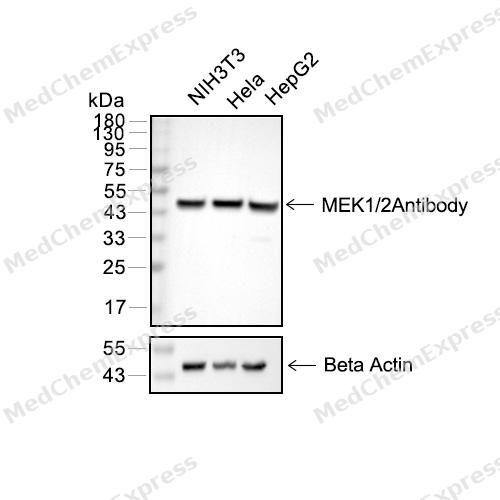 Western blot analysis of extracts from NIH3T3(lane 2(20μg) , Hela(lane 3(20μg) and HepG2(lane 4(20μg) using MEK1/2(HY-P80218) Rabbit mAb. Proteins were transferred to a PVDF membrane and blocked with 5% non-fat milk in TBST for 2 hour at room temperature. The primary antibody (1/1000) and Loading control antibody (Beta Actin, HY-P80438, 1/10000) was used in 5% non-fat milk in TBST at 4°C overnight. Goat Anti-Mouse/Rabbit IgG-HRP Secondary Antibody (1/10000) was used for 1 hour at room temperature.
 -
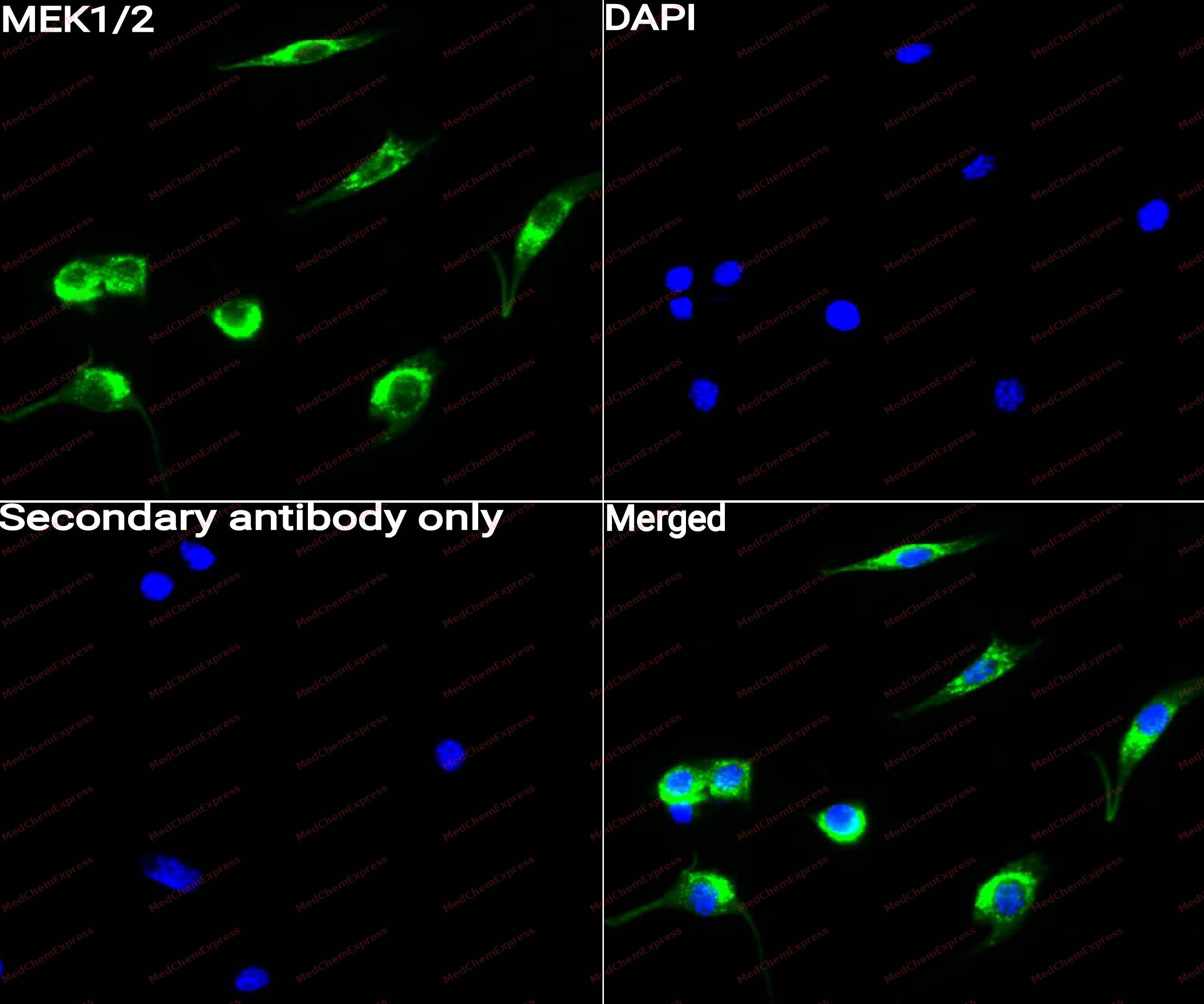 Immunocytochemistry analysis of NIH3T3 cells labeling MEK1/2 with MEK1/2 Antibody (HY-P80218) at 1/50 dilution. Cells were fixed in 4% paraformaldehyde for 15 minutes at room temperature, permeabilized with 0.1% Triton X-100 for 10 minutes at room temperature, then blocked with QuickBlock™ Blocking Buffer for Immunol Staining for 10 min at room temperature. Cells were then incubated with MEK1/2 Antibody (HY-P80218)at 1/50 dilution in QuickBlock™ Blocking Buffer for Immunol Stainingat 4 ℃. Alexa Fluor® 488-conjugated AffiniPure Goat Anti-Rabbit IgG H&L(HY-P8002, Green) was used as the secondary antibody at 1/1,000 dilution. PBS instead of the primary antibody was used as the secondary antibody only control. The Nuclear counterstain was DAPI (Blue).
 -
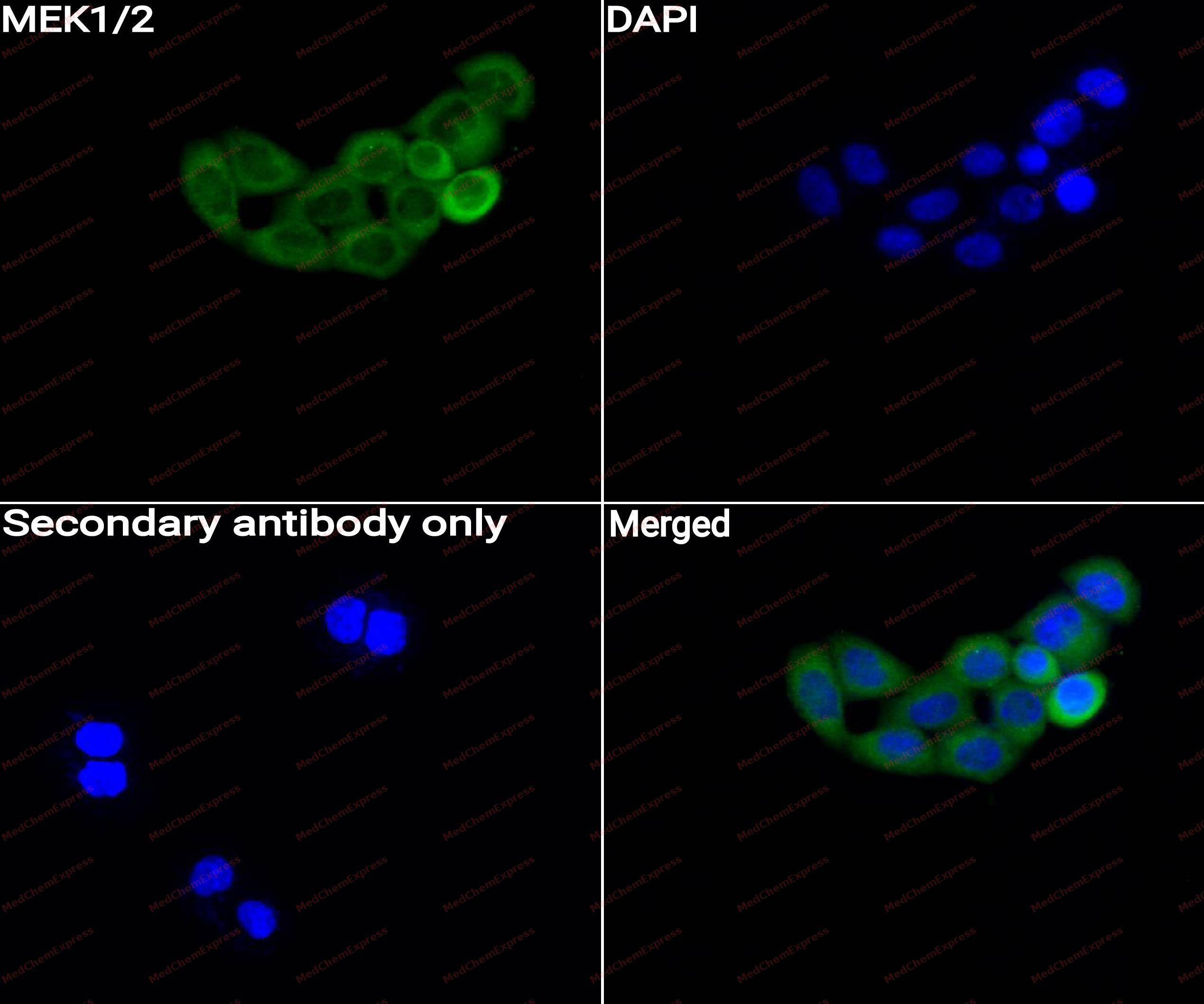 Immunocytochemistry analysis of Hela cells labeling MEK1/2 with MEK1/2 Antibody (HY-P80218) at 1/50 dilution. Cells were fixed in 4% paraformaldehyde for 15 minutes at room temperature, permeabilized with 0.1% Triton X-100 for 10 minutes at room temperature, then blocked with QuickBlock™ Blocking Buffer for Immunol Staining for 10 min at room temperature. Cells were then incubated with MEK1/2 Antibody (HY-P80218)at 1/50 dilution in QuickBlock™ Blocking Buffer for Immunol Staining at 4 ℃. Alexa Fluor® 488-conjugated AffiniPure Goat Anti-Rabbit IgG H&L(HY-P8002,Green) was used as the secondary antibody at 1/1,000 dilution. PBS instead of the primary antibody was used as the secondary antibody only control. The Nuclear counterstain was DAPI (Blue).
 -
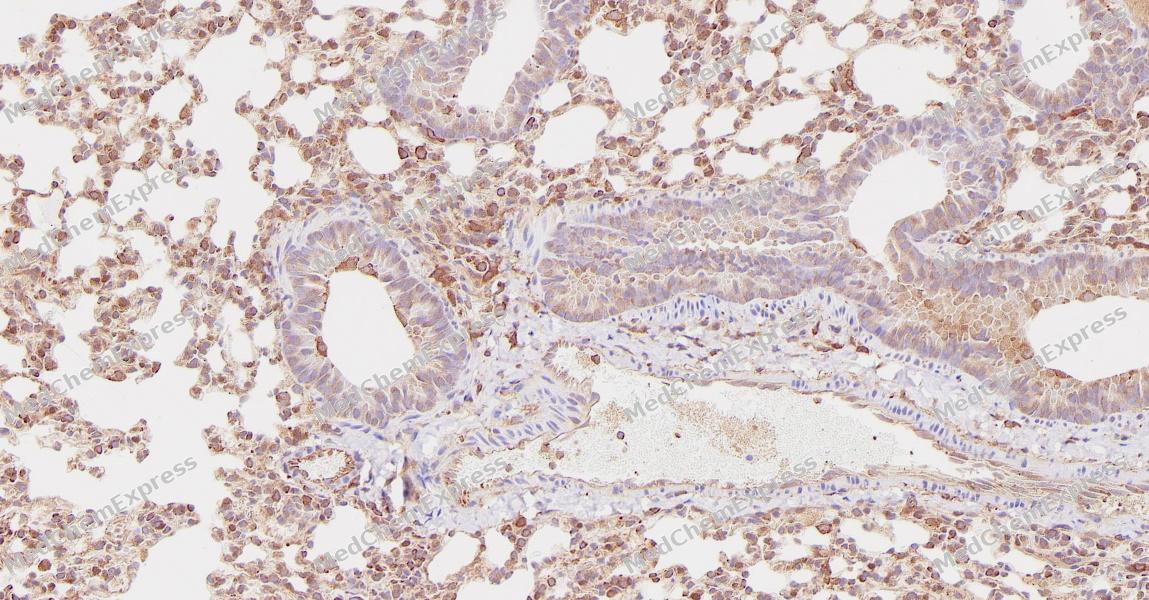 Immunohistochemical analysis of paraffin-embedded Mouse lung tissue using MEK1/2 Antibody. The section was pre-treated using heat mediated antigen retrieval with Tris-EDTA buffer (pH 8.0) for 8 minutes. The tissues were blocked in QuickBlock for 20 minutes at room temperature, washed with ddH2O and PBS, and then probed with the primary antibody (HY-P80218, 1:200) in 4℃ overnight. The detection was performed using an HRP conjugated compact polymer system. DAB was used as the chromogen. Tissues were counterstained with hematoxylin and mounted with DPX.
 -
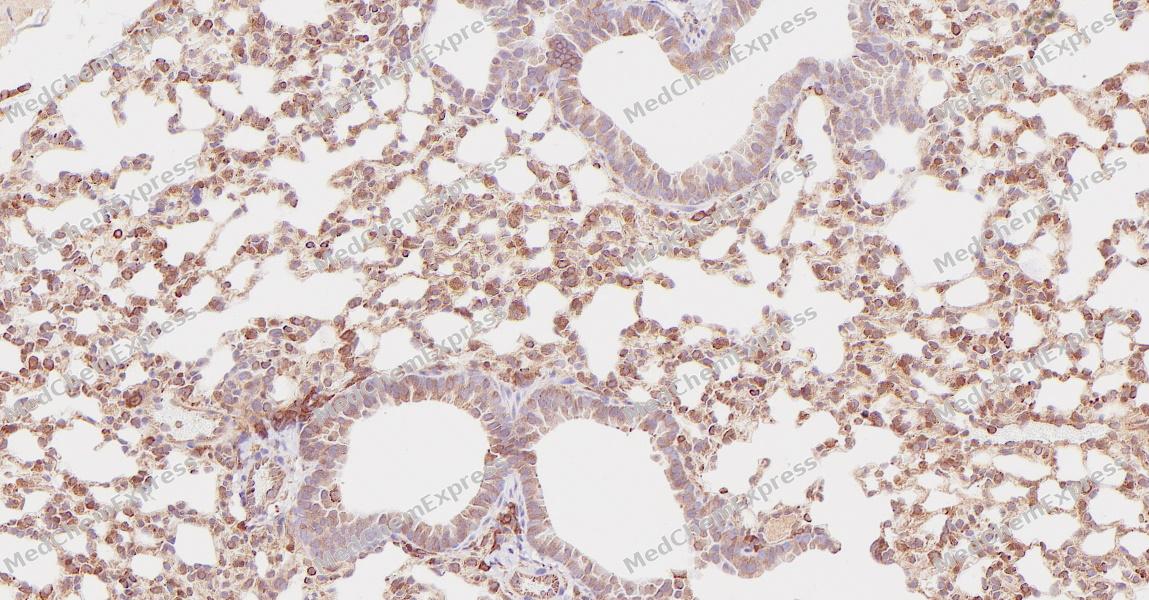 Immunohistochemical analysis of paraffin-embedded Mouse lung tissue using MEK1/2 Antibody. The section was pre-treated using heat mediated antigen retrieval with Tris-EDTA buffer (pH 8.0) for 8 minutes. The tissues were blocked in QuickBlock for 20 minutes at room temperature, washed with ddH2O and PBS, and then probed with the primary antibody (HY-P80218, 1:200) in 4℃ overnight. The detection was performed using an HRP conjugated compact polymer system. DAB was used as the chromogen. Tissues were counterstained with hematoxylin and mounted with DPX.


Background
-
Function
MEK1/2 dual specificity protein kinase which acts as an essential component of the MAP kinase signal transduction pathway. Binding of extracellular ligands such as growth factors, cytokines and hormones to their cell-surface receptors activates RAS and this initiates RAF1 activation. RAF1 then further activates the dual-specificity protein kinases MAP2K1/MEK1 and MAP2K2/MEK2. Both MAP2K1/MEK1 and MAP2K2/MEK2 function specifically in the MAPK/ERK cascade, and catalyze the concomitant phosphorylation of a threonine and a tyrosine residue in a Thr-Glu-Tyr sequence located in the extracellular signal-regulated kinases MAPK3/ERK1 and MAPK1/ERK2, leading to their activation and further transduction of the signal within the MAPK/ERK cascade. Activates BRAF in a KSR1 or KSR2-dependent manner; by binding to KSR1 or KSR2 releases the inhibitory intramolecular interaction between KSR1 or KSR2 protein kinase and N-terminal domains which promotes KSR1 or KSR2-BRAF dimerization and BRAF activation. Depending on the cellular context, this pathway mediates diverse biological functions such as cell growth, adhesion, survival and differentiation, predominantly through the regulation of transcription, metabolism and cytoskeletal rearrangements. One target of the MAPK/ERK cascade is peroxisome proliferator-activated receptor gamma (PPARG), a nuclear receptor that promotes differentiation and apoptosis. MAP2K1/MEK1 has been shown to export PPARG from the nucleus. The MAPK/ERK cascade is also involved in the regulation of endosomal dynamics, including lysosome processing and endosome cycling through the perinuclear recycling compartment (PNRC), as well as in the fragmentation of the Golgi apparatus during mitosis[1].
-
Subcellular Localization
Cytoplasm, cytoskeleton, microtubule organizing center, centrosome; Cytoplasm, cytoskeleton, microtubule organizing center, spindle pole body; Cytoplasm; Nucleus; Membrane; Peripheral membrane protein
-
Expression
Tissue_specificity:It is widely expressed, but present in extremely low concentrations in the brain. -
Isoforms & Post-Translational Modification
Q02750 has 2 isomers: Q02750-1: 43439 Da (predicted); Q02750-2: 40764 Da (predicted).
Phosphorylation at Ser-218 and Ser-222 by MAP kinase kinase kinases (BRAF or MEKK1) positively regulates kinase activity (PubMed:29433126, PubMed:8131746). Also phosphorylated at Thr-292 by MAPK1/ERK2 and at Ser-298 by PAK (PubMed:16129686). MAPK1/ERK2 phosphorylation of Thr-292 occurs in response to cellular adhesion and leads to inhibition of Ser-298 phosphorylation by PAK (PubMed:16129686). Autophosphorylated at Ser-218 and Ser-222, autophosphosphorylation is promoted by NEK10 following UV irradiation (PubMed:20956560);(Microbial infection) Acetylation by Yersinia YopJ prevents phosphorylation and activation, thus blocking the MAPK signaling pathway -
Subunit
Found in a complex with at least BRAF, HRAS, MAP2K1, MAPK3/ERK1 and RGS14 (By similarity). Forms a heterodimer with MAP2K2/MEK2 (By similarity). Forms heterodimers with KSR2 which further dimerize to form tetramers (By similarity). Interacts with KSR1 or KSR2 and BRAF; the interaction with KSR1 or KSR2 mediates KSR1-BRAF or KSR2-BRAF dimerization (PubMed:10409742, PubMed:29433126). Interacts with ARBB2, LAMTOR3 and RAF1 (By similarity). Interacts with MAPK1/ERK2 (PubMed:32721402). Interacts with MORG1 (By similarity). Interacts with PPARG (PubMed:17101779). Interacts with isoform 1 of VRK2 (PubMed:20679487). Interacts with SGK1 (PubMed:19447520). Interacts with BIRC6/bruce (PubMed:18329369). Interacts with KAT7; the interaction promotes KAT7 phosphorylation (By similarity). Interacts with RAF1 and NEK10; the interaction is required for ERK1/2-signaling pathway activation in response to UV irradiation (PubMed:20956560). Interacts with TRAF3IP3 (PubMed:26195727). Interacts with MOS (PubMed:34779126, PubMed:35670744)
-
SwissProt ID
-
Synonyms
MEK1, PRKMK1, MAP2K1, Dual specificity mitogen-activated protein kinase kinase 1, MAP kinase kinase 1, MAPKK 1, MKK1, ERK activator kinase 1, MAPK/ERK kinase 1, MEK 1
-
Research Field
Signal Transduction
Documentation
-
Data Sheet (261 KB)
-
SDS (252 KB)
- English - EN (252 KB)
- Français - FR (252 KB)
- Deutsch - DE (252 KB)
- Norwegian - NO (252 KB)
- Español - ES (252 KB)
- Swedish - SV (252 KB)
- Italian - IT (252 KB)
- Korean - KR (252 KB)
- Portuguese - PT (252 KB)
-
User Guide for Antibodies (1077 KB)
References

 Powered by Bioz
