



GFP Tag Antibody (YA415)
Based on 1 publication(s) in Google Scholar
GFP Antibody is a non-conjugated and Rabbit origined IgG monoclonal antibody, targeting to GFP.
-
Host:
Rabbit
-
Isotype:
IgG
-
Application:
WB, IHC-P, ICC/IF, IP, IF-Tissue
-
Reactivity :
Species independent
-
Formulation:
Supplied in 1*TBS (pH7.4), 0.05% BSA and 40% Glycerol. Preservative: 0.05% Sodium Azide.
-
Conjugation:
Non-conjugated


To place orders, for customer services and technical support, please contact: MedChemExpress USA
Tel: 609-228-6898 E-mail: [email protected] [email protected]



-

HY-P8001
HRP-conjugated Goat Anti-Rabbit IgG H&L -
HY-P80111
DYKDDDDK Tag (FLAG) Antibody (YA780) -
HY-P80232
Myc-tag Antibody (YA702) -
HY-K0201
Anti-HA Magnetic Beads -
HY-P8004
HRP-conjugated Goat Anti-Mouse IgG H&L -
HY-K0207
Anti-Flag Magnetic Beads -
HY-K0010
Protease Inhibitor Cocktail (EDTA-Free, 100× in DMSO) -
HY-K0202
Protein A/G Magnetic Beads -
HY-KE7004
BamH I -
HY-P80626
c-Myc Antibody (YA497)
Publications Citing Use of MedChemExpress (MCE) GFP Tag Antibody (YA415)
More
 1 Publications Citing Use of MCE GFP Tag Antibody (YA415) (3)
-
IP

-
WB

-
WB


Applications
| Application |
WB

WB: Western Blot
|
IHC-P
IHC-P: Immunohistochemistry-Paraffin
|
ICC/IF
ICC/IF: Immunocytochemistry/
Immunofluorescence |
IF-Tissue
IF-Tissue: Immunofluorescence-Tissue
|
IP
IP: Immunoprecipitation
|
|---|---|---|---|---|---|
| Dilution Ratio | 1:5000-1:10000 | 1:200-1:500 | 1:100-1:500 | 1:100-1:500 | 2-5 µg/mL |


Product Details
GFP Antibody is a non-conjugated and Rabbit origined IgG monoclonal antibody, targeting to GFP.
-
Host Rabbit

-
Clonality Recombinant,Monoclonal

-
Species ReactivitySpecies independent
-
Observed Molecular WeightObserved band size: 27 kDa
Note: Due to possible protein modifications or aggregation, the molecular weight should be confirmed by actual measurement, and the predicted value is for reference only.

-
Calculated Molecular Weight Predicted band size: 27 kDa

Synthetic peptide corresponding to Aequorea victoria GFP.AA range:1-50.
Endogenous
Protein A affinity purified.
Non-conjugated
Unmodified
IgG


Product Properties
-
Appearance
Liquid
-
Formulation
Supplied in 1*TBS (pH7.4), 0.05% BSA and 40% Glycerol. Preservative: 0.05% Sodium Azide.
-
Concentration
Batch-dependent, Please check the COA for the concentration of each lot. Check Lot Concentration
-
Storage & Stability
Stored at -20°C for 1 year. Avoid repeated freeze / thaw cycles.
-
Shipping
Shipping with blue ice.


Publications (1)
-
Journal Impact Factor
-
Most Recent
-
Signal Transduct Target Ther
Family with sequence similarity 114 member A1 orchestrates immune evasion in triple-negative breast cancer. [Abstract]2025 Nov 18;10(1):373. PMID: 41249116
GFP Tag Antibody (YA415) purchased from MedChemExpress. Usage Cited in: Signal Transduct Target Ther. 2025 Nov 18;10(1):373. [Abstract]
293T cells were cotransfected with the FAM114A1-Myc plasmid together with the indicated E2F4-GFP (GFP Antibody; 5 µg; dilution 1:1000) mutants. The cells were collected for co-IP after 24 h. The samples were subjected to western blotting to determine interactions.
GFP Tag Antibody (YA415) purchased from MedChemExpress. Usage Cited in: Signal Transduct Target Ther. 2025 Nov 18;10(1):373. [Abstract]
GFP Antibody (GFP) (dilution 1:1000). Py8119 cells transfected with indicated E2F4 mutants were collected for western blotting. Vinculin served as internal control.
GFP Tag Antibody (YA415) purchased from MedChemExpress. Usage Cited in: Signal Transduct Target Ther. 2025 Nov 18;10(1):373. [Abstract]
Cytosol and nuclear fractions of the Py8119 cells were extracted and subjected to western blotting analysis. The ratio of nuclear E2F4-GFP (GFP Antibody; dilution 1:1000) was quantified. Vinculin and Lamin B1 served as internal controls for cytosol and nuclear fractions respectively.


Verification Images
-
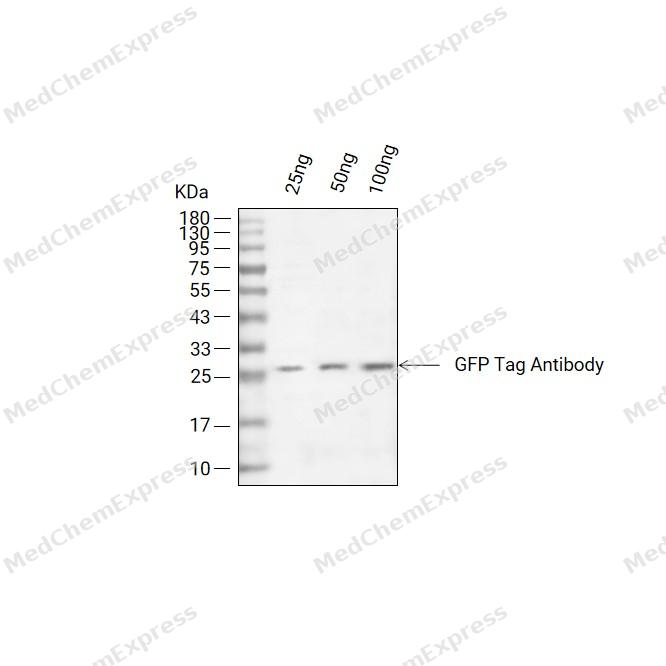 Western blot analysis of extracts from GFP(lane 2(25ng) , GFP(lane 3(50ng) and GFP(lane 4(100ng)using GFP Antibody (HY-P80141) Rabbit mAb. Proteins were transferred to a PVDF membrane and blocked with 5% non-fat milk in TBST for 2 hour at room temperature. The primary antibody (1/1000) and Loading control antibody (Beta Actin, HY-P83730, 1/10000) was used in 5% non-fat milk in TBST at 4°C overnight. Goat Anti-Mouse/Rabbit IgG-HRP Secondary Antibody (1/10000) was used for 1 hour at room temperature.


Background
-
Function
GFP Tag is an Energy-transfer acceptor. Its role is to transduce the blue chemiluminescence of the protein aequorin into green fluorescent light by energy transfer. Fluoresces in vivo upon receiving energy from the Ca(2+)-activated photoprotein aequorin
-
Expression
Tissue_specificity:Photocell -
Subunit
Monomer
-
SwissProt ID
-
Research Field
Tags & Cell Markers
Documentation
-
Data Sheet (234 KB)
-
SDS (251 KB)
- English - EN (251 KB)
- Français - FR (251 KB)
- Deutsch - DE (251 KB)
- Norwegian - NO (251 KB)
- Español - ES (251 KB)
- Swedish - SV (251 KB)
- Italian - IT (251 KB)
- Korean - KR (251 KB)
- Portuguese - PT (251 KB)
-
User Guide for Antibodies (1077 KB)

 Powered by Bioz
