



Carpachromene

Based on 1 Customer Validation
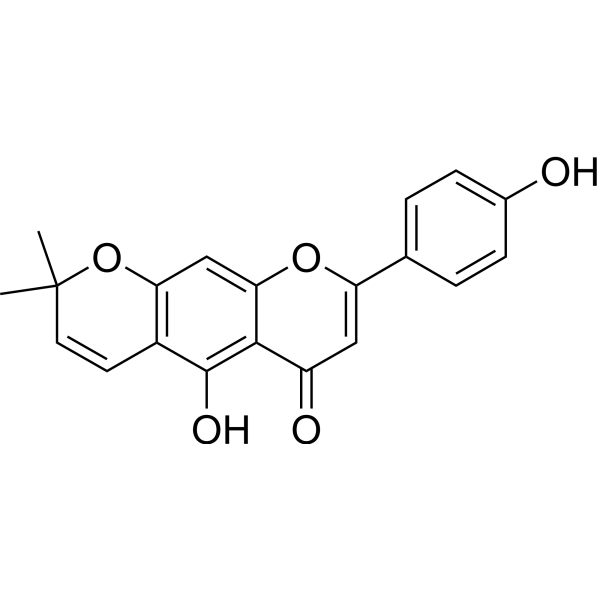
Carpachromene is a potent α-glucosidase enzyme inhibitor. Carpachromene ameliorates insulin resistance in HepG2 cells via modulating IR/IRS1/PI3k/Akt/GSK3/FoxO1 pathway.
Nur für Forschungszwecke. Wir verkaufen nicht an Patienten.
- Reinheit : 98.84%
- CAS. Nr.: 57498-96-1
- Formel: C20H16O5
- Molecular Weight:336.34
-
Speicherung:
-20°C, sealed storage, away from moisture and light
* In solvent : -80°C, 6 months; -20°C, 1 month (sealed storage, away from moisture and light)

To place orders, for customer services and technical support, please contact: MedChemExpress USA
Tel: 609-228-6898 E-mail: [email protected] [email protected]


-
 Biologische Aktivität
-
Chemical Information
- Protokoll
- Reinheit & Dokumentation
- Verweise
-
 Help & FAQs




Biologische Aktivität
Beschreibung
In Vitro
Carpachromene (0-100 μg/mL, 48 h) exhibits cytotoxicity against HepG2, HepG2/IRM, PLC/PRF/5 and Raji cancer cell lines[1].
Carpachromene (20 μg/mL) significantly increases the protein expression ratios of IR, IRS1, PI3K, Akt, GSK3, and FoxO1 in HepG2/IRM cells[1].
Carpachromene (20 μg/mL) improves cellular glycogen synthesis in HepG2/IRM cells[1].
MedChemExpress (MCE) has not independently confirmed the accuracy of these methods. They are for reference only.


Chemical Information
-
CAS. Nr. 57498-96-1
-
Appearance Solid
-
Molecular Weight 336.34
-
Formel C20H16O5
-
Color Light yellow to yellow
-
SMILES
OC1=C2C(OC(C3=CC=C(O)C=C3)=CC2=O)=CC4=C1C=CC(C)(C)O4
-
Structure Classification
-
Versand
Room temperature in continental US; may vary elsewhere.
-
Speicherung
-20°C, sealed storage, away from moisture and light
* In solvent : -80°C, 6 months; -20°C, 1 month (sealed storage, away from moisture and light)


Reinheit & Dokumentation
-
Data Sheet (267 KB)
-
SDS (536 KB)
- English - EN (536 KB)
- Français - FR (536 KB)
- Deutsch - DE (536 KB)
- Norwegian - NO (536 KB)
- Español - ES (536 KB)
- Swedish - SV (536 KB)
- Italian - IT (536 KB)
- Korean - KR (536 KB)
- Portuguese - PT (536 KB)
-
Handling Instructions (2659 KB)
Verweise

Calculators
Konzentration (Stammlösung) × Volumen (Stammlösung) = Konzentration (Ziellösung) × Volumen (Ziellösung)


Carpachromene Related Classifications
HY-N3542 Related Classifications
 Powered by Bioz