



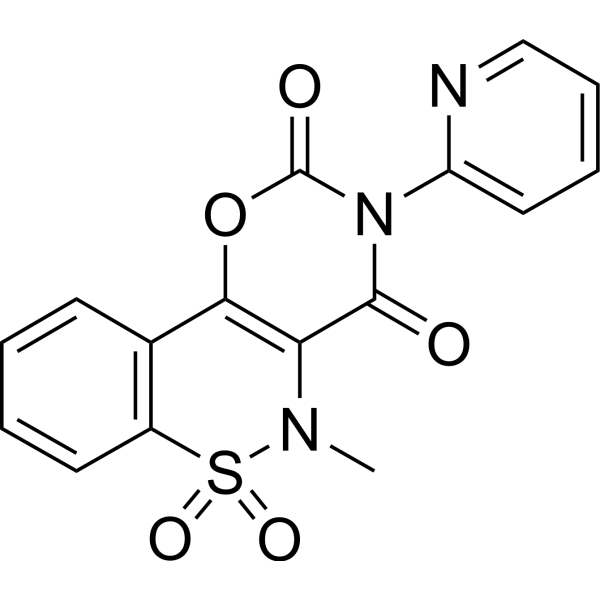
Droxicam

Based on 1 Customer Validation
Droxicam (Ombolan) is a non-steroidal anti-inflammatory agent, with strong analgesic activity. Droxicam acts by inhibiting PGE2 varies, and is characterised by being a pro-drug of Piroxicam (HY-B0253). Droxicam is well tolerated with slight side effects in the said mucosa. Droxicam does not show cardiovascular or respiratory effects in cats, and inhibits peritoneal capillary permeability in mouse.
Nur für Forschungszwecke. Wir verkaufen nicht an Patienten.
- Reinheit : 99.59%
- CAS. Nr.: 90101-16-9
- Formel: C16H11N3O5S
- Molecular Weight:357.34
-
Speicherung:Powder -20°C, 3 years , 4°C, 2 years ; In solvent -80°C, 6 months , -20°C, 1 month

To place orders, for customer services and technical support, please contact: MedChemExpress USA
Tel: 609-228-6898 E-mail: [email protected] [email protected]


-
 Biologische Aktivität
-
Chemical Information
-
Lösungsmittel & Löslichkeit
- Protokoll
- Reinheit & Dokumentation
- Verweise
-
 Help & FAQs




Biologische Aktivität
Beschreibung
In Vivo
Droxicam (ED50, p.o.; 5, 6, 7, 8 h; 7.5, 12.9, 4.8, 8.4 mg/kg) shows high antiinflammatory activity against nystatin-induced edema in rat[1].
Droxicam (ED50, p.o., 1, 2, 3, 4 h: 0.51, 0.94, 1.56, 4.88 mg/kg) shows protective effects in U.V. light-induced erythema in guinea pigs[1].
Droxicam (0.1 mg/kg, 0.33 mg/kg, 1 mg/kg; po; once daliy) shows good antiarthritic activity in rats injected with Mycobacterium butyricum against primary and secondary lesions[1].
Droxicam demonstrates strong analgesic activity in protecting against writhings : induced by phenylbenzoquinone in mice, induced by acetylcholine bromide in mice, with ED50s of 5.3 mg/kg and 1.1 mg/kg, respectively[1].
Droxicam (ED50=0.081 mg/kg; po) protects rat against diarrhea induced by castor oil[1].
Droxicam significantly inhibits peritoneal capillary permeability in mice[1].
Droxicam does not alter rat behavior (80 mg/kg, i.p.) nor that of mice (160 mg/kg, p.o.) in the Irwin's test[1].
Droxicam does not exhibit uricosuric activity in rats, neither shows cardiovascular or respiratory effects in anesthetized cats, nor modify their response to administration of acetylcholine, norepinephrine and histamine[1].
MedChemExpress (MCE) has not independently confirmed the accuracy of these methods. They are for reference only.


Chemical Information
-
CAS. Nr. 90101-16-9
-
Appearance Solid
-
Molecular Weight 357.34
-
Formel C16H11N3O5S
-
Color White to off-white
-
SMILES
O=C(N1C2=CC=CC=N2)C(N3C)=C(OC1=O)C4=C(C=CC=C4)S3(=O)=O
-
Synonyms
Ombolan
-
Versand
Room temperature in continental US; may vary elsewhere.
-
Speicherung
Powder -20°C 3 years 4°C 2 years In solvent -80°C 6 months -20°C 1 month


Lösungsmittel & Löslichkeit
In Vitro:
DMSO : 50 mg/mL (139.92 mM; Need ultrasonic; Hygroscopic DMSO has a significant impact on the solubility of product, please use newly opened DMSO)
Please refer to the solubility information to select the appropriate solvent. Once prepared, please aliquot and store the solution to prevent product inactivation from repeated freeze-thaw cycles.
Storage method and period of stock solution: -80°C, 6 months; -20°C, 1 month. When stored at -80°C, please use it within 6 months. When stored at -20°C, please use it within 1 month.
Please refer to the solubility information to select the appropriate solvent. Once prepared, please aliquot and store the solution to prevent product inactivation from repeated freeze-thaw cycles.
Storage method and period of stock solution: -80°C, 6 months; -20°C, 1 month. When stored at -80°C, please use it within 6 months. When stored at -20°C, please use it within 1 month.
Konzentration (Stammlösung) × Volumen (Stammlösung) = Konzentration (Ziellösung) × Volumen (Ziellösung)


Reinheit & Dokumentation
-
Data Sheet (279 KB)
-
SDS (393 KB)
- English - EN (393 KB)
- Français - FR (393 KB)
- Deutsch - DE (393 KB)
- Norwegian - NO (393 KB)
- Español - ES (393 KB)
- Swedish - SV (393 KB)
- Italian - IT (393 KB)
- Korean - KR (393 KB)
- Portuguese - PT (393 KB)
-
Handling Instructions (2659 KB)
Verweise
[1]. Farré AJ, et al. Pharmacological properties of droxicam, a new non-steroidal anti-inflammatory agent. Methods Find Exp Clin Pharmacol. 1986 Jul;8(7):407-22. [Content Brief]
[2]. Jané F, et al. Droxicam: a pharmacological and clinical review of a new NSAID. Eur J Rheumatol Inflamm. 1991;11(4):3-9. [Content Brief]


Complete Stock Solution Preparation Table
Please refer to the solubility information to select the appropriate solvent. Once prepared, please aliquot and store the solution to prevent product inactivation from repeated freeze-thaw cycles.
Storage method and period of stock solution: -80°C, 6 months; -20°C, 1 month. When stored at -80°C, please use it within 6 months. When stored at -20°C, please use it within 1 month.
| Optional Solvent | Concentration Solvent Mass | 1 mg | 5 mg | 10 mg | 25 mg |
|---|---|---|---|---|---|
| DMSO | 1 mM | 2.7985 mL | 13.9923 mL | 27.9846 mL | 69.9614 mL |
| 5 mM | 0.5597 mL | 2.7985 mL | 5.5969 mL | 13.9923 mL | |
| 10 mM | 0.2798 mL | 1.3992 mL | 2.7985 mL | 6.9961 mL | |
| 15 mM | 0.1866 mL | 0.9328 mL | 1.8656 mL | 4.6641 mL | |
| 20 mM | 0.1399 mL | 0.6996 mL | 1.3992 mL | 3.4981 mL | |
| 25 mM | 0.1119 mL | 0.5597 mL | 1.1194 mL | 2.7985 mL | |
| 30 mM | 0.0933 mL | 0.4664 mL | 0.9328 mL | 2.3320 mL | |
| 40 mM | 0.0700 mL | 0.3498 mL | 0.6996 mL | 1.7490 mL | |
| 50 mM | 0.0560 mL | 0.2798 mL | 0.5597 mL | 1.3992 mL | |
| 60 mM | 0.0466 mL | 0.2332 mL | 0.4664 mL | 1.1660 mL | |
| 80 mM | 0.0350 mL | 0.1749 mL | 0.3498 mL | 0.8745 mL | |
| 100 mM | 0.0280 mL | 0.1399 mL | 0.2798 mL | 0.6996 mL |


Droxicam Related Classifications
HY-107345 Related Classifications
 Powered by Bioz