



Moprolol
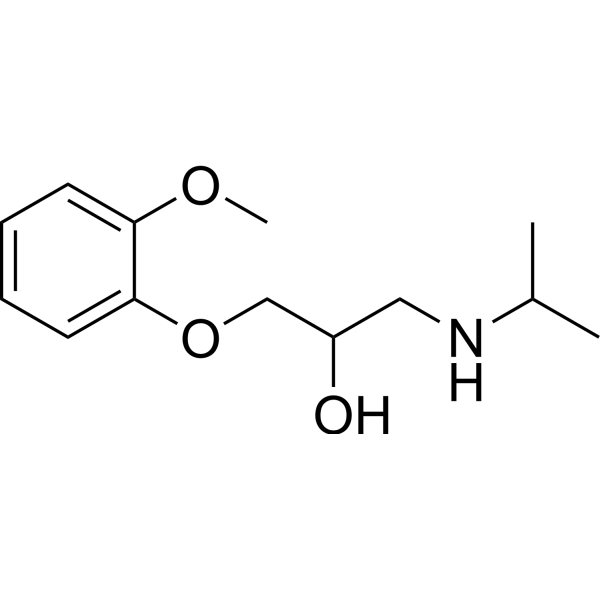
Moprolol ((±)-Moprolol) is an beta-adrenergic receptor blocker, which can be used for research in essential hypertension.
For research use only. We do not sell to patients.
- CAS No.: 5741-22-0
- Formula: C13H21NO3
- Molecular Weight:239.31
-
Storage:
Please store the product under the recommended conditions in the Certificate of Analysis.

To place orders, for customer services and technical support, please contact: MedChemExpress USA
Tel: 609-228-6898 E-mail: [email protected] [email protected]


-
 Biological Activity
-
Chemical Information
- Protocols
- Purity & Documentation
- References
-
 Help & FAQs


All Adrenergic Receptor Isoforms
More

Biological Activity
Description
IC50 & Target
[2]|
Beta-1 adrenergic receptor |
In Vitro
l-Moprolol is a β-blocker L-enantiomer with low negative inotropic activity and mild intrinsic sympathetomimetic activity, which can be used effectively in systemic hypertension studies. In primary open Angle glaucoma (POAG) or ocular hypertension (OHT) models, the topical application of l-Moprolol can reduce intraocular pressure (IOP) as effectively as tiolol, and has emerged as a promising compound for the inhibition of glaucoma due to its lack of activity on bronchial muscles[3].
MedChemExpress (MCE) has not independently confirmed the accuracy of these methods. They are for reference only.


Chemical Information
-
CAS No. 5741-22-0
-
Molecular Weight 239.31
-
Formula C13H21NO3
-
SMILES
OC(CNC(C)C)COC1=CC=CC=C1OC
-
Synonyms
(±)-Moprolol
-
Shipping
Room temperature in continental US; may vary elsewhere.
-
Storage
Please store the product under the recommended conditions in the Certificate of Analysis.


Purity & Documentation
References
[1]. Borowiecki P, et al. Development of a novel chemoenzymatic route to enantiomerically enriched β-adrenolytic agents. A case study toward propranolol, alprenolol, pindolol, carazolol, moprolol, and metoprolol. RSC Adv. 2022 Aug 10;12(34):22150-22160. [Content Brief]
[2]. Liu J, et al. beta1-Adrenergic receptor polymorphisms influence the response to metoprolol monotherapy in patients with essential hypertension. Clin Pharmacol Ther. 2006 Jul;80(1):23-32. [Content Brief]
[3]. Rossetti L, et al. The efficacy of the combination of l-moprolol and dipivefrin in reducing the intraocular pressure in primary open-angle glaucoma or in ocular hypertension. Graefes Arch Clin Exp Ophthalmol. 1994 Nov;232(11):670-4. [Content Brief]

Calculators
Concentration (start) × Volume (start) = Concentration (final) × Volume (final)


Moprolol Related Classifications
HY-108306 Related Classifications
 Powered by Bioz