



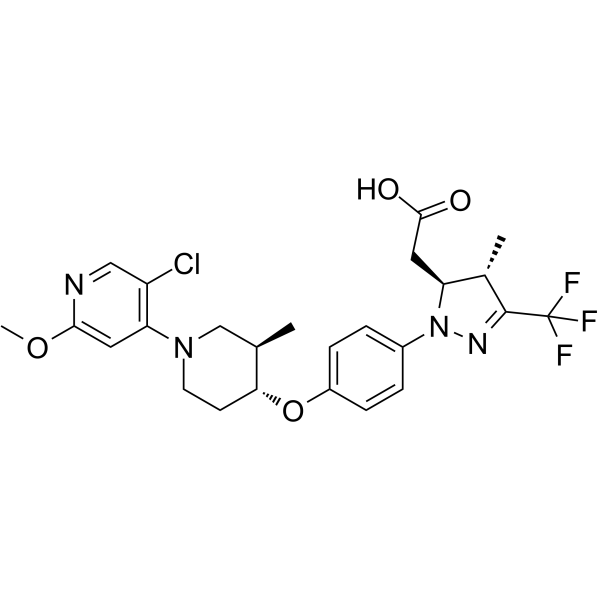
BMS-986118
BMS-986118 is an orally active and selective GPR40 full agonist (EC50 = 0.07 μM). BMS-986118 induces GLP-1 secretion and increases GLP-1 and insulin levels when combined with DPP-4 inhibitors. BMS-986118 shows sustained glucose-lowering effects. BMS-986118 can be used for research on type 2 diabetes.
For research use only. We do not sell to patients.
- CAS No.: 1610562-74-7
- Formula: C25H28ClF3N4O4
- Molecular Weight:540.96
-
Storage:
Please store the product under the recommended conditions in the Certificate of Analysis.

To place orders, for customer services and technical support, please contact: MedChemExpress USA
Tel: 609-228-6898 E-mail: [email protected] [email protected]


-
 Biological Activity
-
Chemical Information
- Purity & Documentation
- References
-
 Help & FAQs




Biological Activity
Description
IC50 & Target
[1]|
GPR40 0.07 μM (EC50) |
Cellular Effect
|
Cell Line

|
Type | Value | Description | References |
|---|---|---|---|---|
| CHO | EC50 |
70 nM
|
Agonist activity against human GPR40 expressed in CHO cells assessed as increase in intracellular calcium by Ca2+ FLIPR assay.
Agonist activity against human GPR40 expressed in CHO cells assessed as increase in intracellular calcium by Ca2+ FLIPR assay.
|
32835725 |
In Vitro
BMS-986118 exhibits potent hGPR40 agonist activity with an EC50 of 0.07 μM[1].
BMS-986118 (<10 μM) is highly selective and shows no significant activity against a broad panel of off-target targets at concentrations up to 10 μM[1].
BMS-986118 is a highly selective and potent full agonist of GPR40, exhibiting an hEC50 of 70 nM in the GPR40 CHO cell line[3].
BMS-986118 acts as a full FFA1 agonist in vitro, stimulating GSIS in Min6 cells and GLP-1 secretion in STC1 cells[6].
BMS-986118 acts as a full agonist to enhance insulin secretion in MIN6 cells and GLP-1 secretion in STC1 cells[5].
MedChemExpress (MCE) has not independently confirmed the accuracy of these methods. They are for reference only.
Parmacokinetics
| Species | Dose | Route | Cmax | Tmax | T1/2 | CL | Vss | F |
|---|---|---|---|---|---|---|---|---|
| Mice[1] | 1 mg/kg (i.v.); 1 mg/kg (p.o.) mg/kg | i.v. | 6.0 μM | 1 h | 3.1 h | 2.0 mL/min/kg | 0.4 L/kg | 100 % |
In Vivo
BMS-986118 (3 mg/kg; single dose), when combined with a DPP4 inhibitor, enhances glucose-stimulated insulin secretion and promotes GLP-1 secretion in mice, demonstrating a dual mechanism of action[1].
BMS-986118 (1-15 mg/kg; p.o.) exhibits in vivo efficacy in the ZDF type 2 diabetic rat model by increasing GLP-1 secretion and reducing HbA1c levels[6].
MedChemExpress (MCE) has not independently confirmed the accuracy of these methods. They are for reference only.
-
Animal Model:Male mice[1]
-
Dosage:0.03, 0.1, and 1 mg/kg
-
Administration:p.o.; single dose
-
Result:Dose-dependently suppressed plasma glucose excursion.
Produced a glucose-lowering effect at 0.1 mg/kg.
Did not observe hypoglycemia at higher doses.
-
Animal Model:Zucker diabetic fatty (ZDF) rats[6]
-
Dosage:1-3 mg/kg (GLP-1); 1-15 mg/kg (HbA1c)
-
Administration:p.o.
-
Result:Markedly increased GLP-1 levels at 1 and 3 mg/kg.
Decreased HbA1c levels by 2.5% at doses of 1-15 mg/kg.


Chemical Information
-
CAS No. 1610562-74-7
-
Molecular Weight 540.96
-
Formula C25H28ClF3N4O4
-
SMILES
COC1=CC(N2CC[C@H]([C@@H](C2)C)OC3=CC=C(C=C3)N4[C@H]([C@@H](C(C(F)(F)F)=N4)C)CC(O)=O)=C(C=N1)Cl
-
Shipping
Room temperature in continental US; may vary elsewhere.
-
Storage
Please store the product under the recommended conditions in the Certificate of Analysis.


Purity & Documentation
References
[1]. Shi J, et al. Discovery of Potent and Orally Bioavailable Dihydropyrazole GPR40 Agonists. Journal of medicinal chemistry. 2018 Feb 08;61(3):681-694. [Content Brief]
[2]. Chen HY, et al. Structure-Activity Relationship of Novel and Selective Biaryl-Chroman GPR40 AgoPAMs. ACS medicinal chemistry letters. 2018 Jul 12;9(7):685-690. [Content Brief]

Calculators
Concentration (start) × Volume (start) = Concentration (final) × Volume (final)


BMS-986118 Related Classifications
HY-12413A Related Classifications
 Powered by Bioz