



Nb-Demethylechitamine
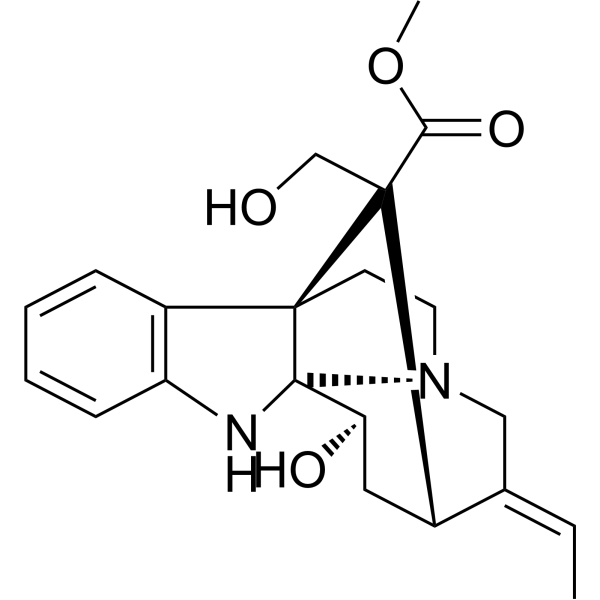
Nb-Demethylechitamine is an alkaloid isolated from the methanol extract of Alstonia rostrata twigs. Nb-Demethylechitamine has in vitro cytotoxic activity against several human cancer cell lines, including human myeloid leukemia HL-60, liver cancer SMMC-7721, lung cancer A-549, breast cancer MCF-7, and colon cancer SW480 cells.
For research use only. We do not sell to patients.
- CAS No.: 60048-88-6
- Formula: C21H26N2O4
- Molecular Weight:370.44
-
Storage:
Please store the product under the recommended conditions in the Certificate of Analysis.

To place orders, for customer services and technical support, please contact: MedChemExpress USA
Tel: 609-228-6898 E-mail: [email protected] [email protected]


-
 Biological Activity
-
Chemical Information
- Protocols
- Purity & Documentation
- References
-
 Help & FAQs




Biological Activity
Description


Chemical Information
-
CAS No. 60048-88-6
-
Molecular Weight 370.44
-
Formula C21H26N2O4
-
SMILES
C/C=C(C1)\[C@@H]2C[C@@H](O)[C@@]3([N@@]1CC4)[C@]4(C2(CO)C(OC)=O)C5=C(N3)C=CC=C5
-
Structure Classification
-
Initial Source
-
Shipping
Room temperature in continental US; may vary elsewhere.
-
Storage
Please store the product under the recommended conditions in the Certificate of Analysis.


Purity & Documentation
References

Calculators
Concentration (start) × Volume (start) = Concentration (final) × Volume (final)


Nb-Demethylechitamine Related Classifications
HY-N3210 Related Classifications
 Powered by Bioz