



Pyrithione
Based on 6 publication(s) in Google Scholar
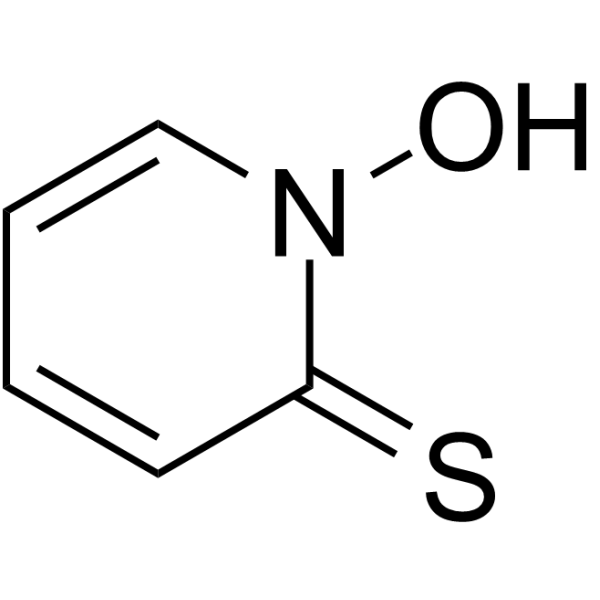
Pyrithione is an inhibitor of membrane transport processes in fungi. Pyrithione is a potent antibiotic aspergillic acid. Pyrithion incubated Penicillium mycelia would have a marked decrease in the activities of a variety of independently regulated transport systems.
Nos produits utilisent uniquement pour la recherche. Nous ne vendons pas aux patients.
- Pureté : 98.01%
- CAS No.: 1121-30-8
- Formule: C5H5NOS
- Masse moléculaire:127.16
-
Stockage:Powder -20°C, 3 years , 4°C, 2 years
* The compound is unstable in solutions, freshly prepared is recommended.

To place orders, for customer services and technical support, please contact: MedChemExpress USA
Tel: 609-228-6898 E-mail: [email protected] [email protected]


-
 Activité biologique
-
Chemical Information
-
Solvant et solubilité
- Pureté et documentation
- Références
-
 Help & FAQs


Publications Citing Use of MedChemExpress (MCE) Pyrithione
MoreVoir tous les produits spécifiques à Isoform Antibiotic
More

Activité biologique
Description
In Vitro
Pyrithione (100 μM-100 mM, 5 min) inhibits 35SO42- transport in P. notatum and L-[14C]-phenylalanine transport in P. chrysogenum (IC50 = 0.6 mM)[1].
Pyrithione (2.5 mM) reduces the ATP level to about 40% of the initial level in P. chrysogenum[1].
Pyrithione (5 mM, 0-90 min) prevents the incorporation of internal accumulated L-[14C]tryptophan and 35SO42- into protein[1].
MedChemExpress (MCE) has not independently confirmed the accuracy of these methods. They are for reference only. .


Chemical Information
-
CAS No. 1121-30-8
-
Appearance Solid
-
Masse moléculaire 127.16
-
Formule C5H5NOS
-
Color Off-white to yellow
-
SMILES
S=C1C=CC=CN1O
-
Livraison
Room temperature in continental US; may vary elsewhere.
-
Stockage
Powder -20°C 3 years 4°C 2 years * The compound is unstable in solutions, freshly prepared is recommended.


Publications (6)
-
Journal Impact Factor
-
Most Recent
-
Sci Rep
Disruption of zinc homeostasis reduces histone acetylation levels in normal and tumor cells. [Abstract]2026 Jan 10;16(1):4983. PMID: 41519875 -
J Neurochem
Zinc induces reactive astrogliosis through ERK-dependent activation of Stat3 and promotes synaptic degeneration. [Abstract]2021 Dec;159(6):1016-1027. PMID: 34699606 -
ACS Chem Neurosci
2026 May 6;17(9):1644-1657. PMID: 42024581 -
Front Mol Neurosci
The Role of Transient Receptor Potential A1 and G Protein-Coupled Receptor 39 in Zinc-Mediated Acute and Chronic Itch in Mice. [Abstract]2022 Jan 12:14:768731. PMID: 35095413 -
STAR Protoc
Protocol for measuring labile cytosolic Zn2+ using an in situ calibration of a genetically encoded FRET sensor. [Abstract]2024 Jun 12;5(2):103130. PMID: 38870018 -


Solvant et solubilité
In Vitro:
DMSO : 125 mg/mL (983.01 mM; Need ultrasonic; Hygroscopic DMSO has a significant impact on the solubility of product, please use newly opened DMSO)
Please refer to the solubility information to select the appropriate solvent. The compound is unstable in solutions, freshly prepared is recommended.
Please refer to the solubility information to select the appropriate solvent. The compound is unstable in solutions, freshly prepared is recommended.
Concentration (start) × Volume (start) = Concentration (final) × Volume (final)
In Vivo:
Select the appropriate dissolution method based on your experimental animal and administration route.
- For the following dissolution methods, please ensure to first prepare a clear stock solution using an In Vitro approach and then sequentially add co-solvents:
- To ensure reliable experimental results, the clarified stock solution can be appropriately stored based on storage conditions. As for the working solution for In Vivo experiments, it is recommended to prepare freshly and use it on the same day.
- The percentages shown for the solvents indicate their volumetric ratio in the final prepared solution. If precipitation or phase separation occurs during preparation, heat and/or sonication can be used to aid dissolution.
Add each solvent one by one: 10% DMSO 40% PEG300 5% Tween-80 45% Saline
Solubility: ≥ 2.08 mg/mL (16.36 mM); Clear solution
This protocol yields a clear solution of ≥ 2.08 mg/mL (saturation unknown).
Taking 1 mL working solution as an example, add 100 μL DMSO stock solution (20.8 mg/mL) to 400 μL PEG300, and mix evenly; then add 50 μL Tween-80 and mix evenly; then add 450 μL Saline to adjust the volume to 1 mL.
Preparation of Saline: Dissolve 0.9 g sodium chloride in ddH₂O and dilute to 100 mL to obtain a clear Saline solution.
Add each solvent one by one: 10% DMSO 90% (20% SBE-β-CD in Saline)
Solubility: ≥ 2.08 mg/mL (16.36 mM); Clear solution
This protocol yields a clear solution of ≥ 2.08 mg/mL (saturation unknown).
Taking 1 mL working solution as an example, add 100 μL DMSO stock solution (20.8 mg/mL) to 900 μL 20% SBE-β-CD in Saline, and mix evenly.
Preparation of 20% SBE-β-CD in Saline (4°C, storage for one week): 2 g SBE-β-CD powder is dissolved in 10 mL Saline, completely dissolve until clear.
In Vivo Dissolution Calculator
Please enter the basic information of animal experiments:
-
-
-
-
Recommended: Prepare an additional quantity of animals to account for potential losses during experiments.
Please enter your animal formula composition:
-
%DMSO +
Recommended: Keep the proportion of DMSO in working solution below 2% if your animal is weak.
-
%+
-
+%Tween-80 + +
-
%Saline +
The co-solvents required include: DMSO, . All of co-solvents are available by MedChemExpress (MCE). , Tween 80. All of co-solvents are available by MedChemExpress (MCE).
Working solution concentration: 0.22 mg/mL
Method for preparing stock solution: mg drug dissolved in μL DMSO. Stock solution concentration: mg/mL. * The compound is unstable in solutions, freshly prepared is recommended.
1. Take μL DMSO stock solution;
2. Add μL .
μL , mix evenly;
3. Then add μL Tween 80, mix evenly;
4. Then add μL
Please ensure that the stock solution in the first step is dissolved to a clear state, and add co-solvents in sequence. You can use ultrasonic heating (ultrasonic cleaner, recommended frequency 20-40 kHz), vortexing, etc. to assist dissolution.


Pureté et documentation
-
Fiche technique (278 KB)
-
SDS (396 KB)
- English - EN (396 KB)
- Français - FR (396 KB)
- Deutsch - DE (396 KB)
- Norwegian - NO (396 KB)
- Español - ES (396 KB)
- Swedish - SV (396 KB)
- Italian - IT (396 KB)
- Korean - KR (396 KB)
- Portuguese - PT (396 KB)
-
Instruction de manipulation (2659 KB)
Références


Complete Stock Solution Preparation Table
Please refer to the solubility information to select the appropriate solvent. The compound is unstable in solutions, freshly prepared is recommended.
| Optional Solvent | Concentration Solvent Mass | 1 mg | 5 mg | 10 mg | 25 mg |
|---|---|---|---|---|---|
| DMSO | 1 mM | 7.8641 mL | 39.3205 mL | 78.6411 mL | 196.6027 mL |
| 5 mM | 1.5728 mL | 7.8641 mL | 15.7282 mL | 39.3205 mL | |
| 10 mM | 0.7864 mL | 3.9321 mL | 7.8641 mL | 19.6603 mL | |
| 15 mM | 0.5243 mL | 2.6214 mL | 5.2427 mL | 13.1068 mL | |
| 20 mM | 0.3932 mL | 1.9660 mL | 3.9321 mL | 9.8301 mL | |
| 25 mM | 0.3146 mL | 1.5728 mL | 3.1456 mL | 7.8641 mL | |
| 30 mM | 0.2621 mL | 1.3107 mL | 2.6214 mL | 6.5534 mL | |
| 40 mM | 0.1966 mL | 0.9830 mL | 1.9660 mL | 4.9151 mL | |
| 50 mM | 0.1573 mL | 0.7864 mL | 1.5728 mL | 3.9321 mL | |
| 60 mM | 0.1311 mL | 0.6553 mL | 1.3107 mL | 3.2767 mL | |
| 80 mM | 0.0983 mL | 0.4915 mL | 0.9830 mL | 2.4575 mL | |
| 100 mM | 0.0786 mL | 0.3932 mL | 0.7864 mL | 1.9660 mL |


Pyrithione Related Classifications
HY-B1747 Related Classifications
 Powered by Bioz