



AChE-IN-62
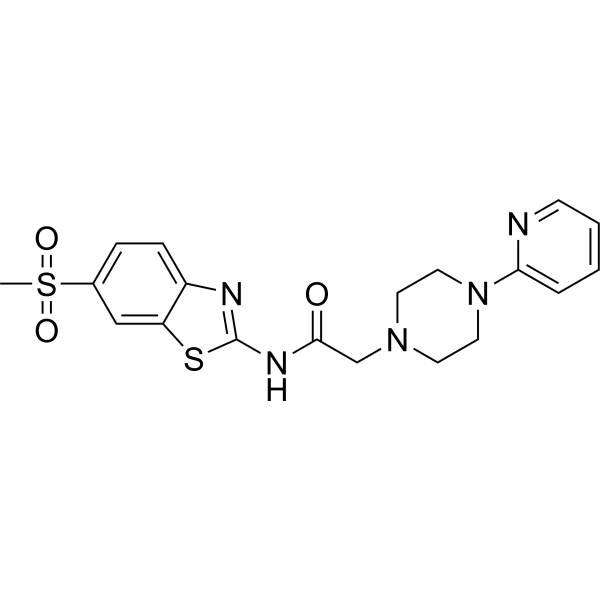
AChE-IN-62 (Compound 1) is an effective mixed and selective acetylcholinesterase (AChE) inhibitor with an IC50 value of 0.421 μM. AChE-IN-62 exhibits excellent blood-brain barrier permeability and neuroprotective effects. Additionally, AChE-IN-62 can inhibit the aggregation of Aβ1-42 with an IC50 value of 44.64 μM. AChE-IN-62 is also an effective multi-target-directed ligand (MTDL) that can be utilized in the research of Alzheimer's disease.
Nur für Forschungszwecke. Wir verkaufen nicht an Patienten.
- Formel: C19H21N5O3S2
- Molecular Weight:431.53
-
Speicherung:
Please store the product under the recommended conditions in the Certificate of Analysis.

To place orders, for customer services and technical support, please contact: MedChemExpress USA
Tel: 609-228-6898 E-mail: [email protected] [email protected]


-
 Biologische Aktivität
-
Chemical Information
- Protokoll
- Reinheit & Dokumentation
- Verweise
-
 Help & FAQs




Biologische Aktivität
Beschreibung
IC50 & Target
IC50: 0.421 μM (AChE)[1].
In Vitro
AChE-IN-62 (50 μM; 24-48 h) effectively inhibits the aggregation of Aβ1−42 with an IC50 value of 44.64 μM[1].
AChE-IN-62 (5-20 μM; 24 h) demonstrates neuroprotective effects in SH-SY5Y and Neuro2A cells by ameliorating the neurotoxic effects mediated by H2O2 (200 μM; 24 h) and Okadaic acid (HY-N6785) (30 nM; 24 h)[1].
MedChemExpress (MCE) has not independently confirmed the accuracy of these methods. They are for reference only. Further protocols information, click here.
-
Cell Line:SH-SY5Y, Neuro2A
-
Concentration:5 μM, 10 μM, 20 μM;
-
Incubation Time:24 h
-
Result:Inhibited the cell death mediated by H2O2 (200 μM; 24 h) and Okadaic acid (HY-N6785).
In Vivo
MedChemExpress (MCE) has not independently confirmed the accuracy of these methods. They are for reference only.
-
Animal Model:Dementia model of Swiss albino mice mediated by scopolamine[1].
-
Dosage:5 mg/kg, 10 mg/kg
-
Administration:Intraperitoneal injection (i.p.); Once daily for 7 days. Before scopolamine (HY-N0296) treatment (3 mg/kg; i.p.; Once daily for 7 days)
-
Result:Reduced the recognition ratio (T2/T1) in mice (a lower T2/T1 value indicates stronger short-term recognition memory).
Significantly enhanced the step-through latency (STL) (a decrease in STL indicates impaired memory).


Chemical Information
-
Molecular Weight 431.53
-
Formel C19H21N5O3S2
-
SMILES
CS(C1=CC=C2C(SC(NC(CN3CCN(C4=CC=CC=N4)CC3)=O)=N2)=C1)(=O)=O
-
Versand
Room temperature in continental US; may vary elsewhere.
-
Speicherung
Please store the product under the recommended conditions in the Certificate of Analysis.

Protokoll
-
Cell Cytotoxicity Assay
Cytotoxicity assays are usually based on the assessment of cell membrane damage, which can also be indirectly detected by measuring cell viability. Detection methods include MTT assay, CKK-8 assay, LDH assay and ATP assay, etc.
-
Transepithelial/transendothelial electrical resistance assay
TEER measures electrical resistance across epithelial or endothelial monolayers cultured on permeable supports, and the readout reflects ionic conductance through the cell barrier, especially the paracellular pathway regulated by junctional integrity. TEER can be measured without destroying the monolayer and is commonly used before or during transport, permeability, barrier-disruption, and barrier-maturation experiments. TEER values are influenced by biological maturation and technical conditions; reported factors include temperature, medium formulation, passage number, electrode geometry, membrane properties, and junctional length during early monolayer maturation. Therefore, TEER should be interpreted with blank-insert subtraction, area normalization, repeated readings, and, when possible, orthogonal barrier readouts such as FITC-dextran flux or tight-junction staining.
-
Alzheimer’s Disease Modeling
Alzheimer’s Disease (AD) is a neurodegenerative disorder characterized by a progressive decline in cognitive functions and loss of specific types of neurons and synapses. Alzheimer's symptoms can be simulated in mice by injecting drugs (such as Aβ) or genetically modified.


Reinheit & Dokumentation
Verweise

Calculators
Konzentration (Stammlösung) × Volumen (Stammlösung) = Konzentration (Ziellösung) × Volumen (Ziellösung)


AChE-IN-62 Related Classifications
HY-161466 Related Classifications
 Powered by Bioz