



LTD4 antagonist 2
LTD4 antagonist 2 (compound 6) is a leukotriene D4 (LTD4) antagonist with an IC50 of 2.8 μM against cysteinyl leukotriene 1 receptor (CysLT1R). LTD4 antagonist 2 is also a G protein-coupled bile acid receptor 1 (GPBAR1) agonist and can be utilized in research related to colitis, metabolic syndromes, and other GPBAR1/CysLT1R-related diseases.
Nur für Forschungszwecke. Wir verkaufen nicht an Patienten.
- CAS. Nr.: 107813-86-5
- Formel: C17H13NO3
- Molecular Weight:279.29
-
Speicherung:
Please store the product under the recommended conditions in the Certificate of Analysis.


To place orders, for customer services and technical support, please contact: MedChemExpress USA
Tel: 609-228-6898 E-mail: [email protected] [email protected]


-
 Biologische Aktivität
-
Chemical Information
- Protokoll
- Reinheit & Dokumentation
- Verweise
-
 Help & FAQs


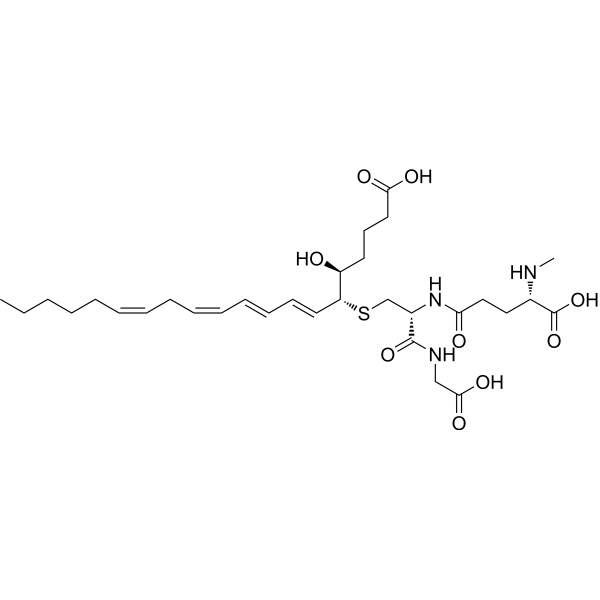
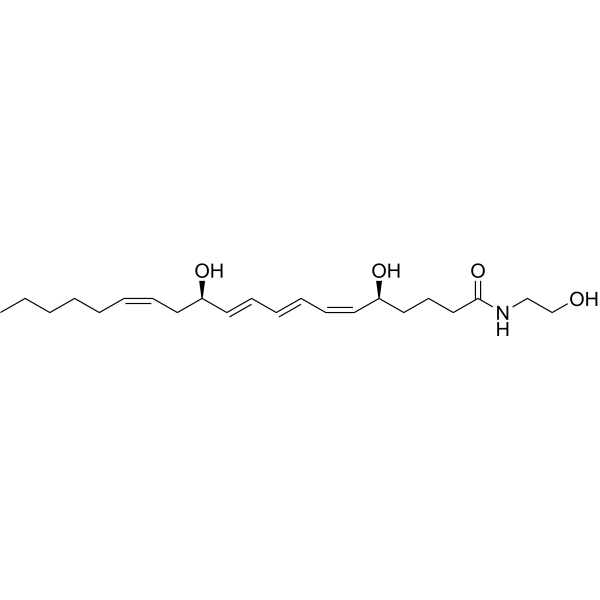

Alle Leukotriene Receptor Isoform-spezifische Produkte anzeigen
More

Biologische Aktivität
Beschreibung


Chemical Information
-
CAS. Nr. 107813-86-5
-
Molecular Weight 279.29
-
Formel C17H13NO3
-
SMILES
O=C(C1=CC(OCC2=NC3=C(C=C2)C=CC=C3)=CC=C1)O
-
Versand
Room temperature in continental US; may vary elsewhere.
-
Speicherung
Please store the product under the recommended conditions in the Certificate of Analysis.

Protokoll
-
Cell Cytotoxicity Assay
Cytotoxicity assays are usually based on the assessment of cell membrane damage, which can also be indirectly detected by measuring cell viability. Detection methods include MTT assay, CKK-8 assay, LDH assay and ATP assay, etc.
-
DSS-Induced Colitis
Dextran sulfate sodium (DSS)-induced colitis is generated by administering DSS in mouse drinking water, producing epithelial injury, barrier disruption, weight loss, diarrhea, fecal blood, colon shortening, histologic mucosal damage, and inflammatory mediator changes; the model is mainly used to study acute or chronic intestinal inflammation resembling selected features of ulcerative colitis. DSS injury is interpreted through clinical and tissue readouts rather than a single molecular endpoint: daily body weight, stool consistency, and bleeding are combined into a disease activity index, while colon length, histology, cytokines, myeloperoxidase activity, intestinal permeability, and tight-junction markers provide complementary measures of inflammation and barrier damage.
-
TNBS-Induced Colitis
TNBS-induced colitis is produced by intrarectal delivery of 2,4,6-trinitrobenzene sulfonic acid in ethanol, where ethanol disrupts the mucosal barrier and TNBS haptenates colonic proteins, generating immune-mediated colonic inflammation with weight loss, diarrhea, ulceration, transmural injury, inflammatory-cell infiltration, and cytokine responses. The model is used as an experimental intestinal inflammation model with Crohn’s disease–like features, especially when Th1-type responses, IL-12–dependent inflammation, chronic relapsing inflammation, or fibrosis-related endpoints are studied.


Reinheit & Dokumentation
Verweise
[1]. Fiorillo B, et al. Structural Basis for Developing Multitarget Compounds Acting on Cysteinyl Leukotriene Receptor 1 and G-Protein-Coupled Bile Acid Receptor 1. J Med Chem. 2021 Nov 25;64(22):16512-16529. [Content Brief]
[2]. Musser JH, et al. N-[(arylmethoxy)phenyl] carboxylic acids, hydroxamic acids, tetrazoles, and sulfonyl carboxamides. Potent orally active leukotriene D4 antagonists of novel structure. J Med Chem. 1990 Jan;33(1):240-5. [Content Brief]

Calculators
Konzentration (Stammlösung) × Volumen (Stammlösung) = Konzentration (Ziellösung) × Volumen (Ziellösung)


LTD4 antagonist 2 Related Classifications
HY-168784 Related Classifications
 Powered by Bioz