



Cichoriin
Based on 2 publication(s) in Google Scholar
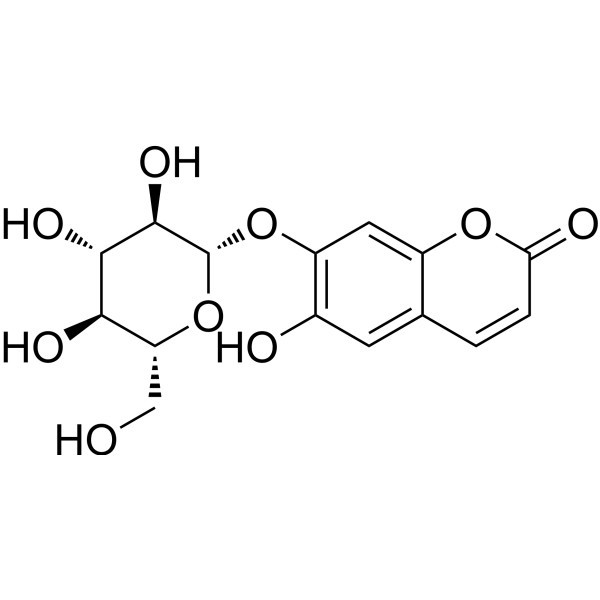
Cichoriin is an orally active coumarin glycoside with broad biological activities. Cichoriin exhibits inhibitory activities against α-amylase, α-glucosidase, pancreatic lipase and DPP-IV, with IC50 values of 5.76, 2.94, 16.83 and 9.16 μg/mL, respectively. Cichoriin significantly improves metabolic dysfunction-associated steatohepatitis (MASH) in mice by activating the AMPK signaling pathway. Cichoriin upregulates PPAR-γ in adipose tissue and alleviates obesity and associated cardiorenal injury in rats. Cichoriin blocks monosodium urate crystal-induced activation of the NLRP3 inflammasome and cell pyroptosis by inhibiting P2Y14R (IC50 = 8.47 nM). In silico virtual screening reveals that Cichoriin has a strong binding affinity for SARS-CoV-2.
Nos produits utilisent uniquement pour la recherche. Nous ne vendons pas aux patients.
- Pureté : 99.9%
- CAS No.: 531-58-8
- Formule: C15H16O9
- Masse moléculaire:340.28
-
Stockage:
4°C, sealed storage, away from moisture and light
* In solvent : -80°C, 6 months; -20°C, 1 month (sealed storage, away from moisture and light)

To place orders, for customer services and technical support, please contact: MedChemExpress USA
Tel: 609-228-6898 E-mail: [email protected] [email protected]


-
 Activité biologique
-
Chemical Information
-
Solvant et solubilité
- Protocole
- Pureté et documentation
- Références
-
 Help & FAQs




Publications Citing Use of MedChemExpress (MCE) Cichoriin
MoreVoir tous les produits spécifiques à Isoform P2Y Receptor
More

Activité biologique
Description
|
PPAR-γ |
DPP-4 |
GLUT4 |
NLRP3 inflammasome |
P2Y14 Receptor |
In Vitro
Cichoriin exhibits favorable binding affinity to multiple diabetes and cardiovascular targets, including α-amylase, α-glucosidase, DPP-IV, PPARγ, AMPK, GLUT-4, ACE and NF-κB, with binding energies ranging from -6.8 to -9.8 kcal/mol[1].
Cichoriin (25-50 μM; 24 h) dose-dependently reduces free fatty acid (FFA)-induced lipid accumulation in HepG2 cells, AML12 cells, and primary mouse hepatocytes[3].
Cichoriin (25-50 μM; 24 h) reduces reactive oxygen species levels in FFA-induced AML12 mouse hepatocytes[3].
Cichoriin (50 μM; 24 h) activates the AMPK pathway by increasing the phosphorylation levels of AMPKα and ACC, and upregulates the expression of CPT-1A in primary mouse hepatocytes treated with free fatty acids (FFA)[3].
Cichoriin (50 μM; 24 h) inhibits the migration and activation of hepatic stellate cells (HSC) (reducing the expression of Col I and α-SMA) in an indirect co-culture system by regulating paracrine signals in primary mouse hepatocytes treated with FFA[3].
Cichoriin (25-50 μM; 24 h) inhibits PDGF-AA secretion from lipotoxic primary mouse hepatocytes[3].
The lipid-lowering, anti-inflammatory, and PDGF-AA inhibitory effects of Cichoriin on free fatty acid (FFA)-treated primary mouse hepatocytes, as well as the anti-fibrotic effect on co-cultivated hepatic stellate cells (HSCs), all depend on the activation of AMPK[3].
Cichoriin (50-200 μM; 24 h) significantly inhibits monosodium urate crystal-induced release of IL-1β and IL-18, as well as protein expression of NLRP3, Caspase-1, GSDMD and ASC in differentiated THP-1 macrophages[5].
Cichorin (50-200 μM; 24 h) effectively inhibits monosodium urate crystal-driven macrophage pyroptosis[5].
MedChemExpress (MCE) has not independently confirmed the accuracy of these methods. They are for reference only. Further protocols information, click here.
-
Cell Line:Primary mouse hepatocytes (with FFA-induced lipotoxicity)
-
Concentration:50 μM
-
Incubation Time:24 h (concurrent with FFA treatment)
-
Result:Significantly increased phosphorylation levels of AMPKα and ACC compared to FFA-only treated cells.
Upregulated CPT-1A protein expression compared to FFA-only treated cells.
-
Cell Line:Indirect Transwell co-culture of primary mouse hepatocytes and primary mouse hepatic stellate cells (HSCs) (with FFA-induced hepatocyte lipotoxicity)
-
Concentration:50 μM
-
Incubation Time:24 h (incubation with hepatocytes, prior to co-culture)
-
Result:Significantly inhibited HSC migration (reduced wound closure rate) compared to FFA-only treated hepatocytes.
Downregulated protein expression of collagen I (Col I) and alpha-smooth muscle actin (α-SMA) in co-cultured HSCs compared to FFA-only treated hepatocytes.
-
Cell Line:Primary mouse hepatocytes (with FFA-induced lipotoxicity)
-
Concentration:25 and 50 μM
-
Incubation Time:24 h
-
Result:Reduced FFA-induced PDGF-AA secretion from primary mouse hepatocytes compared to FFA-only treated hepatocytes.
-
Cell Line:THP-1 macrophages
-
Concentration:25, 100 and 200 μM
-
Incubation Time:Pre-treatment for 1 hour, followed by stimulation with sodium urate crystals for 23 hours
-
Result:Significantly inhibited the release of IL-1β and IL-18.
-
Cell Line:THP-1 macrophages
-
Concentration:25, 100 and 200 μM
-
Incubation Time:Pre-treatment for 1 hour, followed by stimulation with sodium urate crystals for 23 hours
-
Result:Significantly inhibited the protein expression levels of NLRP3, Caspase-1, GSDMD and ASC.
In Vivo
Cichoriin (100-200 mg/kg/day; oral gavage; daily; 6 weeks) dose-dependently alleviates GAN diet-induced MASH and associated liver fibrosis in male C57BL/6J mice via AMPK pathway activation[3].
MedChemExpress (MCE) has not independently confirmed the accuracy of these methods. They are for reference only.
-
Animal Model:Wistar (male, 100-150 g initial weight, high-fat diet-induced obesity)[2]
-
Dosage:50 mg/kg; 100 mg/kg
-
Administration:p.o.; daily; 4 weeks
-
Result:Reduced body-weight gain to 142 g, BMI to 0.58 g/cm2, liver weight to 7.0 g, visceral fat weight to 4.7 g.
Improved serum lipid profile to total cholesterol 125 mg/dL, triglycerides 48 mg/dL, low-density lipoprotein cholesterol 93 mg/dL, high-density lipoprotein cholesterol 23 mg/dL, LDL-C/HDL-C ratio 4.2.
Lowered hepatic malondialdehyde to 107.2 nmol/g tissue, renal malondialdehyde to 78.4 nmol/g tissue, and increased hepatic reduced glutathione to 271 mg/g tissue, renal reduced glutathione to 286 mg/g tissue.
Upregulated peroxisome proliferator-activated receptor gamma mRNA and protein expression in adipose tissue.
Showed moderate improvement in heart, kidney, and liver tissue architecture with reduced tissue damage compared to HFD controls.
Reduced body-weight gain to 123 g, BMI to 0.55 g/cm2, liver weight to 6.7 g, kidney weight to 1.2 g, heart weight to 0.9 g, visceral fat weight to 3.1 g.
Improved serum lipid profile to total cholesterol 85 mg/dL, triglycerides 40 mg/dL, low-density lipoprotein cholesterol 44 mg/dL, high-density lipoprotein cholesterol 33 mg/dL, LDL-C/HDL-C ratio 1.4.
Normalized serum alanine transaminase, aspartate transaminase, urea, creatinine, and creatine kinase MB levels to near-control values.
Lowered hepatic malondialdehyde to 96.9 nmol/g tissue, renal malondialdehyde to 64.3 nmol/g tissue, and increased hepatic reduced glutathione to 325 mg/g tissue, renal reduced glutathione to 339 mg/g tissue.
Upregulated peroxisome proliferator-activated receptor gamma mRNA and protein expression in adipose tissue to levels comparable to the atorvastatin control.
Showed marked improvement in heart, kidney, and liver tissue architecture with minimal residual damage compared to HFD controls.
-
Animal Model:C57BL/6J (male, 8-10 weeks old, 20-25 g, GAN diet-induced MASH)[3]
-
Dosage:100 mg/kg/day; 200 mg/kg/day
-
Administration:oral gavage; daily; 6 weeks
-
Result:Significantly reduced body weight, liver index, and blood glucose levels in a dose-dependent manner.
Decreased serum levels of AST, ALT, LDH, AKP, TC, TG, LDL-C, and NEFA, while increased HDL-C levels.
Attenuated hepatic steatosis, inflammation scores, and NAFLD Activity Score (NAS), with reduced liver lipid content (Oil Red O staining area, hepatic TC, TG).
Lowered hepatic AST, ALT, and LDH levels.
Reduced liver fibrosis, as shown by decreased Masson’s trichrome staining area, hepatic hydroxyproline levels, liver Ishak score, and serum fibrosis biomarkers (HA, LN, Col IV, Pro III).
Dose-dependently suppressed mRNA expression of fibrosis-related genes (Col3a1, Col1a1, Acta2, Tgfb1), reduced Smad2 and Smad4 staining intensity, and downregulated protein expression of α-SMA, TGF-β1, Col III, and Col I.
Decreased hepatic F4/80-positive macrophage density, upregulated hepatic SOD, GSH, and CAT levels, and reduced hepatic MDA content.
Lowered hepatic levels of TNF-α, IL-6, and IL-1β, with downregulated protein levels of p-IKKβ and p-NF-κB p65, and upregulated IκBα.
Enhanced phosphorylation of AMPK (Thr172) and ACC (Ser79) at 200 mg/kg dose, increasing p-AMPK/total AMPK and p-ACC/total ACC ratios.
Reversed GAN diet-induced upregulation of pro-inflammatory factors, fibrogenic markers, and lipogenic enzymes, while restored expression of fatty acid β-oxidation and insulin signaling proteins at 200 mg/kg dose.


Chemical Information
-
CAS No. 531-58-8
-
Appearance Solid
-
Masse moléculaire 340.28
-
Formule C15H16O9
-
Color White to off-white
-
SMILES
OC1=C(C=C2C(C=CC(O2)=O)=C1)O[C@@H]3O[C@@H]([C@H]([C@@H]([C@H]3O)O)O)CO
-
Structure Classification
-
Initial Source
-
Livraison
Room temperature in continental US; may vary elsewhere.
-
Stockage
4°C, sealed storage, away from moisture and light
* In solvent : -80°C, 6 months; -20°C, 1 month (sealed storage, away from moisture and light)


Publications (2)
-
Journal Impact Factor
-
Most Recent
-
Bioorg Chem
Discovery of cyanidin-3-O-galactoside as a novel CNT2 inhibitor for the treatment of hyperuricemia. [Abstract]2025 Jan:154:108108. PMID: 39753042 -
Vet Microbiol
The Chinese medicine monomer Schisandrin C inhibits PRRSV infection by regulating the OGT-PI3K/AKT/mTOR signaling pathway. [Abstract]2026 May:316:110992. PMID: 41865607


Solvant et solubilité
In Vitro:
DMSO : 100 mg/mL (293.88 mM; Need ultrasonic; Hygroscopic DMSO has a significant impact on the solubility of product, please use newly opened DMSO)
Please refer to the solubility information to select the appropriate solvent. Once prepared, please aliquot and store the solution to prevent product inactivation from repeated freeze-thaw cycles.
Storage method and period of stock solution: -80°C, 6 months; -20°C, 1 month (sealed storage, away from moisture and light). When stored at -80°C, please use it within 6 months. When stored at -20°C, please use it within 1 month.
Please refer to the solubility information to select the appropriate solvent. Once prepared, please aliquot and store the solution to prevent product inactivation from repeated freeze-thaw cycles.
Storage method and period of stock solution: -80°C, 6 months; -20°C, 1 month (sealed storage, away from moisture and light). When stored at -80°C, please use it within 6 months. When stored at -20°C, please use it within 1 month.
Concentration (start) × Volume (start) = Concentration (final) × Volume (final)
In Vivo:
Select the appropriate dissolution method based on your experimental animal and administration route.
- For the following dissolution methods, please ensure to first prepare a clear stock solution using an In Vitro approach and then sequentially add co-solvents:
- To ensure reliable experimental results, the clarified stock solution can be appropriately stored based on storage conditions. As for the working solution for In Vivo experiments, it is recommended to prepare freshly and use it on the same day.
- The percentages shown for the solvents indicate their volumetric ratio in the final prepared solution. If precipitation or phase separation occurs during preparation, heat and/or sonication can be used to aid dissolution.
Add each solvent one by one: 10% DMSO 40% PEG300 5% Tween-80 45% Saline
Solubility: ≥ 2.5 mg/mL (7.35 mM); Clear solution
This protocol yields a clear solution of ≥ 2.5 mg/mL (saturation unknown).
Taking 1 mL working solution as an example, add 100 μL DMSO stock solution (25.0 mg/mL) to 400 μL PEG300, and mix evenly; then add 50 μL Tween-80 and mix evenly; then add 450 μL Saline to adjust the volume to 1 mL.
Preparation of Saline: Dissolve 0.9 g sodium chloride in ddH₂O and dilute to 100 mL to obtain a clear Saline solution.
Add each solvent one by one: 10% DMSO 90% (20% SBE-β-CD in Saline)
Solubility: ≥ 2.5 mg/mL (7.35 mM); Clear solution
This protocol yields a clear solution of ≥ 2.5 mg/mL (saturation unknown).
Taking 1 mL working solution as an example, add 100 μL DMSO stock solution (25.0 mg/mL) to 900 μL 20% SBE-β-CD in Saline, and mix evenly.
Preparation of 20% SBE-β-CD in Saline (4°C, storage for one week): 2 g SBE-β-CD powder is dissolved in 10 mL Saline, completely dissolve until clear.
In Vivo Dissolution Calculator
Please enter the basic information of animal experiments:
-
-
-
-
Recommended: Prepare an additional quantity of animals to account for potential losses during experiments.
Please enter your animal formula composition:
-
%DMSO +
Recommended: Keep the proportion of DMSO in working solution below 2% if your animal is weak.
-
%+
-
+%Tween-80 + +
-
%Saline +
The co-solvents required include: DMSO, . All of co-solvents are available by MedChemExpress (MCE). , Tween 80. All of co-solvents are available by MedChemExpress (MCE).
Working solution concentration: 0.22 mg/mL
Method for preparing stock solution: mg drug dissolved in μL DMSO. Stock solution concentration: mg/mL. * In solvent : -80°C, 6 months; -20°C, 1 month (sealed storage, away from moisture and light)
1. Take μL DMSO stock solution;
2. Add μL .
μL , mix evenly;
3. Then add μL Tween 80, mix evenly;
4. Then add μL
Please ensure that the stock solution in the first step is dissolved to a clear state, and add co-solvents in sequence. You can use ultrasonic heating (ultrasonic cleaner, recommended frequency 20-40 kHz), vortexing, etc. to assist dissolution.

Protocole
-
Cell Cytotoxicity Assay
Cytotoxicity assays are usually based on the assessment of cell membrane damage, which can also be indirectly detected by measuring cell viability. Detection methods include MTT assay, CKK-8 assay, LDH assay and ATP assay, etc.
-
Large-size fat particle sorting
Large-size fat particle sorting is widely used to isolate cells up to 200 μm in diameter. Single-cell flow sorting will allow greater insight into adipocyte heterogeneity by identifying gene expression, protein composition, and metabolic signatures at the single-cell level.
-
Research Protocol for Metabolic Diseases
AMP-activated protein kinase, AMPK, is a conserved cellular energy sensor that responds to reduced cellular energy status and coordinates metabolism by increasing ATP-generating catabolic pathways while suppressing ATP-consuming anabolic processes. In metabolic disease research, the AMPK pathway is experimentally relevant because it regulates hepatic lipid synthesis, fatty acid oxidation, glucose production, skeletal-muscle glucose disposal, mTORC1-linked biosynthesis, autophagy, mitochondrial homeostasis, and whole-body energy balance. The central pathway logic is that energy stress, metformin, exercise-like stimulation, or direct AMPK activators increase AMPKα Thr172 phosphorylation and downstream substrate phosphorylation, including ACC and RAPTOR. Phosphorylation of ACC suppresses lipogenesis and supports fatty acid oxidation, whereas phosphorylation of RAPTOR suppresses mTORC1 signaling and links cellular energy status to growth and protein synthesis control. The pathway is linked
-
Pyroptosis Solutions
Pyroptosis is a lytic inflammatory cell-death pathway executed by gasdermin pores, most classically through inflammasome-mediated activation of caspase-1, cleavage of gasdermin D, membrane pore formation, LDH release, and secretion of IL-1β and IL-18. The canonical pathway is commonly modeled by priming cells with an inflammatory signal such as LPS to induce pro-IL-1β and inflammasome components, followed by an activation signal such as ATP or nigericin to activate NLRP3, ASC speck formation, caspase-1 cleavage, GSDMD cleavage, cytokine release, and pyroptotic membrane rupture. The non-canonical pathway is triggered when cytosolic LPS activates mouse caspase-11 or human caspase-4/5, leading to GSDMD cleavage and pyroptosis, and this can secondarily activate NLRP3-dependent IL-1β release. Pyroptosis is linked to inflammatory injury, infection, cancer, liver disease, ocular disease, placental inflammation, and other disease phenotypes, but unresolved questions include which gasdermin fam


Pureté et documentation
-
Fiche technique (292 KB)
-
SDS (252 KB)
- English - EN (252 KB)
- Français - FR (252 KB)
- Deutsch - DE (252 KB)
- Norwegian - NO (252 KB)
- Español - ES (252 KB)
- Swedish - SV (252 KB)
- Italian - IT (252 KB)
- Korean - KR (252 KB)
- Portuguese - PT (252 KB)
-
Instruction de manipulation (2659 KB)
Références
[1]. Sishu NK, et al. Cichoriin, a coumarin glycoside with antidiabetic effect and cardioprotective activity against H2O2 induced oxidative stress in H9c2 cells: in-vitro and in-silico study. Free Radic Biol Med. 2025;241:671-688. [Content Brief]
[2]. Khalil HE, et al. Cichoriin, a Biocoumarin, Mitigates Oxidative Stress and Associated Adverse Dysfunctions on High-Fat Diet-Induced Obesity in Rats. Life (Basel). 2022;12(11):1731. Published 2022 Oct 28. [Content Brief]
[3]. Zhao Y, et al. Cichoriin suppresses hepatic lipid accumulation and fibrosis in mice metabolic dysfunction associated steatohepatitis via the AMPK pathway. Biochem Pharmacol. 2026;245:117630. [Content Brief]
[4]. Rivero-Segura NA, et al. In Silico Screening of Natural Products Isolated from Mexican Herbal Medicines against COVID-19. Biomolecules. 2021;11(2):216. Published 2021 Feb 4. [Content Brief]
[5].
Wu X, et al. Mechanistic insights into how cichoriin inhibits P2Y14R to suppress MSU-induced gouty inflammation. BMC Biotechnol. 2026 Apr 15.
[Content Brief]


Complete Stock Solution Preparation Table
Please refer to the solubility information to select the appropriate solvent. Once prepared, please aliquot and store the solution to prevent product inactivation from repeated freeze-thaw cycles.
Storage method and period of stock solution: -80°C, 6 months; -20°C, 1 month (sealed storage, away from moisture and light). When stored at -80°C, please use it within 6 months. When stored at -20°C, please use it within 1 month.
| Optional Solvent | Concentration Solvent Mass | 1 mg | 5 mg | 10 mg | 25 mg |
|---|---|---|---|---|---|
| DMSO | 1 mM | 2.9388 mL | 14.6938 mL | 29.3876 mL | 73.4689 mL |
| 5 mM | 0.5878 mL | 2.9388 mL | 5.8775 mL | 14.6938 mL | |
| 10 mM | 0.2939 mL | 1.4694 mL | 2.9388 mL | 7.3469 mL | |
| 15 mM | 0.1959 mL | 0.9796 mL | 1.9592 mL | 4.8979 mL | |
| 20 mM | 0.1469 mL | 0.7347 mL | 1.4694 mL | 3.6734 mL | |
| 25 mM | 0.1176 mL | 0.5878 mL | 1.1755 mL | 2.9388 mL | |
| 30 mM | 0.0980 mL | 0.4898 mL | 0.9796 mL | 2.4490 mL | |
| 40 mM | 0.0735 mL | 0.3673 mL | 0.7347 mL | 1.8367 mL | |
| 50 mM | 0.0588 mL | 0.2939 mL | 0.5878 mL | 1.4694 mL | |
| 60 mM | 0.0490 mL | 0.2449 mL | 0.4898 mL | 1.2245 mL | |
| 80 mM | 0.0367 mL | 0.1837 mL | 0.3673 mL | 0.9184 mL | |
| 100 mM | 0.0294 mL | 0.1469 mL | 0.2939 mL | 0.7347 mL |


Cichoriin Related Classifications
HY-N8599 Related Classifications
 Powered by Bioz
Keywords
- Cichoriin
- 531-58-8
- Amylases
- Glycosidase
- Lipase
- Dipeptidyl Peptidase
- p38 MAPK
- PPAR
- P2Y Receptor
- NOD-like Receptor (NLR)
- SARS-CoV
- Pyroptosis
- GLUT
- Angiotensin-converting Enzyme (ACE)
- NF-κB
- AML12 cells
- SARS-CoV-2
- porcine pancreatic lipase
- PPAR-γ
- α-amylase
- α-glucosidase
- HepG2 cells
- primary mouse hepatocytes
- AMPK
- DPP-IV
- Inhibitor
- inhibitor
- inhibit