



Crassicauline A

Based on 1 Customer Validation
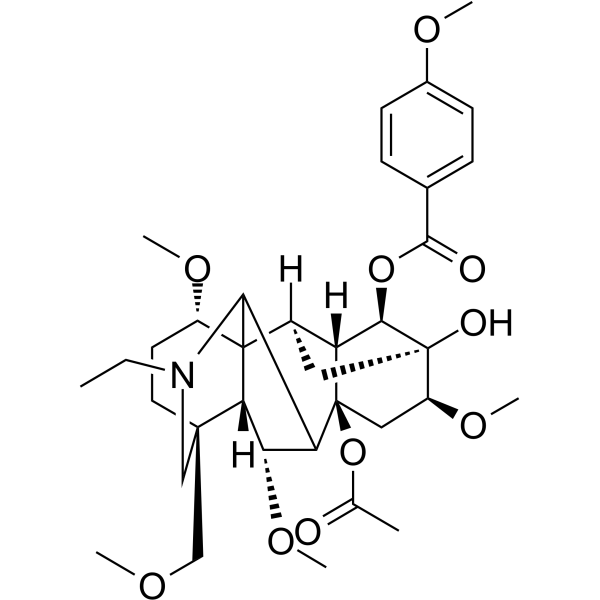
Crassicauline A (Crassicaulin A) is a diester-type diterpenoid alkaloid. Crassicauline A exhibits feeding deterrent activity against adult Tribolium castaneum, with a EC50 of 1134.5 ppm. Crassicauline A induces arrhythmia at a dose of 0.10 mg/kg.
For research use only. We do not sell to patients.
- Purity : 98.78%
- CAS No.: 79592-91-9
- Formula: C35H49NO10
- Molecular Weight:643.76
-
Storage:
4°C, protect from light
* In solvent : -80°C, 6 months; -20°C, 1 month (protect from light)

To place orders, for customer services and technical support, please contact: MedChemExpress USA
Tel: 609-228-6898 E-mail: [email protected] [email protected]


-
 Biological Activity
-
Chemical Information
-
Solvent & Solubility
- Protocols
- Purity & Documentation
- References
-
 Help & FAQs




All Parasite Isoforms
More

Biological Activity
Description
In Vitro
Crassicauline A is a compound found in the roots of Aconitum episcopale[1].
MedChemExpress (MCE) has not independently confirmed the accuracy of these methods. They are for reference only. Further protocols information, click here.
In Vivo
Crassicauline A (0.10 mg/kg; i.v.; single dose) induces severe arrhythmias including VPB, VT, and VF in normal rats[2].
MedChemExpress (MCE) has not independently confirmed the accuracy of these methods. They are for reference only.
-
Animal Model:Tribolium castaneum (unsexed, 2 weeks old)[1]
-
Dosage:10 ppm; 30 ppm; 100 ppm; 300 ppm; 1000 ppm
-
Administration:/
-
Result:Reduced diet consumption to 97.81% of control at 10 ppm.
Reduced diet consumption to 89.73% of control at 30 ppm.
Reduced diet consumption to 78.36% of control at 100 ppm.
Reduced diet consumption to 69.59% of control at 300 ppm.
Reduced diet consumption to 53.29% of control at 1000 ppm.
Achieved an EC50 of 1134.5 ppm for feeding reduction relative to control.


Chemical Information
-
CAS No. 79592-91-9
-
Appearance Solid
-
Molecular Weight 643.76
-
Formula C35H49NO10
-
Color White to off-white
-
SMILES
CO[C@@H](CC[C@]1(COC)[C@@]2([H])[C@H]3OC)C42[C@@](C[C@@]5(O)[C@@H]6OC(C7=CC=C(OC)C=C7)=O)([H])[C@@]6([H])[C@](OC(C)=O)(C[C@@H]5OC)C3C4N(C1)CC
-
Synonyms
Crassicaulin A
-
Structure Classification
-
Initial Source
-
Shipping
Room temperature in continental US; may vary elsewhere.
-
Storage
4°C, protect from light
* In solvent : -80°C, 6 months; -20°C, 1 month (protect from light)


Solvent & Solubility
In Vitro:
DMSO : 100 mg/mL (155.34 mM; Need ultrasonic; Hygroscopic DMSO has a significant impact on the solubility of product, please use newly opened DMSO)
Please refer to the solubility information to select the appropriate solvent. Once prepared, please aliquot and store the solution to prevent product inactivation from repeated freeze-thaw cycles.
Storage method and period of stock solution: -80°C, 6 months; -20°C, 1 month (protect from light). When stored at -80°C, please use it within 6 months. When stored at -20°C, please use it within 1 month.
Please refer to the solubility information to select the appropriate solvent. Once prepared, please aliquot and store the solution to prevent product inactivation from repeated freeze-thaw cycles.
Storage method and period of stock solution: -80°C, 6 months; -20°C, 1 month (protect from light). When stored at -80°C, please use it within 6 months. When stored at -20°C, please use it within 1 month.
Concentration (start) × Volume (start) = Concentration (final) × Volume (final)
In Vivo:
Select the appropriate dissolution method based on your experimental animal and administration route.
- For the following dissolution methods, please ensure to first prepare a clear stock solution using an In Vitro approach and then sequentially add co-solvents:
- To ensure reliable experimental results, the clarified stock solution can be appropriately stored based on storage conditions. As for the working solution for In Vivo experiments, it is recommended to prepare freshly and use it on the same day.
- The percentages shown for the solvents indicate their volumetric ratio in the final prepared solution. If precipitation or phase separation occurs during preparation, heat and/or sonication can be used to aid dissolution.
Add each solvent one by one: 10% DMSO 40% PEG300 5% Tween-80 45% Saline
Solubility: ≥ 2.5 mg/mL (3.88 mM); Clear solution
This protocol yields a clear solution of ≥ 2.5 mg/mL (saturation unknown).
Taking 1 mL working solution as an example, add 100 μL DMSO stock solution (25.0 mg/mL) to 400 μL PEG300, and mix evenly; then add 50 μL Tween-80 and mix evenly; then add 450 μL Saline to adjust the volume to 1 mL.
Preparation of Saline: Dissolve 0.9 g sodium chloride in ddH₂O and dilute to 100 mL to obtain a clear Saline solution.
Add each solvent one by one: 10% DMSO 90% (20% SBE-β-CD in Saline)
Solubility: ≥ 2.5 mg/mL (3.88 mM); Clear solution
This protocol yields a clear solution of ≥ 2.5 mg/mL (saturation unknown).
Taking 1 mL working solution as an example, add 100 μL DMSO stock solution (25.0 mg/mL) to 900 μL 20% SBE-β-CD in Saline, and mix evenly.
Preparation of 20% SBE-β-CD in Saline (4°C, storage for one week): 2 g SBE-β-CD powder is dissolved in 10 mL Saline, completely dissolve until clear.
In Vivo Dissolution Calculator
Please enter the basic information of animal experiments:
-
-
-
-
Recommended: Prepare an additional quantity of animals to account for potential losses during experiments.
Please enter your animal formula composition:
-
%DMSO +
Recommended: Keep the proportion of DMSO in working solution below 2% if your animal is weak.
-
%+
-
+%Tween-80 + +
-
%Saline +
The co-solvents required include: DMSO, . All of co-solvents are available by MedChemExpress (MCE). , Tween 80. All of co-solvents are available by MedChemExpress (MCE).
Working solution concentration: 0.22 mg/mL
Method for preparing stock solution: mg drug dissolved in μL DMSO. Stock solution concentration: mg/mL. * In solvent : -80°C, 6 months; -20°C, 1 month (protect from light)
1. Take μL DMSO stock solution;
2. Add μL .
μL , mix evenly;
3. Then add μL Tween 80, mix evenly;
4. Then add μL
Please ensure that the stock solution in the first step is dissolved to a clear state, and add co-solvents in sequence. You can use ultrasonic heating (ultrasonic cleaner, recommended frequency 20-40 kHz), vortexing, etc. to assist dissolution.

Protocols
-
Cardiac voltage-sensitive optical mapping
Cardiac voltage-sensitive optical mapping records changes in transmembrane potential from cardiac tissue by staining the preparation with a voltage-sensitive dye and imaging fluorescence changes during electrical activation; the resulting optical action potentials can be used to map activation time, action potential duration, conduction velocity, wavefront propagation, and arrhythmia dynamics. The optical signal represents a relative fluorescence change from a tissue volume rather than a single-cell intracellular recording, so spatial resolution, sampling rate, voltage resolution, optical magnification, light penetration, and motion control must be considered together when interpreting optical action potentials.


Purity & Documentation
-
Data Sheet (282 KB)
-
SDS (252 KB)
- English - EN (252 KB)
- Français - FR (252 KB)
- Deutsch - DE (252 KB)
- Norwegian - NO (252 KB)
- Español - ES (252 KB)
- Swedish - SV (252 KB)
- Italian - IT (252 KB)
- Korean - KR (252 KB)
- Portuguese - PT (252 KB)
-
Handling Instructions (2659 KB)
References
[1]. Liu ZL, et al. Feeding deterrents from Aconitum episcopale roots against the red flour beetle, Tribolium castaneum. J Agric Food Chem. 2011;59(8):3701-3706. [Content Brief]
[2]. Tao P, et al. Attenuation and Structural Transformation of Crassicauline A During Sand Frying Process and Antiarrhythmic Effects of its Transformed Products. Front Pharmacol. 2021;12:734671. Published 2021 Nov 2. [Content Brief]


Complete Stock Solution Preparation Table
Please refer to the solubility information to select the appropriate solvent. Once prepared, please aliquot and store the solution to prevent product inactivation from repeated freeze-thaw cycles.
Storage method and period of stock solution: -80°C, 6 months; -20°C, 1 month (protect from light). When stored at -80°C, please use it within 6 months. When stored at -20°C, please use it within 1 month.
| Optional Solvent | Concentration Solvent Mass | 1 mg | 5 mg | 10 mg | 25 mg |
|---|---|---|---|---|---|
| DMSO | 1 mM | 1.5534 mL | 7.7669 mL | 15.5337 mL | 38.8343 mL |
| 5 mM | 0.3107 mL | 1.5534 mL | 3.1067 mL | 7.7669 mL | |
| 10 mM | 0.1553 mL | 0.7767 mL | 1.5534 mL | 3.8834 mL | |
| 15 mM | 0.1036 mL | 0.5178 mL | 1.0356 mL | 2.5890 mL | |
| 20 mM | 0.0777 mL | 0.3883 mL | 0.7767 mL | 1.9417 mL | |
| 25 mM | 0.0621 mL | 0.3107 mL | 0.6213 mL | 1.5534 mL | |
| 30 mM | 0.0518 mL | 0.2589 mL | 0.5178 mL | 1.2945 mL | |
| 40 mM | 0.0388 mL | 0.1942 mL | 0.3883 mL | 0.9709 mL | |
| 50 mM | 0.0311 mL | 0.1553 mL | 0.3107 mL | 0.7767 mL | |
| 60 mM | 0.0259 mL | 0.1294 mL | 0.2589 mL | 0.6472 mL | |
| 80 mM | 0.0194 mL | 0.0971 mL | 0.1942 mL | 0.4854 mL | |
| 100 mM | 0.0155 mL | 0.0777 mL | 0.1553 mL | 0.3883 mL |


Crassicauline A Related Classifications
HY-N1924 Related Classifications
 Powered by Bioz