



DC271
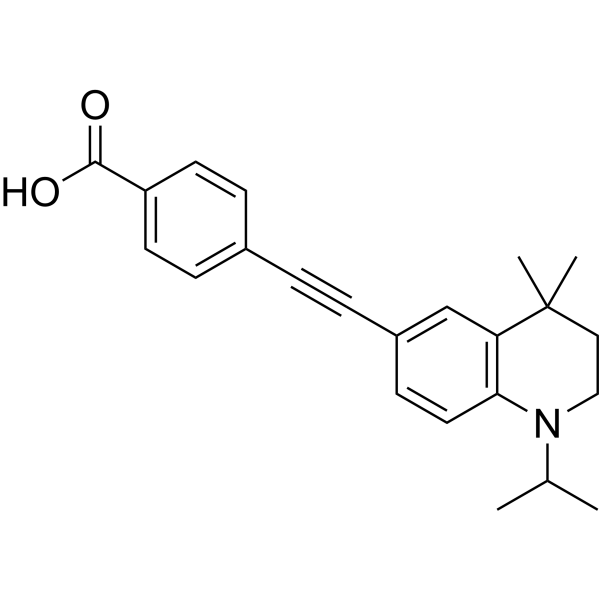
DC271 is a RAR agonist and synthetic retinoid that binds to the retinoid-binding site of cellular retinoic acid-binding protein II (CRBP-II). DC271 exhibits solvatochromic fluorescence properties: it produces intense blue-shifted emission in nonpolar environments and weak red-shifted emission in polar environments, and its severe fluorescence quenching in aqueous solutions can be reversed by embedding in the hydrophobic retinoid-binding protein pocket. DC271 enables direct detection of the binding between unlabeled compounds and related retinoid-binding proteins via fluorescence competition assays (Ex/Em = 355 nm/460 nm).
Nos produits utilisent uniquement pour la recherche. Nous ne vendons pas aux patients.
- Pureté : 97.7%
- CAS No.: 198696-03-6
- Formule: C23H25NO2
- Masse moléculaire:347.45
-
Stockage:
-20°C, protect from light
* In solvent : -80°C, 6 months; -20°C, 1 month (protect from light)

To place orders, for customer services and technical support, please contact: MedChemExpress USA
Tel: 609-228-6898 E-mail: [email protected] [email protected]


-
 Activité biologique
-
Chemical Information
- Pureté et documentation
- Références
-
 Help & FAQs




Activité biologique
Description
In Vitro
Guide (The following is our recommended solution. This solution is merely a guideline and should be modified according to your specific needs.)
DC271 Fluorescence Competition Binding Assay for CRABP-II Binding Experiment
1. Reagents and Solution Preparation
1.1 DC271 Stock Solution: Dissolve DC271 in anhydrous DMSO to prepare a 10 mM stock solution.
1.2 CRABP-II Protein: Recombinant expressed and purified human CRABP-II (or CRABP-I), dissolved in an appropriate buffer (such as 20 mM Tris-HCl, pH 7.4, 150 mM NaCl, 1 mM DTT), concentration determination (A280 or Bradford).
1.3 Detection buffer: Low fluorescence background buffer, recommended 20-50 mM Tris-HCl, pH 7.2-7.5, containing 50-150 mM NaCl.
1.4 Test compound (competitive ligand): Dissolved in DMSO, with the final DMSO concentration in the system ≤ 1% (typically ≤ 0.1%-0.5%).
1.5 Blank control: Equal volume of DMSO; Positive control can be ATRA (HY-14649) or EC23 (HY-12309).
2. 96-Well Plate Fluorescence Replacement (Competitive) Experiment
Suitable for qualitative initial screening or quantitative determination of IC50/Kd:
2.1 Add CRABP-II + DC271 complex
In a 96-well plate with black color, low adsorption and non-binding surface, add:
CRABP-II: final concentration 100 nM
DC271: final concentration slightly higher or equal (also commonly 100 nM - 200 nM, to ensure saturation binding)
Make up the volume with the detection buffer (usually final volume 100 - 200 μL/well), gently mix.
2.2 Formation of DC271-CRABP-II complex
Incubate at room temperature in the dark or at 4℃ for 10–30 minutes to allow the binding of DC271 and CRABP-II to reach equilibrium (the fluorescence signal reaches a plateau).
2.3 Adding Competitive Ligands (Test Compound)
Add the gradient-diluted test compound or a single concentration (for qualitative screening), mix well, and incubate in the dark for 15-30 minutes.
2.4 Fluorescence Detection
Using an enzyme detector for testing:
Excitation (Excitation): 355 nm (within the range of 340 - 410 nm)
Emission (Emission): 460 nm
Subtract the blank value of the buffer solution, and record the fluorescence intensity (FI) of each well.
2.5 Data Analysis.
MedChemExpress (MCE) has not independently confirmed the accuracy of these methods. They are for reference only.


Chemical Information
-
CAS No. 198696-03-6
-
Appearance Solid
-
Masse moléculaire 347.45
-
Formule C23H25NO2
-
Color Light yellow to yellow
-
SMILES
O=C(O)C1=CC=C(C#CC2=CC3=C(N(C(C)C)CCC3(C)C)C=C2)C=C1
-
Livraison
Room temperature in continental US; may vary elsewhere.
-
Stockage
-20°C, protect from light
* In solvent : -80°C, 6 months; -20°C, 1 month (protect from light)


Pureté et documentation
-
Fiche technique (272 KB)
-
SDS (252 KB)
- English - EN (252 KB)
- Français - FR (252 KB)
- Deutsch - DE (252 KB)
- Norwegian - NO (252 KB)
- Español - ES (252 KB)
- Swedish - SV (252 KB)
- Italian - IT (252 KB)
- Korean - KR (252 KB)
- Portuguese - PT (252 KB)
-
Instruction de manipulation (2659 KB)
Références

Calculators
Concentration (start) × Volume (start) = Concentration (final) × Volume (final)


DC271 Related Classifications
HY-D1190 Related Classifications
 Powered by Bioz