
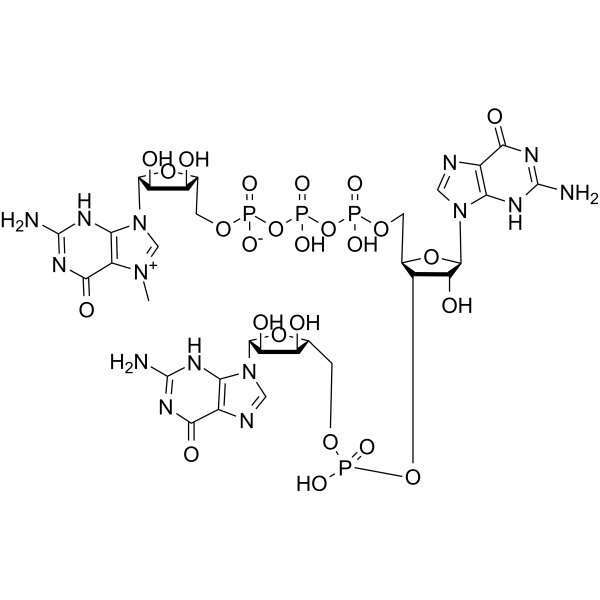
m7GpppGpG
m7GpppGpG is an unmodified trinucleotide cap analog with enhancer activity. When incorporated into mRNA, it effectively enhances translational efficiency, stability, and protein expression levels of the mRNA. m7GpppGpG can serve as a standard cap analog for in vitro mRNA synthesis to support antigen generation and presentation by dendritic cells, although its expression efficiency in dendritic cells is 20-fold lower than that of the m7GpppApG cap.
Para uso exclusivo en investigación. No vendemos a pacientes.
- No. CAS: 133608-76-1
- Fòrmula: C31H41N15O25P4
- Peso molecular:1147.64
-
Almacenamiento:
Please store the product under the recommended conditions in the Certificate of Analysis.
Ver todos los productos específicos de isoformas DNA/RNA Synthesis
More
Actividad biológica
Descripciòn
In Vitro
m7GpppGpG (10 mM; 2 total hours at 37°C) generates the functional m7GpppGpG cap structure alongside non-functional reversed-capped molecules during in vitro mRNA synthesis, with overall capping efficiency of ~90% under typical conditions[1].
mRNA capped with m7GpppGpG exhibits 20-fold lower translation efficiency in JAWSII murine dendritic cells relative to mRNA capped with m7GpppApG, independent of eIF4E affinity and decapping enzyme resistance[2].
MedChemExpress (MCE) has not independently confirmed the accuracy of these methods. They are for reference only. Further protocols information, click here.
Chemical Information
-
No. CAS 133608-76-1
-
Peso molecular 1147.64
-
Fòrmula C31H41N15O25P4
-
SMILES
O=P(O)(OC[C@@H]1[C@@H](OP(O)(OC[C@H]2O[C@@H](N3C(NC(N)=NC4=O)=C4N=C3)[C@H](O)[C@@H]2O)=O)[C@@H](O)[C@H](N5C(NC(N)=NC6=O)=C6N=C5)O1)OP(OP(OC[C@H]7O[C@@H](N8C(NC(N)=N9)=C([N+](C)=C8)C9=O)[C@H](O)[C@@H]7O)([O-])=O)(O)=O
-
Envío
Room temperature in continental US; may vary elsewhere.
-
Almacenamiento
Please store the product under the recommended conditions in the Certificate of Analysis.
Protocolo
-
RNA extraction experimental
By lysing cells, releasing RNA, and removing impurities such as proteins and DNA, high-purity RNA products are finally obtained. The commonly used traditional method is the guanidine isothiocyanate/phenol/chloroform method (Trizol), which is suitable for a variety of animal materials including animal tissues, microorganisms, cultured cells, etc., and most plant materials.
-
Western Blot
Western blotting (WB) is a commonly used experimental method in molecular biology, biochemistry, and immunogenetics for identifying and quantifying target proteins. It combines gel electrophoresis with immunoassay, enabling researchers to analyze protein expression, post-translational modifications, and molecular weight.
-
Monocyte-derived dendritic cell differentiation
Human monocyte-derived dendritic cells are generated by isolating PBMC-derived monocytes and culturing them with GM-CSF plus IL-4, which produces cells with dendritic-cell antigen-presenting properties, reduced monocyte phenotype, and increased dendritic-cell functional readouts such as antigen uptake, allogeneic T-cell stimulation, and expression of markers including HLA-DR, CD80, CD86, CD83, CD1a, or CD209 depending on protocol and maturation state. The main readout is phenotypic and functional differentiation: immature MoDCs are commonly evaluated by loss or reduction of CD14 with acquisition of dendritic-cell markers and antigen uptake capacity, whereas mature MoDCs are evaluated by increased CD83, CD80, CD86, HLA-DR, and T-cell stimulatory function after exposure to maturation stimuli such as TNF-α or a cytokine/PGE2 cocktail.
-
Protocol For Protein Expression And Purification
Recombinant protein expression in Escherichia coli followed by purification of a His-tagged soluble protein by immobilized metal affinity chromatography (IMAC), with optional MBP fusion and TEV tag removal when the construct includes these elements. The biological readout is production of the encoded target protein, detected as an inducible band at the expected molecular mass by SDS-PAGE and quantified by total protein assay or chromatographic absorbance; the purification readout is enrichment of the target protein in elution fractions after selective binding of polyhistidine residues to immobilized Ni2+/metal-chelate resin and elution by imidazole-containing buffer. Expression is driven by an inducible bacterial expression system, commonly T7/lac-based, in which IPTG or lactose/auto-induction activates transcription and translation of the cloned gene; lower induction temperature, lower inducer concentration, induction timing, and solubility-enhancing fusion tags can influence the frac
Pureza y Documentación
Referencias
[1]. Grudzien-Nogalska E, et al. Synthetic mRNAs with superior translation and stability properties. Methods in molecular biology (Clifton, N.J.). 2013;969:55-72. [Content Brief]
[2]. Uchida S, et al. Nanomedicine-Based Approaches for mRNA Delivery. Molecular pharmaceutics. 2020 Oct 05;17(10):3654-3684. [Content Brief]
Calculators
Concentration (start) × Volume (start) = Concentration (final) × Volume (final)

