



Fenticonazole
Based on 4 publication(s) in Google Scholar
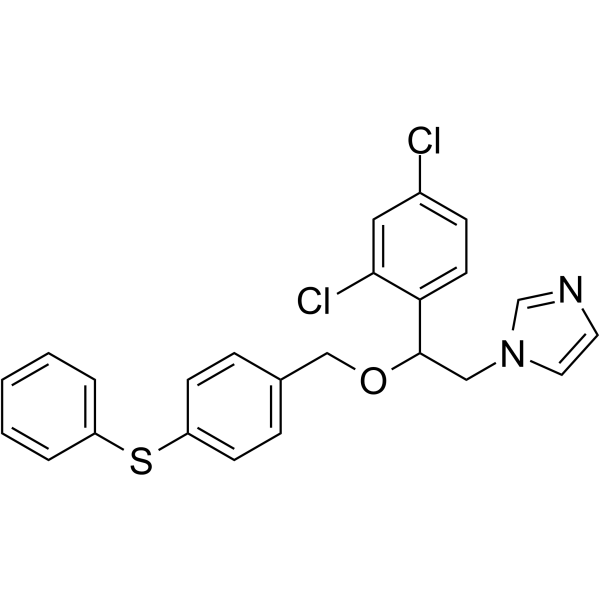
Fenticonazole is an imidazole derivative with antibacterial and antifungal activity. Fenticonazole has the potential for the research of mixed vaginitis.
Nur für Forschungszwecke. Wir verkaufen nicht an Patienten.
- CAS. Nr.: 72479-26-6
- Formel: C24H20Cl2N2OS
- Molecular Weight:455.40
-
Speicherung:
Please store the product under the recommended conditions in the Certificate of Analysis.

To place orders, for customer services and technical support, please contact: MedChemExpress USA
Tel: 609-228-6898 E-mail: [email protected] [email protected]


-
 Biologische Aktivität
-
Chemical Information
- Protokoll
- Reinheit & Dokumentation
- Verweise
-
 Help & FAQs


Publications Citing Use of MedChemExpress (MCE) Fenticonazole
More

Biologische Aktivität
Beschreibung


Chemical Information
-
CAS. Nr. 72479-26-6
-
Molecular Weight 455.40
-
Formel C24H20Cl2N2OS
-
SMILES
ClC1=CC=C(C(Cl)=C1)C(OCC2=CC=C(SC=3C=CC=CC3)C=C2)CN4C=NC=C4
-
Versand
Room temperature in continental US; may vary elsewhere.
-
Speicherung
Please store the product under the recommended conditions in the Certificate of Analysis.


Publications (4)
-
Journal Impact Factor
-
Most Recent
-
Pharmacol Res
Identification of the anti-fungal drug fenticonazole nitrate as a novel PPARγ-modulating ligand with good therapeutic index: Structure-based screening and biological validation. [Abstract]2021 Nov:173:105860. PMID: 34461220 -
Molecules
Identification of Novel PPARγ Partial Agonists Based on Virtual Screening Strategy: In Silico and In Vitro Experimental Validation. [Abstract]2024 Oct 15;29(20):4881. PMID: 39459249 -
Bioorg Chem
Structure-based screening and biological validation of the anti-thrombotic drug-dicoumarol as a novel and potent PPARγ-modulating ligand. [Abstract]2022 Dec:129:106191. PMID: 36270169 -
BMC Cancer
Single-cell transcriptional signature-based drug repurposing and in vitro evaluation in colorectal cancer. [Abstract]2024 Mar 25;24(1):371. PMID: 38528462


Reinheit & Dokumentation
Verweise
[1]. Tumietto F, et al. Looking for appropriateness in the cure of mixed vaginitis: the role of fenticonazole as an empiric treatment. Future Microbiol. 2019;14:1349-1355. [Content Brief]
[2]. Veronese M, et al. Fenticonazole, a new imidazole derivative with antibacterial and antifungal activity. In vitro study. Arzneimittelforschung. 1981;31(12):2133-2137. [Content Brief]

Calculators
Konzentration (Stammlösung) × Volumen (Stammlösung) = Konzentration (Ziellösung) × Volumen (Ziellösung)


Fenticonazole Related Classifications
HY-W115276 Related Classifications
 Powered by Bioz