



NVS-SM2

Based on 1 Customer Validation
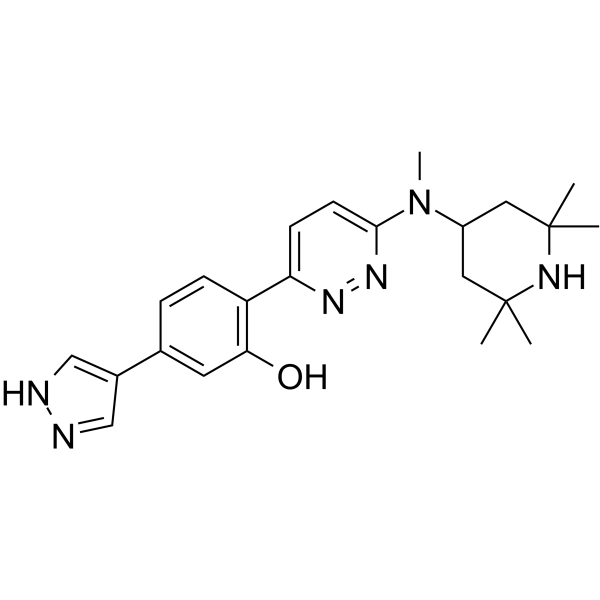
NVS-SM2 is a potent, orally active and brain-penetrant SMN2 splicing enhancer with an EC50 of 2 nM for SMN. NVS-SM2 enhances U1-pre-mRNA association. NVS-SM2 promotes exon 7 inclusion and restores normal survival motor neuron (SMN) protein expression. NVS-SM2 can be used for spinal muscular atrophy (SMA) research.
For research use only. We do not sell to patients.
- Purity : 99.15%
- CAS No.: 1562333-92-9
- Formula: C23H30N6O
- Molecular Weight:406.52
-
Storage:Powder -20°C, 3 years ; In solvent -80°C, 6 months , -20°C, 1 month

To place orders, for customer services and technical support, please contact: MedChemExpress USA
Tel: 609-228-6898 E-mail: [email protected] [email protected]


-
 Biological Activity
-
Chemical Information
-
Solvent & Solubility
- Protocols
- Purity & Documentation
- References
-
 Help & FAQs


All DNA/RNA Synthesis Isoforms
More

Biological Activity
Description
IC50 & Target
EC50: 5 nM (SMN)[1]
In Vitro
For NVS-SM2, the molecular mechanism of action is via stabilization of the transient double-strand RNA structure formed by the SMN2 pre-mRNA and U1 small nuclear ribonucleic protein (snRNP) complex. The binding affinity of U1 snRNP to the 5' splice site is increased in a sequence-selective manner, discrete from constitutive recognition[1].
MedChemExpress (MCE) has not independently confirmed the accuracy of these methods. They are for reference only. Further protocols information, click here.
In Vivo
Pharmacokinetic analysis demonstrate that NVS-SM2 is readily available in the brain after IV and oral (PO) administration in mouse and rat with Tmax of 3 h after PO with 3 mg/kg in mice, and NVS-SM2 treatment induces a 1.5-fold increase in SMN protein levels in the mouse brain[1].
MedChemExpress (MCE) has not independently confirmed the accuracy of these methods. They are for reference only.
-
Animal Model:Severe SMA mice[2]
-
Dosage:0.1 mg/kg and 1 mg/kg
-
Administration:Subcutaneous injection; daily from day 2 to day 15, followed by every other day until day 30
-
Result:Extended survival in a severe SMA mouse model.


Chemical Information
-
CAS No. 1562333-92-9
-
Appearance Solid
-
Molecular Weight 406.52
-
Formula C23H30N6O
-
Color Off-white to light yellow
-
SMILES
OC1=C(C(N=N2)=CC=C2N(C(CC3(C)C)CC(C)(N3)C)C)C=CC(C4=CNN=C4)=C1
-
Shipping
Room temperature in continental US; may vary elsewhere.
-
Storage
Powder -20°C 3 years In solvent -80°C 6 months -20°C 1 month


Solvent & Solubility
In Vitro:
DMSO : 75 mg/mL (184.49 mM; Need ultrasonic; Hygroscopic DMSO has a significant impact on the solubility of product, please use newly opened DMSO)
Please refer to the solubility information to select the appropriate solvent. Once prepared, please aliquot and store the solution to prevent product inactivation from repeated freeze-thaw cycles.
Storage method and period of stock solution: -80°C, 6 months; -20°C, 1 month. When stored at -80°C, please use it within 6 months. When stored at -20°C, please use it within 1 month.
Please refer to the solubility information to select the appropriate solvent. Once prepared, please aliquot and store the solution to prevent product inactivation from repeated freeze-thaw cycles.
Storage method and period of stock solution: -80°C, 6 months; -20°C, 1 month. When stored at -80°C, please use it within 6 months. When stored at -20°C, please use it within 1 month.
Concentration (start) × Volume (start) = Concentration (final) × Volume (final)

Protocols
-
RNA extraction experimental
By lysing cells, releasing RNA, and removing impurities such as proteins and DNA, high-purity RNA products are finally obtained. The commonly used traditional method is the guanidine isothiocyanate/phenol/chloroform method (Trizol), which is suitable for a variety of animal materials including animal tissues, microorganisms, cultured cells, etc., and most plant materials.
-
Western Blot
Western blotting (WB) is a commonly used experimental method in molecular biology, biochemistry, and immunogenetics for identifying and quantifying target proteins. It combines gel electrophoresis with immunoassay, enabling researchers to analyze protein expression, post-translational modifications, and molecular weight.
-
Protocol For Protein Expression And Purification
Recombinant protein expression in Escherichia coli followed by purification of a His-tagged soluble protein by immobilized metal affinity chromatography (IMAC), with optional MBP fusion and TEV tag removal when the construct includes these elements. The biological readout is production of the encoded target protein, detected as an inducible band at the expected molecular mass by SDS-PAGE and quantified by total protein assay or chromatographic absorbance; the purification readout is enrichment of the target protein in elution fractions after selective binding of polyhistidine residues to immobilized Ni2+/metal-chelate resin and elution by imidazole-containing buffer. Expression is driven by an inducible bacterial expression system, commonly T7/lac-based, in which IPTG or lactose/auto-induction activates transcription and translation of the cloned gene; lower induction temperature, lower inducer concentration, induction timing, and solubility-enhancing fusion tags can influence the frac


Purity & Documentation
-
Data Sheet (272 KB)
-
SDS (251 KB)
- English - EN (251 KB)
- Français - FR (251 KB)
- Deutsch - DE (251 KB)
- Norwegian - NO (251 KB)
- Español - ES (251 KB)
- Swedish - SV (251 KB)
- Italian - IT (251 KB)
- Korean - KR (251 KB)
- Portuguese - PT (251 KB)
-
Handling Instructions (2659 KB)
References
[1]. James Palacino, et al. SMN2 splice modulators enhance U1-pre-mRNA association and rescue SMA mice. Nat Chem Biol. 2015 Jul;11(7):511-7. [Content Brief]
[2]. Anne Rietz, et al. Short-duration splice promoting compound enables a tunable mouse model of spinal muscular atrophy. Life Sci Alliance. 2020 Nov 24;4(1):e202000889. [Content Brief]


Complete Stock Solution Preparation Table
Please refer to the solubility information to select the appropriate solvent. Once prepared, please aliquot and store the solution to prevent product inactivation from repeated freeze-thaw cycles.
Storage method and period of stock solution: -80°C, 6 months; -20°C, 1 month. When stored at -80°C, please use it within 6 months. When stored at -20°C, please use it within 1 month.
| Optional Solvent | Concentration Solvent Mass | 1 mg | 5 mg | 10 mg | 25 mg |
|---|---|---|---|---|---|
| DMSO | 1 mM | 2.4599 mL | 12.2995 mL | 24.5990 mL | 61.4976 mL |
| 5 mM | 0.4920 mL | 2.4599 mL | 4.9198 mL | 12.2995 mL | |
| 10 mM | 0.2460 mL | 1.2300 mL | 2.4599 mL | 6.1498 mL | |
| 15 mM | 0.1640 mL | 0.8200 mL | 1.6399 mL | 4.0998 mL | |
| 20 mM | 0.1230 mL | 0.6150 mL | 1.2300 mL | 3.0749 mL | |
| 25 mM | 0.0984 mL | 0.4920 mL | 0.9840 mL | 2.4599 mL | |
| 30 mM | 0.0820 mL | 0.4100 mL | 0.8200 mL | 2.0499 mL | |
| 40 mM | 0.0615 mL | 0.3075 mL | 0.6150 mL | 1.5374 mL | |
| 50 mM | 0.0492 mL | 0.2460 mL | 0.4920 mL | 1.2300 mL | |
| 60 mM | 0.0410 mL | 0.2050 mL | 0.4100 mL | 1.0250 mL | |
| 80 mM | 0.0307 mL | 0.1537 mL | 0.3075 mL | 0.7687 mL | |
| 100 mM | 0.0246 mL | 0.1230 mL | 0.2460 mL | 0.6150 mL |


NVS-SM2 Related Classifications
HY-111520 Related Classifications
 Powered by Bioz