



FAICAR

Based on 1 Customer Validation
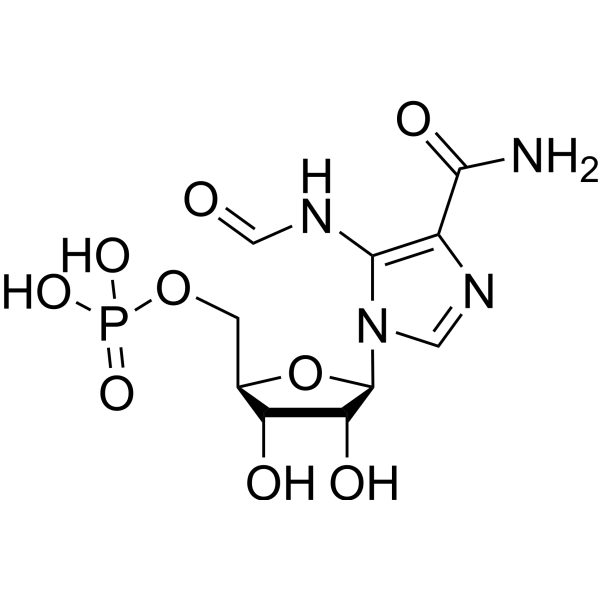
FAICAR (5-Formamidoimidazole-4-carboxamide ribotide) is a purine nucleotide and the IMP cyclohydrolase substrate of Cryptococcus neoformans ATIC. It is a key intermediate in the de novo purine synthesis pathway. FAICAR can be used in studies related to Cryptococcus neoformans infection.
Para uso exclusivo en investigación. No vendemos a pacientes.
- Pureza : 85.0%
- No. CAS: 13018-54-7
- Fòrmula: C10H15N4O9P
- Peso molecular:366.22
-
Almacenamiento:
-20°C, stored under nitrogen
* In solvent : -80°C, 6 months; -20°C, 1 month (stored under nitrogen)

To place orders, for customer services and technical support, please contact: MedChemExpress USA
Tel: 609-228-6898 E-mail: [email protected] [email protected]


-
 Actividad biológica
-
Chemical Information
- Protocolo
- Pureza y Documentación
- Referencias
-
 Help & FAQs


Ver todos los productos específicos de isoformas DNA/RNA Synthesis
More

Actividad biológica
Descripciòn
In Vitro
FAICAR (0.005-0.3 mM) was used as substrate at 37°C, and recombinantly expressed C. neoformans ATIC exhibits IMP cyclohydrolase activity with a Km_app of 30 μM, Vmax of 8.6 U/mg, and kcat of 7.7 s−1[1].
FAICAR (0.1-4 μM) acts as a substrate for human AICAR transformylase-IMP cyclohydrolase's IMP cyclohydrolase domain, with a Ks of 0.87 μM at pH 7.4, and supports an IMP cyclohydrolase specific activity of 29.5 nmol IMP formed/min/μg protein at a concentration of 4 μM[2].
MedChemExpress (MCE) has not independently confirmed the accuracy of these methods. They are for reference only.


Chemical Information
-
No. CAS 13018-54-7
-
Appearance Solid
-
Peso molecular 366.22
-
Fòrmula C10H15N4O9P
-
Color Dark purple to black
-
SMILES
O=C(C1=C(NC=O)N([C@@H]2O[C@H](COP(O)(O)=O)[C@@H](O)[C@H]2O)C=N1)N
-
Synonyms
5-Formamidoimidazole-4-carboxamide ribotide
-
Structure Classification
-
Initial Source
Methanocaldococcus jannaschii
-
Envío
Room temperature in continental US; may vary elsewhere.
-
Almacenamiento
-20°C, stored under nitrogen
* In solvent : -80°C, 6 months; -20°C, 1 month (stored under nitrogen)


Pureza y Documentación
-
Ficha de datos (307 KB)
-
SDS (252 KB)
- English - EN (252 KB)
- Français - FR (252 KB)
- Deutsch - DE (252 KB)
- Norwegian - NO (252 KB)
- Español - ES (252 KB)
- Swedish - SV (252 KB)
- Italian - IT (252 KB)
- Korean - KR (252 KB)
- Portuguese - PT (252 KB)
-
Instrucciones de manejo (2659 KB)
Referencias
[1]. Wizrah MSI, et al. AICAR transformylase/IMP cyclohydrolase (ATIC) is essential for de novo purine biosynthesis and infection by Cryptococcus neoformans. J Biol Chem. 2022;298(10):102453. [Content Brief]
[2]. Szabados E, et al. Radioassay of bifunctional 5-aminoimidazole-4-carboxamide ribotide transformylase-IMP cyclohydrolase by thin-layer chromatography. Anal Biochem. 1994;221(2):401-404. [Content Brief]
[3]. Vergis JM, et al. Catalytic mechanism of the cyclohydrolase activity of human aminoimidazole carboxamide ribonucleotide formyltransferase/inosine monophosphate cyclohydrolase. Biochemistry. 2004;43(5):1184-1192. [Content Brief]

Calculators
Concentration (start) × Volume (start) = Concentration (final) × Volume (final)


FAICAR Related Classifications
HY-133157 Related Classifications
 Powered by Bioz