



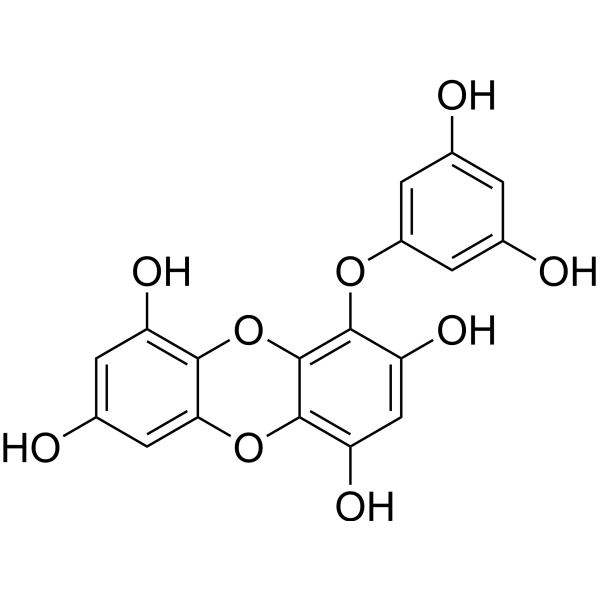
Eckol

Based on 1 Customer Validation
Eckol is a potent hMAO-A (Mixed) and hMAO-B (non-competitive) inhibitor with IC50s of 7.20 and 83.44 μM, respectively. Eckol shows stimulatory effects in maize and can be used as a plant biostimulant. Eckol also shows antiallergic and antiviral effects.
商品は「研究用試薬」です。人や動物の医療用・臨床診断用・食品用の製品ではありません。
研究用途以外に使用した場合、当社は一切の責任を負いかねます。
- 純度 : 98.95%
- CAS 番号: 88798-74-7
- 分子式: C18H12O9
- 分子量:372.28
-
保管条件:
-20°C, sealed storage, away from moisture and light
* In solvent : -80°C, 6 months; -20°C, 1 month (sealed storage, away from moisture and light)

To place orders, for customer services and technical support, please contact: MedChemExpress USA
Tel: 609-228-6898 E-mail: [email protected] [email protected]


-
 生物活性
生物活性
-
化学情報
- プロトコル
- 純度とドキュメンテーション
- 参考文献
-
 Help & FAQs




生物活性
製品説明
|
hMAO-A 7.20 μM (IC50) |
hMAO-B 83.44 μM (IC50) |
H1N1 89.5 μM (IC50) |
Cellular Effect
|
Cell Line

|
Type | Value | Description | References |
|---|---|---|---|---|
| Vero | CC50 |
>200 μM
Compound: 3
|
Cytotoxicity against african green monkey Vero cells assessed as cell death by MTT assay
Cytotoxicity against african green monkey Vero cells assessed as cell death by MTT assay
|
[PMID: 23647823] |
体外実験
Pretreatment with Eckol (25-100 μg/mL; 2 h) significantly reduces β-hexosaminidase release in IgE/BSA-stimulated BMCMC in a dose-dependent manner[3].
Eckol (25-100 μg/mL; 1 h) inhibits the production of Th2-type cytokines, such as IL-4, IL-5, and IL-13 as well as proinflammatory cytokines, such as IL-6[3].
Eckol (25-100 μg/mL) attenuates cytokine mRNA levels such as IL-1β, IL-4, IL-5, IL-6, IL-13, IFN-γ, and TNF-α in IgE/BSA-stimulated BMCMC[3].
Eckol (25-100 μg/mL; 1 h) inhibits NF-κB activation in IgE/BSA-stimulated BMCMC[3].
Eckol showes a moderate IC50 value (89.5 µM) against the influenza A/Bervig-Mission/1/18 (H1N1) virus[4].
MedChemExpress (MCE) has not independently confirmed the accuracy of these methods. They are for reference only.
-
Cell Line:Bone marrow-derived cultured mast cells (BMCMC)
-
Concentration:25, 50 and 100 μg/mL
-
Incubation Time:1 h
-
Result:Inhibited the degradation of IκB-α within the cytosol and the translocation of the NF-κB/p65 subunit into the nucleus that were induced by IgE/BSA.
体内実験
Eckol (50 or 100 μg/mouse; intradermal; once) reduces allergic inflammatory responses in the passive cutaneous anaphylaxis (PCA)-induced mice[3].
MedChemExpress (MCE) has not independently confirmed the accuracy of these methods. They are for reference only.
-
Animal Model:BALB/c mice (8 weeks old), IgE/BSA-induced passive cutaneous anaphylaxis (PCA) model[3]
-
Dosage:50 or 100 μg/mouse
-
Administration:Intradermal injection, applied on mice ear 2 h prior to anaphylaxis induction
-
Result:Reduced allergic inflammatory responses.


化学情報
-
CAS 番号 88798-74-7
-
性状 Solid
-
分子量 372.28
-
分子式 C18H12O9
-
Color White to off-white
-
SMILES
OC1=C2C(OC3=C(O)C=C(O)C=C3O2)=C(OC4=CC(O)=CC(O)=C4)C(O)=C1
-
別名
BE003
-
Structure Classification
-
Initial Source
-
輸送条件
Room temperature in continental US; may vary elsewhere.
-
保管条件
-20°C, sealed storage, away from moisture and light
* In solvent : -80°C, 6 months; -20°C, 1 month (sealed storage, away from moisture and light)


純度とドキュメンテーション
-
データシート (277 KB)
-
SDS (251 KB)
- English - EN (251 KB)
- Français - FR (251 KB)
- Deutsch - DE (251 KB)
- Norwegian - NO (251 KB)
- Español - ES (251 KB)
- Swedish - SV (251 KB)
- Italian - IT (251 KB)
- Korean - KR (251 KB)
- Portuguese - PT (251 KB)
-
取扱説明書 (2659 KB)
参考文献
[1]. Jung HA, et al. Evaluation of the inhibitory effects of eckol and dieckol isolated from edible brown alga Eisenia bicyclis on human monoamine oxidases A and B. Arch Pharm Res. 2017 Apr;40(4):480-491. [Content Brief]
[2]. Rengasamy KR, et al. Enhancing growth, phytochemical constituents and aphid resistance capacity in cabbage with foliar application of eckol--a biologically active phenolic molecule from brown seaweed. N Biotechnol. 2016 Mar 25;33(2):273-9. [Content Brief]
[3]. Han EJ, et al. Eckol from Ecklonia cava Suppresses Immunoglobulin E-mediated Mast Cell Activation and Passive Cutaneous Anaphylaxis in Mice. Nutrients. 2020 May 9;12(5):1361. [Content Brief]
[4]. Besednova NN, et al. Antiviral Effects of Polyphenols from Marine Algae. Biomedicines. 2021 Feb 17;9(2):200. [Content Brief]

Calculators
濃度 (開始) × 体積 (開始) = 濃度 (終了) × 体積 (終了)


Eckol 関連分類
HY-114203 関連分類
 Powered by Bioz