



Kamebakaurin
Based on 1 publication(s) in Google Scholar
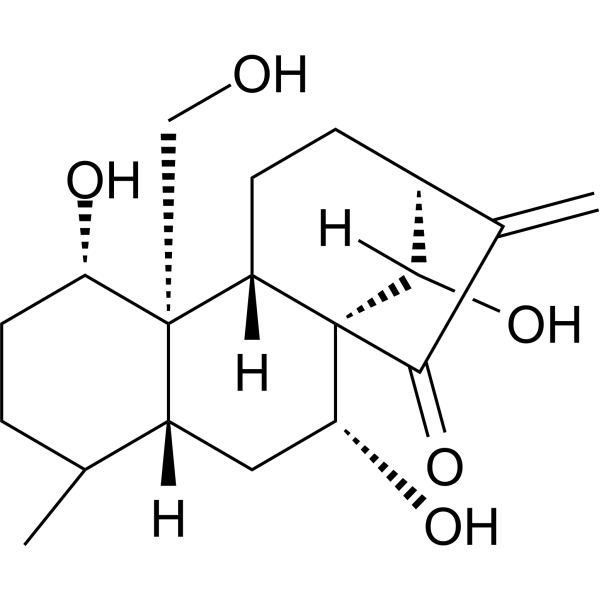
Kamebakaurin is an orally active diterpenoid compound that can be isolated from Isodon excia (Maxin.). Kamebakaurin can inhibit NF-κB activation by directly targeting the DNA-binding activity of p50. Kamebakaurin can induce apoptosis and cell cycle arrest in tumor cells. Kamebakaurin has anti-inflammatory and anti-tumor activities.
For research use only. We do not sell to patients.
- Purity : 99.64%
- CAS No.: 73981-34-7
- Formula: C20H30O5
- Molecular Weight:350.45
-
Storage:
4°C, protect from light
* In solvent : -80°C, 6 months; -20°C, 1 month (protect from light)

To place orders, for customer services and technical support, please contact: MedChemExpress USA
Tel: 609-228-6898 E-mail: [email protected] [email protected]


-
 Biological Activity
-
Chemical Information
-
Solvent & Solubility
- Protocols
- Purity & Documentation
- References
-
 Help & FAQs



Publications Citing Use of MedChemExpress (MCE) Kamebakaurin
MoreAll Caspase Isoforms
More

Biological Activity
Description
Cellular Effect
|
Cell Line

|
Type | Value | Description | References |
|---|---|---|---|---|
| P388 | IC50 |
0.82 μg/mL
Compound: 8
|
Cytotoxicity against mouse P388 cells
Cytotoxicity against mouse P388 cells
|
[PMID: 15043413] |
In Vitro
Kamebakaurin (0-10 μg/mL; 8.5 h) can inhibit the expression of NF-κB reporter genes and DNA-binding activities induced by TNF-α, Phorbol 12-myristate 13-acetate (HY-18739), and LPS (HY-D1056) in a dose-dependent manner in various cells such as Jurkat and THP-1[1].
Kamebakaurin (0-10 μg/mL; 3.5-48 h) can inhibit the expression of TNF-α-induced NF-κB target genes and induce apoptosis, significantly enhancing caspase-8 activity in MCF-7 cells[1].
Kamebakaurin (0-30 μM; 12 h) can significantly inhibit the accumulation of hypoxia-induced HIF-1α protein in the cell nucleus of HCT116 cells, as well as inhibit the expression of HIF-1α target genes VEGF and EPO, and can induce cell cycle arrest[2].
MedChemExpress (MCE) has not independently confirmed the accuracy of these methods. They are for reference only.
-
Cell Line:HCT116 cells were cultured under hypoxia conditions
-
Concentration:30 μM
-
Incubation Time:12 h
-
Result:Decreased the staining of HIF-1α in the cell nucleus.
-
Cell Line:HCT116 cells were cultured under hypoxia conditions
-
Concentration:0, 3, 10 and 30 μM
-
Incubation Time:12 h
-
Result:Inhibited the VEGF and GLUT-1 protein level.
Inhibited the cyclin D1 and c-Myc protein level.
In Vivo
Kamebakaurin (100 mg/kg; oral administration; 7 days) can inhibit Acetaminophen (APAP) (HY-66005)-induced hepatotoxicity when used for pretreatment in C57BL/6J mice[3].
MedChemExpress (MCE) has not independently confirmed the accuracy of these methods. They are for reference only.
-
Animal Model:Crj:BALB/c nu/nu female athymic nude mice aged six weeks old treated HCT116 cells[2]
-
Dosage:15 and 50 mg/kg
-
Administration:Oral administration; every other day for 40 days
-
Result:Significantly inhibited the growth of HCT116 cells in the xenograft tumor model at a dose of 50 mg/kg.
Significantly decreased the protein levels of HIF-1α in the tumors, while having no significant effect on Topo-I levels
Significantly decreased the serum VEGF levels in a dose-dependent manner.
-
Animal Model:Female C57BL/6J mice aged 6 weeks old treated APAP(HY-66005)[2]
-
Dosage:100 mg/kg
-
Administration:Oral administration; 7 days
-
Result:Significantly reduced the increases in plasma levels of hepatic injury markers (ALT and AST) induced by APAP.
Eliminated the APAP-induced upregulation of hepatic MDA levels and significantly decreased the GSH depletion caused by APAP.
Attenuated the APAP-induced increase in hepatic and plasma TNFα levels, and there was a tendency for a decrease in IL-6 mRNA levels.
Showed antioxidant capacity, with its total antioxidant power increasing in a dose-dependent manner, although its radical scavenging activity was relatively small
Did not significantly change the expression of hepatic CYP2e1 and CYP1a2 mRNA.


Chemical Information
-
CAS No. 73981-34-7
-
Appearance Solid
-
Molecular Weight 350.45
-
Formula C20H30O5
-
Color White to off-white
-
SMILES
O[C@H]1[C@@]23[C@](CC[C@@]1([H])C(C3=O)=C)([H])[C@]4([C@](C(C)(CC[C@@H]4O)C)([H])C[C@H]2O)CO
-
Structure Classification
-
Shipping
Room temperature in continental US; may vary elsewhere.
-
Storage
4°C, protect from light
* In solvent : -80°C, 6 months; -20°C, 1 month (protect from light)


Publications (1)
-
Journal Impact Factor
-
Most Recent
-
iScience
2024 Jun 26;27(7):110388. PMID: 39092178


Solvent & Solubility
In Vitro:
DMSO : 100 mg/mL (285.35 mM; Need ultrasonic; Hygroscopic DMSO has a significant impact on the solubility of product, please use newly opened DMSO)
Please refer to the solubility information to select the appropriate solvent. Once prepared, please aliquot and store the solution to prevent product inactivation from repeated freeze-thaw cycles.
Storage method and period of stock solution: -80°C, 6 months; -20°C, 1 month (protect from light). When stored at -80°C, please use it within 6 months. When stored at -20°C, please use it within 1 month.
Please refer to the solubility information to select the appropriate solvent. Once prepared, please aliquot and store the solution to prevent product inactivation from repeated freeze-thaw cycles.
Storage method and period of stock solution: -80°C, 6 months; -20°C, 1 month (protect from light). When stored at -80°C, please use it within 6 months. When stored at -20°C, please use it within 1 month.
Concentration (start) × Volume (start) = Concentration (final) × Volume (final)
In Vivo:
Select the appropriate dissolution method based on your experimental animal and administration route.
- For the following dissolution methods, please ensure to first prepare a clear stock solution using an In Vitro approach and then sequentially add co-solvents:
- To ensure reliable experimental results, the clarified stock solution can be appropriately stored based on storage conditions. As for the working solution for In Vivo experiments, it is recommended to prepare freshly and use it on the same day.
- The percentages shown for the solvents indicate their volumetric ratio in the final prepared solution. If precipitation or phase separation occurs during preparation, heat and/or sonication can be used to aid dissolution.
Add each solvent one by one: 10% DMSO 40% PEG300 5% Tween-80 45% Saline
Solubility: ≥ 2.5 mg/mL (7.13 mM); Clear solution
This protocol yields a clear solution of ≥ 2.5 mg/mL (saturation unknown).
Taking 1 mL working solution as an example, add 100 μL DMSO stock solution (25.0 mg/mL) to 400 μL PEG300, and mix evenly; then add 50 μL Tween-80 and mix evenly; then add 450 μL Saline to adjust the volume to 1 mL.
Preparation of Saline: Dissolve 0.9 g sodium chloride in ddH₂O and dilute to 100 mL to obtain a clear Saline solution.
Add each solvent one by one: 10% DMSO 90% (20% SBE-β-CD in Saline)
Solubility: ≥ 2.5 mg/mL (7.13 mM); Clear solution
This protocol yields a clear solution of ≥ 2.5 mg/mL (saturation unknown).
Taking 1 mL working solution as an example, add 100 μL DMSO stock solution (25.0 mg/mL) to 900 μL 20% SBE-β-CD in Saline, and mix evenly.
Preparation of 20% SBE-β-CD in Saline (4°C, storage for one week): 2 g SBE-β-CD powder is dissolved in 10 mL Saline, completely dissolve until clear.
In Vivo Dissolution Calculator
Please enter the basic information of animal experiments:
-
-
-
-
Recommended: Prepare an additional quantity of animals to account for potential losses during experiments.
Please enter your animal formula composition:
-
%DMSO +
Recommended: Keep the proportion of DMSO in working solution below 2% if your animal is weak.
-
%+
-
+%Tween-80 + +
-
%Saline +
The co-solvents required include: DMSO, . All of co-solvents are available by MedChemExpress (MCE). , Tween 80. All of co-solvents are available by MedChemExpress (MCE).
Working solution concentration: 0.22 mg/mL
Method for preparing stock solution: mg drug dissolved in μL DMSO. Stock solution concentration: mg/mL. * In solvent : -80°C, 6 months; -20°C, 1 month (protect from light)
1. Take μL DMSO stock solution;
2. Add μL .
μL , mix evenly;
3. Then add μL Tween 80, mix evenly;
4. Then add μL
Please ensure that the stock solution in the first step is dissolved to a clear state, and add co-solvents in sequence. You can use ultrasonic heating (ultrasonic cleaner, recommended frequency 20-40 kHz), vortexing, etc. to assist dissolution.


Purity & Documentation
-
Data Sheet (294 KB)
-
SDS (252 KB)
- English - EN (252 KB)
- Français - FR (252 KB)
- Deutsch - DE (252 KB)
- Norwegian - NO (252 KB)
- Español - ES (252 KB)
- Swedish - SV (252 KB)
- Italian - IT (252 KB)
- Korean - KR (252 KB)
- Portuguese - PT (252 KB)
-
Handling Instructions (2659 KB)
References
[1]. Lee JH, et al. Kaurane diterpene, kamebakaurin, inhibits NF-kappa B by directly targeting the DNA-binding activity of p50 and blocks the expression of antiapoptotic NF-kappa B target genes. J Biol Chem. 2002 May 24;277(21):18411-20. [Content Brief]
[2]. Wang KS, et al. Kamebakaurin inhibits the expression of hypoxia-inducible factor-1α and its target genes to confer antitumor activity. Oncol Rep. 2016 Apr;35(4):2045-52. [Content Brief]
[3]. Yoshioka H, et al. Suppressive effect of kamebakaurin on acetaminophen-induced hepatotoxicity by inhibiting lipid peroxidation and inflammatory response in mice. Pharmacol Rep. 2017 Oct;69(5):903-907. [Content Brief]


Complete Stock Solution Preparation Table
Please refer to the solubility information to select the appropriate solvent. Once prepared, please aliquot and store the solution to prevent product inactivation from repeated freeze-thaw cycles.
Storage method and period of stock solution: -80°C, 6 months; -20°C, 1 month (protect from light). When stored at -80°C, please use it within 6 months. When stored at -20°C, please use it within 1 month.
| Optional Solvent | Concentration Solvent Mass | 1 mg | 5 mg | 10 mg | 25 mg |
|---|---|---|---|---|---|
| DMSO | 1 mM | 2.8535 mL | 14.2674 mL | 28.5347 mL | 71.3369 mL |
| 5 mM | 0.5707 mL | 2.8535 mL | 5.7069 mL | 14.2674 mL | |
| 10 mM | 0.2853 mL | 1.4267 mL | 2.8535 mL | 7.1337 mL | |
| 15 mM | 0.1902 mL | 0.9512 mL | 1.9023 mL | 4.7558 mL | |
| 20 mM | 0.1427 mL | 0.7134 mL | 1.4267 mL | 3.5668 mL | |
| 25 mM | 0.1141 mL | 0.5707 mL | 1.1414 mL | 2.8535 mL | |
| 30 mM | 0.0951 mL | 0.4756 mL | 0.9512 mL | 2.3779 mL | |
| 40 mM | 0.0713 mL | 0.3567 mL | 0.7134 mL | 1.7834 mL | |
| 50 mM | 0.0571 mL | 0.2853 mL | 0.5707 mL | 1.4267 mL | |
| 60 mM | 0.0476 mL | 0.2378 mL | 0.4756 mL | 1.1889 mL | |
| 80 mM | 0.0357 mL | 0.1783 mL | 0.3567 mL | 0.8917 mL | |
| 100 mM | 0.0285 mL | 0.1427 mL | 0.2853 mL | 0.7134 mL |


Kamebakaurin Related Classifications
HY-N6046 Related Classifications
 Powered by Bioz