



Latanoprost acid
Based on 1 publication(s) in Google Scholar
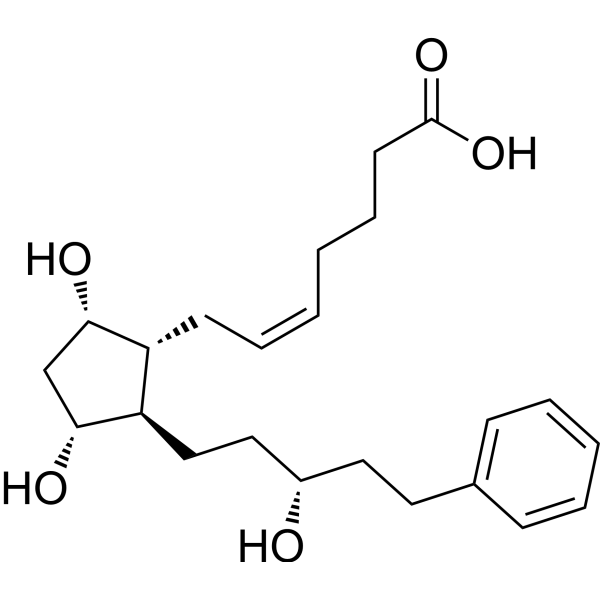
Latanoprost acid, an analog of prostaglandin (PG) F2α, is an selective prostanoid receptor (FP) agonist that specifically activates the FP-PG receptor. Latanoprost acid inhibits RANKL-induced osteoclastgenesis and function by inhibiting ERK, AKT, JNK, and p38 cascade, following by the c-fos/NFATc1 pathway. Latanoprost acid is a medication which works to lower pressure inside the eyes.
For research use only. We do not sell to patients.
- Purity : 98.77%
- CAS No.: 41639-83-2
- Formula: C23H34O5
- Molecular Weight:390.51
-
Storage:Pure form -20°C, 3 years , 4°C, 2 years ; In solvent -80°C, 6 months , -20°C, 1 month

To place orders, for customer services and technical support, please contact: MedChemExpress USA
Tel: 609-228-6898 E-mail: [email protected] [email protected]


-
 Biological Activity
-
Chemical Information
-
Solvent & Solubility
- Purity & Documentation
- References
-
 Help & FAQs


-
HY-B0191
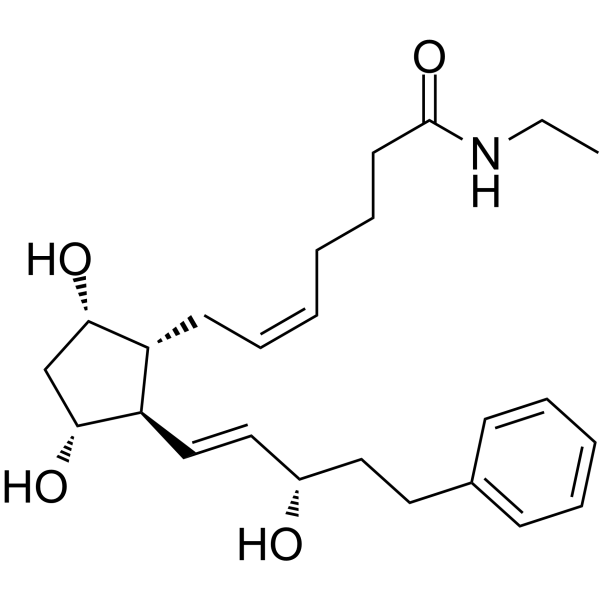
BimatoprostProstaglandin Analog -
HY-B0601
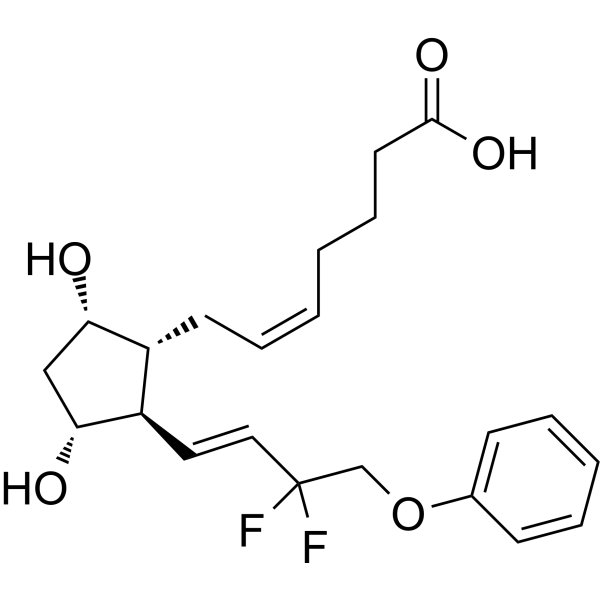
Tafluprost acidFP Receptor Agonist -
HY-108560
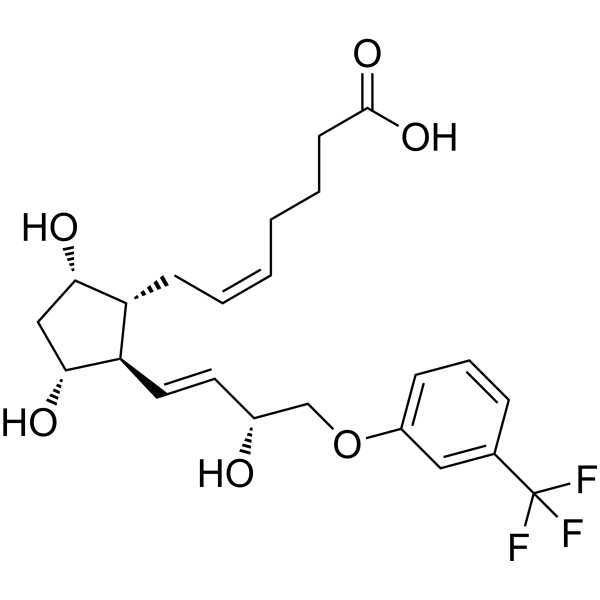
(+)-FluprostenolPTGER2 Agonist -
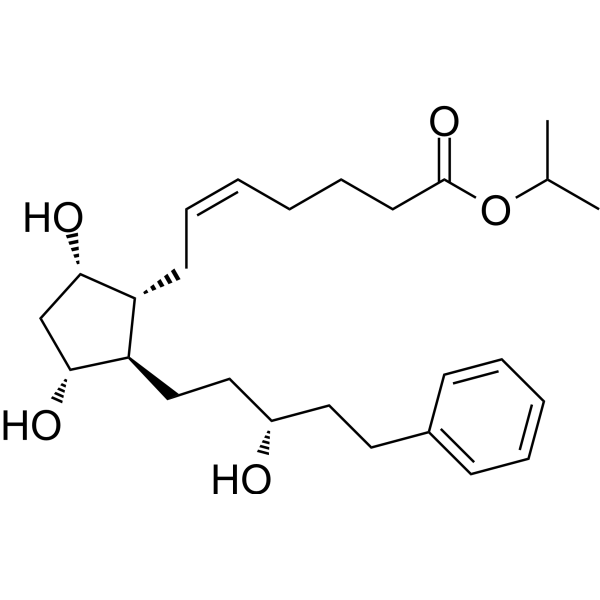
HY-B0577
LatanoprostProstaglandin Receptor Agonist -
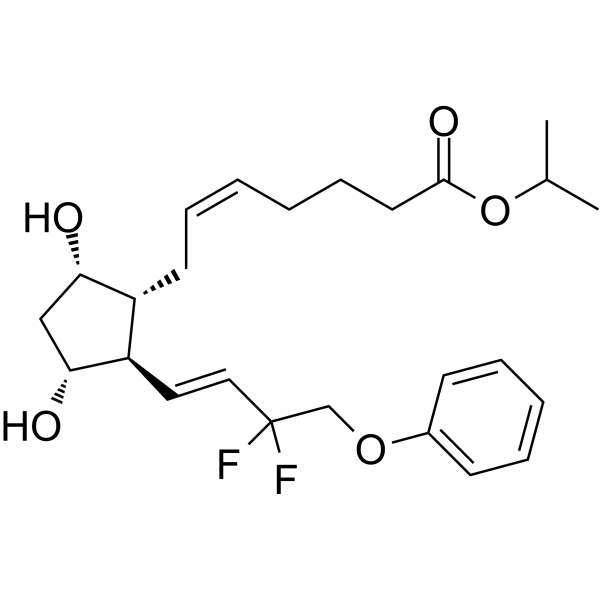
HY-B0600
TafluprostProstaglandin Receptor Agonist -

HY-113756AR
Latanoprost acid (Standard)Selective FP Agonist -

HY-B0600R
Tafluprost (Standard)Prostaglandin Receptor Agonist -
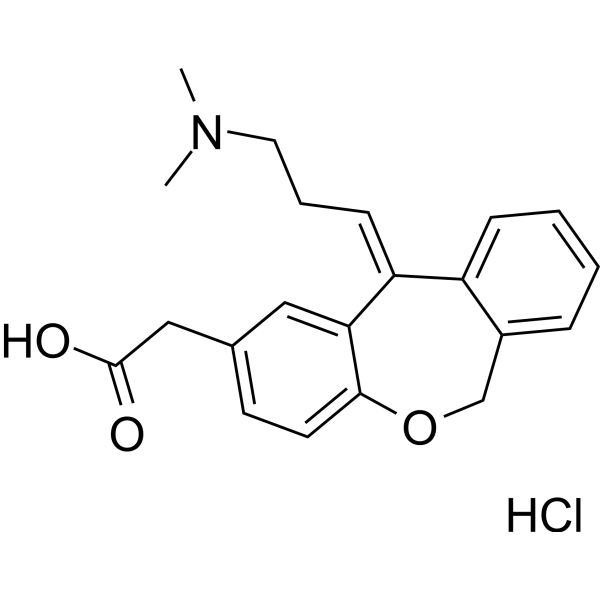
HY-B0426A
Olopatadine hydrochlorideHistamine H1 Receptor Antagonist, Mast Cell Stabilizer -
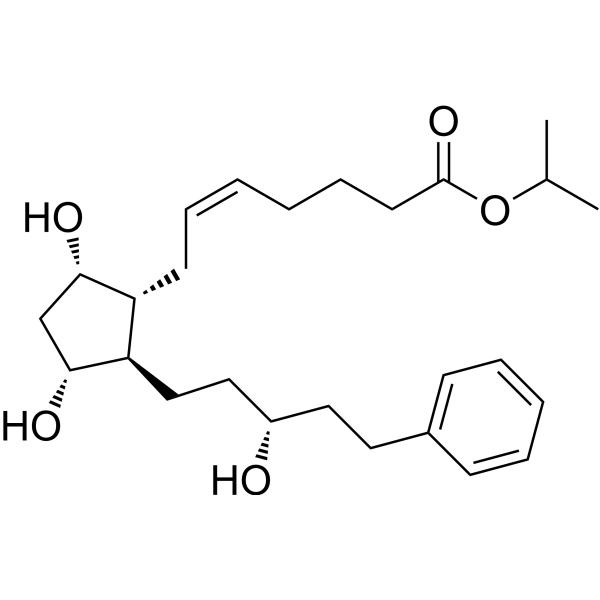
HY-B0577R
Latanoprost (Standard) -

HY-B0191R
Bimatoprost (Standard)Prostaglandin Analog -

HY-116889
15-Keto latanoprost acid -

HY-125774
Bimatoprost acidProstaglandin FP Receptor Agonist
Publications Citing Use of MedChemExpress (MCE) Latanoprost acid
More

Biological Activity
Description
IC50 & Target
[1]|
FP |
Cellular Effect
|
Cell Line

|
Type | Value | Description | References |
|---|---|---|---|---|
| NIH3T3 | EC50 |
31.7 nM
Compound: latanoprost acid
|
Agonist activity at FP receptor in Swiss mouse 3T3 cells assessed as [3H]-IP accumulation by scintillation counting
Agonist activity at FP receptor in Swiss mouse 3T3 cells assessed as [3H]-IP accumulation by scintillation counting
|
[PMID: 19101156] |
In Vitro
Latanoprost acid (10-20 μM;24 h) reduces he protein expressions of c-fos and NFATc1[1].
Latanoprost acid (10μM with 50ng/ml RANKL) significantly inhibits ERK, p38, AKT and JNK[1].
Latanoprost acid (10-20 μM) significantly inhibits the mature osteoclast formation[1].
MedChemExpress (MCE) has not independently confirmed the accuracy of these methods. They are for reference only. .
-
Cell Line:Bone marrow-derived macrophages cells (BMMs)
-
Concentration:10 μM, 20 μM
-
Incubation Time:24 hours
-
Result:Reduced he protein expressions of c-fos and NFATc1.
In Vivo
MedChemExpress (MCE) has not independently confirmed the accuracy of these methods. They are for reference only.
-
Animal Model:8-week-old C57BL/6J mice[1]
-
Dosage:20 mg/kg
-
Administration:Intraperitoneally injected; once a day for 7 days
-
Result:Notably prevented LPS-induced bone destruction at a dose of 20mg/kg.


Chemical Information
-
CAS No. 41639-83-2
-
Appearance Viscous Liquid
-
Molecular Weight 390.51
-
Formula C23H34O5
-
Color Colorless to light yellow
-
SMILES
O[C@@H]1[C@@H]([C@H]([C@@H](C1)O)CC[C@H](CCC2=CC=CC=C2)O)C/C=C\CCCC(O)=O
-
Shipping
Room temperature in continental US; may vary elsewhere.
-
Storage
Pure form -20°C 3 years 4°C 2 years In solvent -80°C 6 months -20°C 1 month


Publications (1)
-
Journal Impact Factor
-
Most Recent
-
Nat Commun
2023 May 9;14(1):2668. PMID: 37160891


Solvent & Solubility
In Vitro:
DMSO : 100 mg/mL (256.08 mM; Need ultrasonic; Hygroscopic DMSO has a significant impact on the solubility of product, please use newly opened DMSO)
Please refer to the solubility information to select the appropriate solvent. Once prepared, please aliquot and store the solution to prevent product inactivation from repeated freeze-thaw cycles.
Storage method and period of stock solution: -80°C, 6 months; -20°C, 1 month. When stored at -80°C, please use it within 6 months. When stored at -20°C, please use it within 1 month.
Please refer to the solubility information to select the appropriate solvent. Once prepared, please aliquot and store the solution to prevent product inactivation from repeated freeze-thaw cycles.
Storage method and period of stock solution: -80°C, 6 months; -20°C, 1 month. When stored at -80°C, please use it within 6 months. When stored at -20°C, please use it within 1 month.
Concentration (start) × Volume (start) = Concentration (final) × Volume (final)
In Vivo:
Select the appropriate dissolution method based on your experimental animal and administration route.
- For the following dissolution methods, please ensure to first prepare a clear stock solution using an In Vitro approach and then sequentially add co-solvents:
- To ensure reliable experimental results, the clarified stock solution can be appropriately stored based on storage conditions. As for the working solution for In Vivo experiments, it is recommended to prepare freshly and use it on the same day.
- The percentages shown for the solvents indicate their volumetric ratio in the final prepared solution. If precipitation or phase separation occurs during preparation, heat and/or sonication can be used to aid dissolution.
Add each solvent one by one: 10% DMSO 40% PEG300 5% Tween-80 45% Saline
Solubility: 2.5 mg/mL (6.40 mM); Clear solution; Need ultrasonic
This protocol yields a clear solution of 2.5 mg/mL.
Taking 1 mL working solution as an example, add 100 μL DMSO stock solution (25.0 mg/mL) to 400 μL PEG300, and mix evenly; then add 50 μL Tween-80 and mix evenly; then add 450 μL Saline to adjust the volume to 1 mL.
Preparation of Saline: Dissolve 0.9 g sodium chloride in ddH₂O and dilute to 100 mL to obtain a clear Saline solution.
Add each solvent one by one: 10% DMSO 90% (20% SBE-β-CD in Saline)
Solubility: 2.5 mg/mL (6.40 mM); Clear solution; Need ultrasonic
This protocol yields a clear solution of 2.5 mg/mL.
Taking 1 mL working solution as an example, add 100 μL DMSO stock solution (25.0 mg/mL) to 900 μL 20% SBE-β-CD in Saline, and mix evenly.
Preparation of 20% SBE-β-CD in Saline (4°C, storage for one week): 2 g SBE-β-CD powder is dissolved in 10 mL Saline, completely dissolve until clear.
In Vivo Dissolution Calculator
Please enter the basic information of animal experiments:
-
-
-
-
Recommended: Prepare an additional quantity of animals to account for potential losses during experiments.
Please enter your animal formula composition:
-
%DMSO +
Recommended: Keep the proportion of DMSO in working solution below 2% if your animal is weak.
-
%+
-
+%Tween-80 + +
-
%Saline +
The co-solvents required include: DMSO, . All of co-solvents are available by MedChemExpress (MCE). , Tween 80. All of co-solvents are available by MedChemExpress (MCE).
Working solution concentration: 0.22 mg/mL
Method for preparing stock solution: mg drug dissolved in μL DMSO. Stock solution concentration: mg/mL.
1. Take μL DMSO stock solution;
2. Add μL .
μL , mix evenly;
3. Then add μL Tween 80, mix evenly;
4. Then add μL
Please ensure that the stock solution in the first step is dissolved to a clear state, and add co-solvents in sequence. You can use ultrasonic heating (ultrasonic cleaner, recommended frequency 20-40 kHz), vortexing, etc. to assist dissolution.


Purity & Documentation
-
Data Sheet (279 KB)
-
SDS (396 KB)
- English - EN (396 KB)
- Français - FR (396 KB)
- Deutsch - DE (396 KB)
- Norwegian - NO (396 KB)
- Español - ES (396 KB)
- Swedish - SV (396 KB)
- Italian - IT (396 KB)
- Korean - KR (396 KB)
- Portuguese - PT (396 KB)
-
Handling Instructions (2659 KB)
References
[1]. Weinreb RN, et al. Effects of prostaglandins on the aqueous humor outflow pathways. Surv Ophthalmol. 2002 Aug;47 Suppl 1:S53-64. [Content Brief]
[2]. Xu X, et al. The prevention of latanoprost on osteoclastgenesis in vitro and lipopolysaccharide-induced murine calvaria osteolysis in vivo. J Cell Biochem. 2018 Jun;119(6):4680-4691. [Content Brief]


Complete Stock Solution Preparation Table
Please refer to the solubility information to select the appropriate solvent. Once prepared, please aliquot and store the solution to prevent product inactivation from repeated freeze-thaw cycles.
Storage method and period of stock solution: -80°C, 6 months; -20°C, 1 month. When stored at -80°C, please use it within 6 months. When stored at -20°C, please use it within 1 month.
| Optional Solvent | Concentration Solvent Mass | 1 mg | 5 mg | 10 mg | 25 mg |
|---|---|---|---|---|---|
| DMSO | 1 mM | 2.5608 mL | 12.8038 mL | 25.6075 mL | 64.0188 mL |
| 5 mM | 0.5122 mL | 2.5608 mL | 5.1215 mL | 12.8038 mL | |
| 10 mM | 0.2561 mL | 1.2804 mL | 2.5608 mL | 6.4019 mL | |
| 15 mM | 0.1707 mL | 0.8536 mL | 1.7072 mL | 4.2679 mL | |
| 20 mM | 0.1280 mL | 0.6402 mL | 1.2804 mL | 3.2009 mL | |
| 25 mM | 0.1024 mL | 0.5122 mL | 1.0243 mL | 2.5608 mL | |
| 30 mM | 0.0854 mL | 0.4268 mL | 0.8536 mL | 2.1340 mL | |
| 40 mM | 0.0640 mL | 0.3201 mL | 0.6402 mL | 1.6005 mL | |
| 50 mM | 0.0512 mL | 0.2561 mL | 0.5122 mL | 1.2804 mL | |
| 60 mM | 0.0427 mL | 0.2134 mL | 0.4268 mL | 1.0670 mL | |
| 80 mM | 0.0320 mL | 0.1600 mL | 0.3201 mL | 0.8002 mL | |
| 100 mM | 0.0256 mL | 0.1280 mL | 0.2561 mL | 0.6402 mL |


Latanoprost acid Related Classifications
HY-113756A Related Classifications
 Powered by Bioz