



Amino Fatty Acid Standards
- 1
- 2
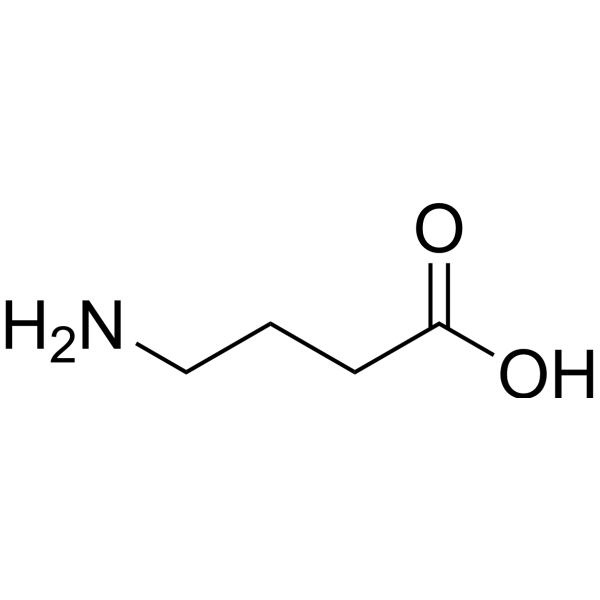
- Formula: C4H9NO2
- Molecular Weight: 103.12
γ-Aminobutyric acid (Standard) is the analytical standard of γ-Aminobutyric acid. This product is intended for research and analytical applications. γ-Aminobutyric acid (4-Aminobutyric acid) is a major inhibitory neurotransmitter in the adult mammalian brain, binding to the ionotropic GABA receptors (GABAA receptors) and metabotropic receptors (GABAB receptors. γ-Aminobutyric acid shows calming effect by blocking specific signals of central nervous system.

- Formula: C6H13NO2
- Molecular Weight: 131.18
L-Isoleucine (Standard) is the analytical standard of L-Isoleucine. This product is intended for research and analytical applications. L-Isoleucine is an orally active branched chain amino acid, which is the L-enantiomer of isoleucine. L-Isoleucine has a role as a Saccharomyces cerevisiae metabolite, an Escherichia coli metabolite, a plant metabolite, a human metabolite, an algal metabolite and a mouse metabolite. L-Isoleucine regulates the inflammatory response to protect against pathogens in vivo and in vitro.
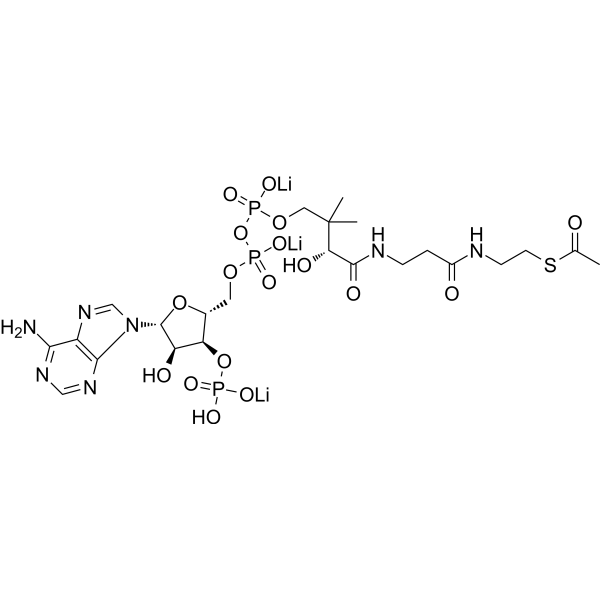
- Formula: C23H35Li3N7O17P3S
- Molecular Weight: 827.37
Acetyl-coenzyme A (Acetyl-CoA) trilithium is a membrane-impermeant central metabolic intermediate, participates in the TCA cycle and oxidative phosphorylation metabolism. Acetyl-coenzyme A trilithium regulates various cellular mechanisms by providing (sole donor) acetyl groups to target amino acid residues for post-translational acetylation reactions of proteins. Acetyl Coenzyme A trilithium is also a key precursor of lipid synthesis.

- Formula: C6H13NO2
- Molecular Weight: 131.17
L-Norleucine (Standard) is the analytical standard of L-Norleucine. This product is intended for research and analytical applications. L-Norleucine ((S)-2-Aminohexanoic acid) is an isomer of leucine, specifically affects protein synthesis in skeletal muscle, and has antivirus activity.

- Formula: C4H9NO2
- Molecular Weight: 103.12
3-Aminoisobutyric acid (Standard) is the analytical standard of 3-Aminoisobutyric acid. This product is used for research and analytical applications. 3-Aminoisobutyric acid (β-Aminoisobutyric acid) exhibits anti-inflammatory and antioxidant effects. It increases the expression of brown fat cell-specific genes in white adipose tissue and enhances fatty acid β-oxidation in hepatocytes. 3-Aminoisobutyric acid alleviates insulin resistance and inflammation induced by palmitic acid or a high-fat diet in mice via the AMPK–PPARδ-dependent pathway. 3-Aminoisobutyric acid is a catabolite of thymine and valine in skeletal muscle.

- Formula: C6H11NO4
- Molecular Weight: 161.16
Aminoadipic acid (Standard) is the analytical standard of Aminoadipic acid. This product is intended for research and analytical applications. Aminoadipic acid is an orally active lysine oxide derivative. Aminoadipic acid induces ROS generation, increases free Ca2+, decreases SOD, and activates TXNIP/NLRP3 pathway. Aminoadipic acid has pro-inflammatory effects. Aminoadipic acid can be used in atherosclerosis research[1][2][3][4].

- Formula: C5H11NO2
- Molecular Weight: 117.15
L-Norvaline (Standard) is the analytical standard of L-Norvaline (HY-Y0399). This product is intended for research and analytical applications. L-Norvaline is the inhibitor for arginase, that promotes the production of NO, reduces oxidative stress, improves insulin resistance, and exhibits antioxidant and anti-hyperglycemic effects. L-Norvaline can be used in research of Alzheimer’s disease.

- Formula: C5H11NO2
- Molecular Weight: 117.15
5-Aminovaleric acid (Standard) is the analytical standard of 5-Aminovaleric acid. This product is intended for research and analytical applications. 5-Aminovaleric acid is believed to act as a methylene homologue of gamma-aminobutyric acid (GABA) and functions as a weak GABA agonist.

- Formula: C25H48N6O8
- Molecular Weight: 560.68
Deferoxamine (Standard) is the analytical standard of Deferoxamine. This product is intended for research and analytical applications. Deferoxamine (Deferoxamine B) is an iron chelator (binds to Fe(III) and many other metal cations), is widely used to reduce iron accumulation and deposition in tissues. Deferoxamine upregulates HIF-1α levels with good antioxidant activity. Deferoxamine also shows anti-proliferative activity, can induce apoptosis and autophagy in cancer cells. Deferoxamine can be used in studies of diabetes, neurodegenerative diseases as well as anti-cancer and anti-COVID-19.

- Formula: C4H9NO2
- Molecular Weight: 103.12
D(-)-2-Aminobutyric acid (Standard) is the analytical standard of D(-)-2-Aminobutyric acid. This product is intended for research and analytical applications. D(-)-2-Aminobutyric acid is a substrate of D-amino acid oxidase.

- Formula: C4H9NO2
- Molecular Weight: 103.12
L-2-Aminobutyric acid (Standard) is the analytical standard of L-2-Aminobutyric acid. This product is intended for research and analytical applications. L-2-Aminobutyric acid is a non-proteinogenic amino acid that exists in human tissues and body fluids. L-2-Aminobutyric acid is formed by the transamination of oxobutyric acid. L-2-Aminobutyric acid can serve as a precursor for anticonvulsant and anti-tuberculosis agents and is a key intermediate in the chemical and pharmaceutical industries.
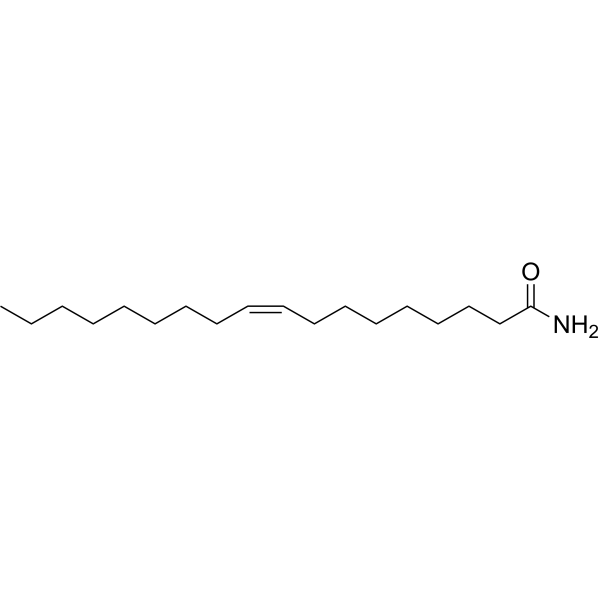
- Formula: C18H35NO
- Molecular Weight: 281.48
Oleamide (Standard) is the analytical standard of Oleamide. This product is intended for research and analytical applications. Oleamide is an endogenous fatty acid amide which can be synthesized de novo in the mammalian nervous system, and has been detected in human plasma.
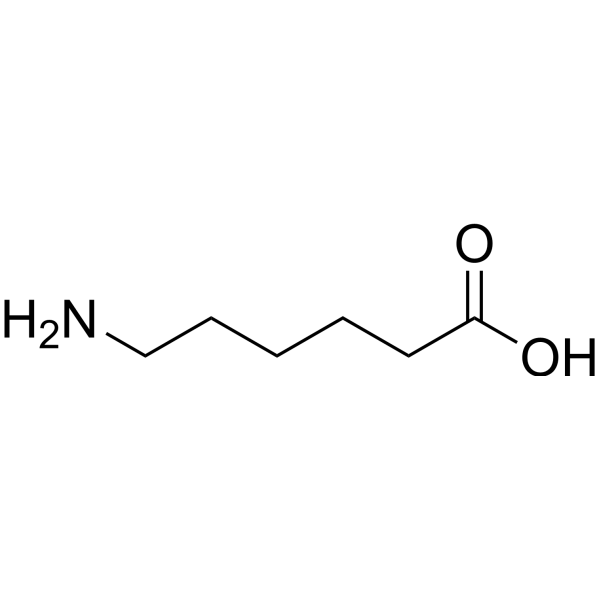
- Formula: C6H13NO2
- Molecular Weight: 131.17
6-Aminocaproic acid (Standard) is the analytical standard of 6-Aminocaproic acid. This product is intended for research and analytical applications. 6-Aminocaproic acid (EACA), a monoamino carboxylic acid, is a potent and orally active inhibitor of plasmin and plasminogen. 6-Aminocaproic acid is a potent antifibrinolytic agent. 6-Aminocaproic acid prevents clot lysis through the competitive binding of lysine residues on plasminogen, inhibiting plasmin formation and reducing fibrinolysis. 6-Aminocaproic acid can be used for the research of bleeding disorders.

- Formula: C21H39NO6
- Molecular Weight: 401.54
Myriocin (Standard) is the analytical standard of Myriocin. This product is intended for research and analytical applications. Myriocin (Thermozymocidin), a fungal metabolite could be isolated from Myriococcum albomyces, Isaria sinclairi and Mycelia sterilia, is a potent inhibitor of serine-palmitoyl-transferase (SPT) and a key enzyme in de novo synthesis of sphingolipids. Myriocin suppresses replication of both the subgenomic HCV-1b replicon and the JFH-1 strain of genotype 2a infectious HCV, with an IC50 of 3.5 μg/mL for inhibiting HCV infection[1][2][3].

- Formula: C3H7NO3
- Molecular Weight: 105.09

- Formula: C18H33NO
- Molecular Weight: 279.46
1-Phenyl-2-propanol (Standard) is the analytical standard of 1-Phenyl-2-propanol. This product is intended for research and analytical applications. 1-Phenyl-2-propanol (Benzylmethylcarbinol) is a natural product.

- Formula: C5H11NO2
- Molecular Weight: 117.15
DL-Valine (Standard) is the analytical standard of DL-Valine. This product is intended for research and analytical applications. DL-Valine is a valine derivative.

- Formula: C6H13NO2
- Molecular Weight: 131.18
(±)-Leucine (Standard) is the analytical standard of (±)-Leucine. This product is intended for research and analytical applications. (±)-Leucine (DL-Leucine), an isomer of Leucine, chemosterilant and dietary additive. (±)-Leucine inhibits growth of Escherichia coli HfrH by 92.08%.

- Formula: C4H7NO2
- Molecular Weight: 101.10

- Formula: C3H9ClN2O2
- Molecular Weight: 140.57
2,3-Diaminopropionic acid hydrochloride is the precursor of antibiotics and the siderophore staphyloferrin B. 2,3-Diaminopropionic acid hydrochloride is the inhibitor for polyphenoloxidase (PPO).
- 1
- 2



