



MCH(human, mouse, rat) TFA
Based on 1 publication(s) in Google Scholar
MCH (human, mouse, rat) TFA is a cyclic neuropeptide mainly synthesized by neurons in the lateral hypothalamic area. MCH (human, mouse, rat) TFA also serves as an endogenous ligand for the melanin-concentrating hormone receptor (MHC receptor), with a binding IC50 of 0.3 nM and 1.5 nM for human MCH-1R and MCH-2R, respectively; its functional EC50 values are 3.9 nM and 88.7 nM. MCH (human, mouse, rat) TFA acts not only as an orexigenic signal but also as a key integrating and regulatory hormone for energy homeostasis and sleep-wake cycles. MCH (human, mouse, rat) TFA can be used in studies related to obesity, sleep disorders, and other associated conditions.
For research use only. We do not sell to patients.
- Purity : 99.09%
- Formula: C107H161F3N30O28S4
- Molecular Weight:2500.86
-
Storage:
Sealed storage, away from moisture.
Powder -80°C, 2 years , -20°C, 1 year* In solvent : -80°C, 6 months; -20°C, 1 month (sealed storage, away from moisture)

To place orders, for customer services and technical support, please contact: MedChemExpress USA
Tel: 609-228-6898 E-mail: [email protected] [email protected]


-
 Biological Activity
-
Chemical Information
-
Solvent & Solubility
- Protocols
- Purity & Documentation
- References
-
 Help & FAQs


Publications Citing Use of MedChemExpress (MCE) MCH(human, mouse, rat) TFA
More

Biological Activity
Description
IC50 & Target
Binding IC50: 0.3 nM (MCH1R)IC50: 1.5 nM (MCH1R)[1]
In Vitro
MCH (human, mouse, rat) TFA potently displaces the binding of [125I]Phe13-Tyr19-MCH to MCH-2R on the membranes of transfected COS-7 and CHO cells, with an IC50 of 1.5 nM[2].
MCH (human, mouse, rat) (60 min) TFA dose-dependently activates calcium mobilization in CHO cells stably expressing human MCH-2R, with an EC50 of 0.1 nM[2].
MCH (human, mouse, rat) (30 s) TFA induces a robust, dose-dependent intracellular calcium response in HEK293-AEQ17 cells stably expressing human MCH-2R, with an EC50 of 31 nM[2].
MCH (human, mouse, rat) (1 h) TFA potently stimulates inositol phosphate turnover in HEK293-AEQ17 cells stably expressing human MCH-2R, with an EC50 of 2.7 nM[2].
MCH (human, mouse, rat) TFA reduces the release of α-MSH and secretion of CART in rodent hypothalamic tissue explants, and induces the release of NPY and AgRP[3].
MCH (human, mouse, rat) TFA induces dose-dependent GIRK currents in Xenopus laevis oocytes co-expressing SLC-1 receptors and GIRK channels[4].
MCH (human, mouse, rat) TFA induces calcium-mediated chloride currents in Xenopus laevis oocytes expressing the SLC-1 receptor by activating the phospholipase C pathway[4].
MCH (human, mouse, rat) TFA exerts inhibitory effects on primary cultured rat LH neurons, including reducing spontaneous firing frequency, suppressing glutamatergic synaptic transmission, and decreasing the amplitude of VDCC via a Gi/o-dependent pathway, with an IC50 of 7.84 nM, and it does not induce GIRK currents[4].
MedChemExpress (MCE) has not independently confirmed the accuracy of these methods. They are for reference only.
In Vivo
Levels of MCH (human, mouse, rat) TFA are upregulated in fasted rats, leptin-deficient ob/ob obese mice, fa/fa rats, and diet-induced obese rats[2].
TFA form of MCH (human, mouse, rat) (administered intracerebroventricularly; acute single injection; chronic infusion) exerts orexigenic effects in Wistar rats and Sprague-Dawley rats, including increased acute food intake and obesity induced by chronic infusion[3].
TFA form of MCH (human, mouse, rat) (intracerebral/intracerebroventricular; chronic administration) increases food intake, body weight and obesity in mice, while overexpression of this substance in the lateral hypothalamus induces obesity and insulin resistance[4].
TFA form of MCH (human, mouse, rat) (administered intracerebrally; administered intracerebroventricularly; administered locally in the hypothalamus; acutely administered) stimulates food intake in rats[4].
MCH (human, mouse, rat) TFA regulates memory retention in rats[4].
MedChemExpress (MCE) has not independently confirmed the accuracy of these methods. They are for reference only.


Chemical Information
-
Appearance Solid
-
Molecular Weight 2500.86
-
Formula C107H161F3N30O28S4
-
Color White to off-white
-
Synonyms
Melanin-concentrating hormone(human, mouse, rat) TFA
-
Sequence
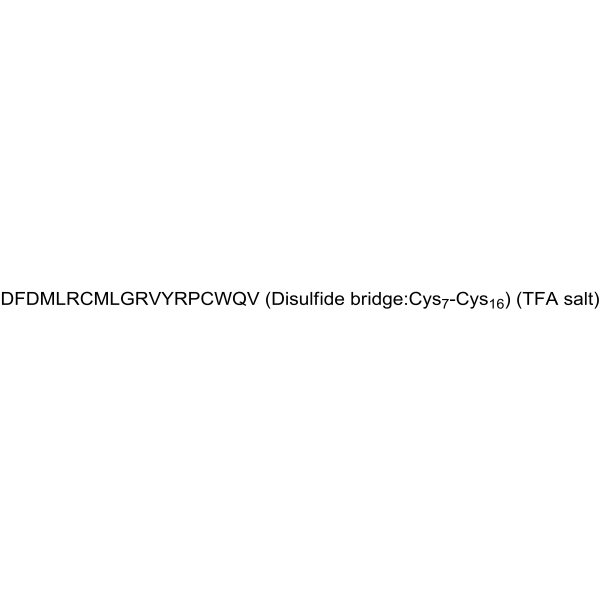
Asp-Phe-Asp-Met-Leu-Arg-Cys-Met-Leu-Gly-Arg-Val-Tyr-Arg-Pro-Cys-Trp-Gln-Val (Disulfide bridge:Cys7-Cys16)
-
Sequence Shortening
DFDMLRCMLGRVYRPCWQV (Disulfide bridge:Cys7-Cys16)
-
Shipping
Room temperature in continental US; may vary elsewhere.
-
Storage
Sealed storage, away from moisture
Powder -80°C 2 years -20°C 1 year * In solvent : -80°C, 6 months; -20°C, 1 month (sealed storage, away from moisture)


Publications (1)
-
Journal Impact Factor
-
Most Recent
-
Adv Sci (Weinh)
Targeting MCH Neuroendocrine Circuit in Lateral Hypothalamus to Protect Against Skeletal Senescence. [Abstract]2024 Nov;11(43):e2309951. PMID: 39320347


Solvent & Solubility
In Vitro:
H2O : ≥ 100 mg/mL (39.99 mM)
DMSO : 100 mg/mL (39.99 mM; Need ultrasonic; Hygroscopic DMSO has a significant impact on the solubility of product, please use newly opened DMSO)
* "≥" means soluble, but saturation unknown.
Please refer to the solubility information to select the appropriate solvent. Once prepared, please aliquot and store the solution to prevent product inactivation from repeated freeze-thaw cycles.
Storage method and period of stock solution: -80°C, 6 months; -20°C, 1 month (sealed storage, away from moisture). When stored at -80°C, please use it within 6 months. When stored at -20°C, please use it within 1 month.
* Note: If you choose water as the stock solution, please dilute it to the working solution, then filter and sterilize it with a 0.22 μm filter before use.
Please refer to the solubility information to select the appropriate solvent. Once prepared, please aliquot and store the solution to prevent product inactivation from repeated freeze-thaw cycles.
Storage method and period of stock solution: -80°C, 6 months; -20°C, 1 month (sealed storage, away from moisture). When stored at -80°C, please use it within 6 months. When stored at -20°C, please use it within 1 month.
* Note: If you choose water as the stock solution, please dilute it to the working solution, then filter and sterilize it with a 0.22 μm filter before use.
Concentration (start) × Volume (start) = Concentration (final) × Volume (final)
In Vivo:
Select the appropriate dissolution method based on your experimental animal and administration route.
- For the following dissolution methods, please ensure to first prepare a clear stock solution using an In Vitro approach and then sequentially add co-solvents:
- To ensure reliable experimental results, the clarified stock solution can be appropriately stored based on storage conditions. As for the working solution for In Vivo experiments, it is recommended to prepare freshly and use it on the same day.
- The percentages shown for the solvents indicate their volumetric ratio in the final prepared solution. If precipitation or phase separation occurs during preparation, heat and/or sonication can be used to aid dissolution.
Add each solvent one by one: 10% DMSO 40% PEG300 5% Tween-80 45% Saline
Solubility: ≥ 2.5 mg/mL (1.00 mM); Clear solution
This protocol yields a clear solution of ≥ 2.5 mg/mL (saturation unknown).
Taking 1 mL working solution as an example, add 100 μL DMSO stock solution (25.0 mg/mL) to 400 μL PEG300, and mix evenly; then add 50 μL Tween-80 and mix evenly; then add 450 μL Saline to adjust the volume to 1 mL.
Preparation of Saline: Dissolve 0.9 g sodium chloride in ddH₂O and dilute to 100 mL to obtain a clear Saline solution.
Add each solvent one by one: 10% DMSO 90% (20% SBE-β-CD in Saline)
Solubility: ≥ 2.5 mg/mL (1.00 mM); Clear solution
This protocol yields a clear solution of ≥ 2.5 mg/mL (saturation unknown).
Taking 1 mL working solution as an example, add 100 μL DMSO stock solution (25.0 mg/mL) to 900 μL 20% SBE-β-CD in Saline, and mix evenly.
Preparation of 20% SBE-β-CD in Saline (4°C, storage for one week): 2 g SBE-β-CD powder is dissolved in 10 mL Saline, completely dissolve until clear.
In Vivo Dissolution Calculator
Please enter the basic information of animal experiments:
-
-
-
-
Recommended: Prepare an additional quantity of animals to account for potential losses during experiments.
Working solution concentration: 0.22 mg/mL
This product has good water solubility, please refer to the measured solubility data in water/PBS/Saline for details.


Purity & Documentation
-
Data Sheet (287 KB)
-
SDS (252 KB)
- English - EN (252 KB)
- Français - FR (252 KB)
- Deutsch - DE (252 KB)
- Norwegian - NO (252 KB)
- Español - ES (252 KB)
- Swedish - SV (252 KB)
- Italian - IT (252 KB)
- Korean - KR (252 KB)
- Portuguese - PT (252 KB)
-
Handling Instructions (2659 KB)
References
[1]. Diniz GB, et al. The Melanin-Concentrating Hormone (MCH) System: A Tale of Two Peptides. Front Neurosci. 2019;13:1280. Published 2019 Nov 26. [Content Brief]
[2].
Sailer AW, et al. Identification and characterization of a second melanin-concentrating hormone receptor, MCH-2R. Proc Natl Acad Sci U S A. 2001 Jun 19;98(13):7564-9.
[Content Brief]
[3]. Griffond B, et al. MCH and feeding behavior-interaction with peptidic network. Peptides. 2009;30(11):2045-2051. [Content Brief]
[4]. Gao XB, et al. Electrophysiological effects of MCH on neurons in the hypothalamus. Peptides. 2009;30(11):2025-2030. [Content Brief]


Complete Stock Solution Preparation Table
Please refer to the solubility information to select the appropriate solvent. Once prepared, please aliquot and store the solution to prevent product inactivation from repeated freeze-thaw cycles.
Storage method and period of stock solution: -80°C, 6 months; -20°C, 1 month (sealed storage, away from moisture). When stored at -80°C, please use it within 6 months. When stored at -20°C, please use it within 1 month.
| Optional Solvent | Concentration Solvent Mass | 1 mg | 5 mg | 10 mg | 25 mg |
|---|---|---|---|---|---|
| H2O / DMSO | 1 mM | 0.3999 mL | 1.9993 mL | 3.9986 mL | 9.9966 mL |
| 5 mM | 0.0800 mL | 0.3999 mL | 0.7997 mL | 1.9993 mL | |
| 10 mM | 0.0400 mL | 0.1999 mL | 0.3999 mL | 0.9997 mL | |
| 15 mM | 0.0267 mL | 0.1333 mL | 0.2666 mL | 0.6664 mL | |
| 20 mM | 0.0200 mL | 0.1000 mL | 0.1999 mL | 0.4998 mL | |
| 25 mM | 0.0160 mL | 0.0800 mL | 0.1599 mL | 0.3999 mL | |
| 30 mM | 0.0133 mL | 0.0666 mL | 0.1333 mL | 0.3332 mL |
* Note: If you choose water as the stock solution, please dilute it to the working solution, then filter and sterilize it with a 0.22 μm filter before use.


MCH(human, mouse, rat) TFA Related Classifications
HY-P1205A Related Classifications
 Powered by Bioz