



Methsuximide
Based on 1 publication(s) in Google Scholar
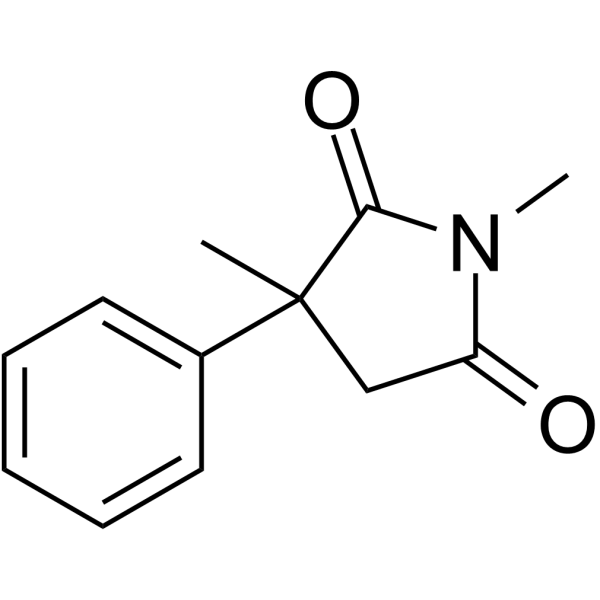
Methsuximide (Mesuximide) is an orally active succinimide-derived antiepileptic agent. Methsuximide interacts with cytochrome P-450, increases the level of hepatic microsomal cytochrome P-450, and inhibits or competes with the cytochrome P-450 CYP 2C9/10 subtype. Methsuximide can be used in epilepsy-related research.
For research use only. We do not sell to patients.
- Purity : 99.83%
- CAS No.: 77-41-8
- Formula: C12H13NO2
- Molecular Weight:203.24
-
Storage:Powder -20°C, 3 years , 4°C, 2 years ; In solvent -80°C, 6 months , -20°C, 1 month

To place orders, for customer services and technical support, please contact: MedChemExpress USA
Tel: 609-228-6898 E-mail: [email protected] [email protected]


-
 Biological Activity
-
Chemical Information
-
Solvent & Solubility
- Purity & Documentation
- References
-
 Help & FAQs



Publications Citing Use of MedChemExpress (MCE) Methsuximide
More

Biological Activity
Description
In Vitro
MedChemExpress (MCE) has not independently confirmed the accuracy of these methods. They are for reference only.
In Vivo
Methsuximide (8 mg/egg; chorioallantoic injection; single dose) induces a 50-fold increase in hepatic porphyrin levels, demonstrating marked porphyrogenic activity in 17-day-old chick embryos[1].
Methsuximide (33-250 mg/kg; p.o.; single dose) completely suppresses Pentylenetetrazol-induced initial clonic seizures in Sprague-Dawley rats at oral doses of 63 mg/kg and higher, with neurotoxic effects (ataxia, loss of grasping reflex) increasing with dose[2].
Methsuximide (84-100 mg/kg; p.o.; single dose) protects 50% of Webster strain mice from supramaximal electroshock-induced tonic extensor seizures at an oral ED50 of 84 mg/kg without causing neurologic deficits, and achieves maximal anti-extensor seizure activity at non-neurotoxic doses[2].
Methsuximide (500-3000 mg/kg; p.o.; single dose) has an acute oral LD50 of 1405 mg/kg in albino mice, with high doses causing immediate, transient neurotoxicity and respiratory failure leading to death[2].
Methsuximide (232-1755 mg/kg; p.o.; daily; 4 weeks) is tolerated by male albino mice with only mild food intake and weight gain depression, and no mortality or overt behavioral abnormalities[2].
Methsuximide (10-200 mg/kg; p.o.; twice daily, 5 days/week; 183-367 days) is tolerated by dogs at doses up to 75 mg/kg twice daily (5 days/week) for 6 months with no toxic reactions, while doses of 100 and 200 mg/kg twice daily cause mild incoordination; no organ damage or abnormal clinical findings occur across all tested doses[2].
Methsuximide (50-200 mg/kg; p.o.; once daily, 5 days/week; 147-371 days) is tolerated by Macaca rhesus monkeys at doses up to 100 mg/kg once daily (5 days/week) for up to 1 year with only occasional mild incoordination, while 200 mg/kg causes transient marked ataxia; no mortality, organ damage, or abnormal clinical findings occur across all tested doses[2].
MedChemExpress (MCE) has not independently confirmed the accuracy of these methods. They are for reference only.
-
Animal Model:CFHB Wistar (male, 110-130 g)[1]
-
Dosage:0.5 mmole/kg/day; 2.0 mmole/kg/day; 100 mg/kg (single dose for anticonvulsant tolerance study)
-
Administration:p.o.; two equally divided daily doses; 3 days; p.o.; single dose (1 hour before leptazol infusion)
-
Result:Increased liver weight to 5.61 g and liver weight as a percentage of body weight to 4.72% at 2.0 mmole/kg/day, with proliferation of hepatic smooth endoplasmic reticulum observed.
Reduced hexobarbitone-induced sleeping time to 5.00 minutes at 0.5 mmole/kg/day and 7.57 minutes at 2.0 mmole/kg/day.
Increased in vitro hepatic microsomal hexobarbitone oxidation to 10.06 nmole/mg protein/min and aniline hydroxylation to 2.77 nmole/mg protein/min at 0.5 mmole/kg/day.
Increased hepatic ALA synthetase activity to 82 nmoles ALA/g wet liver/hr at 0.5 mmole/kg/day, without altering hepatic or urinary porphyrin levels.
Increased hepatic microsomal cytochrome P-450 to 219% of control levels per gram liver and 201% of control levels per mg microsomal protein at 0.5 mmole/kg/day; increased cytochrome P-450 to 249% of control levels per gram liver at 2.0 mmole/kg/day.
Reduced anticonvulsant activity, with the minimum convulsant dose of leptazol decreased to 34.3 mg/kg in rats pretreated with 0.5 mmole/kg/day for 3 days.
Produced a type I spectral shift (absorption peak at 390 nm, trough at 422 nm) with rat liver microsomes at 1-4 mM, with maximal absorbance change (Δ absorbance ≡ 0.06) at 3 mM.
-
Animal Model:17-day-old chick embryos[1]
-
Dosage:8 mg/egg
-
Administration:chorioallantoic injection; single dose
-
Result:Increased chick embryo liver porphyrins approximately 50-fold, with a mean level of 10 μg coproporphyrin I/g liver compared to untreated embryos (mean 0.188 μg/g).
-
Animal Model:Sprague-Dawley (100-150 g)[2]
-
Dosage:250 mg/kg; 125 mg/kg; 63 mg/kg; 33 mg/kg
-
Administration:p.o.; single dose
-
Result:Prevented convulsions in 0/5 rats at 250 mg/kg, with associated loss of grasping reflex.
Prevented convulsions in 0/5 rats at 125 mg/kg, with associated ataxia.
Prevented convulsions in 0/5 rats at 63 mg/kg, with associated slight ataxia.
Allowed convulsions in 3/5 rats at 33 mg/kg, with no associated neurologic deficits.
-
Animal Model:Webster (20-24 g)[2]
-
Dosage:84 mg/kg; 100 mg/kg
-
Administration:p.o.; single dose
-
Result:Achieved an ED50 of 84 mg/kg for protecting mice from tonic extensor seizures, with no associated neurologic deficits.
Increased CS50 to exceed 400 mA at 100 mg/kg, achieving maximal anti-extensor seizure effect at non-neurotoxic dose levels.
-
Animal Model:Albino (15-25 g)[2]
-
Dosage:500 mg/kg; 600 mg/kg; 750 mg/kg; 1000 mg/kg; 1500 mg/kg; 3000 mg/kg
-
Administration:p.o.; single dose
-
Result:Exhibited an acute oral LD50 of 1405 mg/kg.
Caused immediate neurotoxic effects including marked incoordination, loss of grasping and righting reflexes, dyspnea, and respiratory failure after high-dose administration, with depression lasting 3-18 hours (up to 48 hours at higher doses).
Resulted in deaths typically occurring within the first 18 hours at high doses.
-
Animal Model:Albino (male)[2]
-
Dosage:232 mg/kg; 456 mg/kg; 806 mg/kg; 1755 mg/kg
-
Administration:p.o.; daily; 4 weeks
-
Result:Caused no mortality across all dose groups.
Induced 0% food intake depression at 232 and 456 mg/kg, and 7% food intake depression at 806 and 1755 mg/kg.
Caused 22% weight gain depression at 232 mg/kg, 31% at 456 mg/kg, 22% at 806 mg/kg, and 45% at 1755 mg/kg.
Showed no abnormalities in physical appearance or behavior.
-
Animal Model:Albino (male)[2]
-
Dosage:134 mg/kg; 155 mg/kg; 281 mg/kg; 637 mg/kg
-
Administration:p.o.; daily; 26 weeks
-
Result:Caused no mortality across all dose groups.
Induced 5% food intake depression at 134 mg/kg, 4% at 281 mg/kg, 0% at 637 mg/kg, and 12% at 155 mg/kg.
Caused 0% weight gain depression at 134 and 281 mg/kg, 13% at 637 mg/kg, and 2% at 155 mg/kg.
Showed no abnormalities in physical appearance or behavior; hematological, biochemical, and pathological findings remained normal for rats receiving up to 637 mg/kg daily for 6 months.
-
Animal Model:Dog[2]
-
Dosage:10 mg/kg; 20 mg/kg; 40 mg/kg; 75 mg/kg; 100 mg/kg; 200 mg/kg
-
Administration:p.o.; twice daily, 5 days/week; 183-367 days
-
Result:Caused no mortality across all dose groups.
Produced no toxic reactions at 10, 20, 40, and 75 mg/kg twice daily; caused slight incoordination at 100 and 200 mg/kg twice daily.
Resulted in average weight changes ranging from -1.12 kg to +1.80 kg across dose groups.
Showed normal hematological, biochemical, urine, liver, and kidney function tests, and no abnormalities in gross and microscopic organ examinations.
-
Animal Model:Macaca rhesus (male and female)[2]
-
Dosage:50 mg/kg; 100 mg/kg; 200 mg/kg
-
Administration:p.o.; once daily, 5 days/week; 147-371 days
-
Result:Caused no mortality across all dose groups.
Induced occasional slight incoordination after the 189th dose at 50 mg/kg; caused occasional slight incoordination (one monkey showed no reactions) at 100 mg/kg; caused marked ataxia 0.5-1 hour after dosing, lasting 2-24 hours at 200 mg/kg.
Resulted in all monkeys gaining body weight, with average weight change ranging from +0.60 kg to +2.6 kg.
Showed normal hematological, biochemical, and pathological findings.
Clinical Trial
| NCT Number | Sponsor | Condition | Start Date |
Phase

|
|---|---|---|---|---|
| NCT01329991 | 2011-05 | PHASE1 |


Chemical Information
-
CAS No. 77-41-8
-
Appearance Solid
-
Molecular Weight 203.24
-
Formula C12H13NO2
-
Color White to off-white
-
SMILES
O=C(C(C1=CC=CC=C1)(C)C2)N(C)C2=O
-
Synonyms
Mesuximide; Celontin
-
Shipping
Room temperature in continental US; may vary elsewhere.
-
Storage
Powder -20°C 3 years 4°C 2 years In solvent -80°C 6 months -20°C 1 month


Publications (1)
-
Journal Impact Factor
-
Most Recent
-
Cell Death Dis
2025 Jun 2;16(1):426. PMID: 40456737


Solvent & Solubility
In Vitro:
DMSO : 100 mg/mL (492.03 mM; Need ultrasonic; Hygroscopic DMSO has a significant impact on the solubility of product, please use newly opened DMSO)
Please refer to the solubility information to select the appropriate solvent. Once prepared, please aliquot and store the solution to prevent product inactivation from repeated freeze-thaw cycles.
Storage method and period of stock solution: -80°C, 6 months; -20°C, 1 month. When stored at -80°C, please use it within 6 months. When stored at -20°C, please use it within 1 month.
Please refer to the solubility information to select the appropriate solvent. Once prepared, please aliquot and store the solution to prevent product inactivation from repeated freeze-thaw cycles.
Storage method and period of stock solution: -80°C, 6 months; -20°C, 1 month. When stored at -80°C, please use it within 6 months. When stored at -20°C, please use it within 1 month.
Concentration (start) × Volume (start) = Concentration (final) × Volume (final)
In Vivo:
Select the appropriate dissolution method based on your experimental animal and administration route.
- For the following dissolution methods, please ensure to first prepare a clear stock solution using an In Vitro approach and then sequentially add co-solvents:
- To ensure reliable experimental results, the clarified stock solution can be appropriately stored based on storage conditions. As for the working solution for In Vivo experiments, it is recommended to prepare freshly and use it on the same day.
- The percentages shown for the solvents indicate their volumetric ratio in the final prepared solution. If precipitation or phase separation occurs during preparation, heat and/or sonication can be used to aid dissolution.
Add each solvent one by one: 10% DMSO 40% PEG300 5% Tween-80 45% Saline
Solubility: ≥ 2.5 mg/mL (12.30 mM); Clear solution
This protocol yields a clear solution of ≥ 2.5 mg/mL (saturation unknown).
Taking 1 mL working solution as an example, add 100 μL DMSO stock solution (25.0 mg/mL) to 400 μL PEG300, and mix evenly; then add 50 μL Tween-80 and mix evenly; then add 450 μL Saline to adjust the volume to 1 mL.
Preparation of Saline: Dissolve 0.9 g sodium chloride in ddH₂O and dilute to 100 mL to obtain a clear Saline solution.
Add each solvent one by one: 10% DMSO 90% (20% SBE-β-CD in Saline)
Solubility: ≥ 2.5 mg/mL (12.30 mM); Clear solution
This protocol yields a clear solution of ≥ 2.5 mg/mL (saturation unknown).
Taking 1 mL working solution as an example, add 100 μL DMSO stock solution (25.0 mg/mL) to 900 μL 20% SBE-β-CD in Saline, and mix evenly.
Preparation of 20% SBE-β-CD in Saline (4°C, storage for one week): 2 g SBE-β-CD powder is dissolved in 10 mL Saline, completely dissolve until clear.
In Vivo Dissolution Calculator
Please enter the basic information of animal experiments:
-
-
-
-
Recommended: Prepare an additional quantity of animals to account for potential losses during experiments.
Please enter your animal formula composition:
-
%DMSO +
Recommended: Keep the proportion of DMSO in working solution below 2% if your animal is weak.
-
%+
-
+%Tween-80 + +
-
%Saline +
The co-solvents required include: DMSO, . All of co-solvents are available by MedChemExpress (MCE). , Tween 80. All of co-solvents are available by MedChemExpress (MCE).
Working solution concentration: 0.22 mg/mL
Method for preparing stock solution: mg drug dissolved in μL DMSO. Stock solution concentration: mg/mL.
1. Take μL DMSO stock solution;
2. Add μL .
μL , mix evenly;
3. Then add μL Tween 80, mix evenly;
4. Then add μL
Please ensure that the stock solution in the first step is dissolved to a clear state, and add co-solvents in sequence. You can use ultrasonic heating (ultrasonic cleaner, recommended frequency 20-40 kHz), vortexing, etc. to assist dissolution.


Purity & Documentation
-
Data Sheet (306 KB)
-
SDS (393 KB)
- English - EN (393 KB)
- Français - FR (393 KB)
- Deutsch - DE (393 KB)
- Norwegian - NO (393 KB)
- Español - ES (393 KB)
- Swedish - SV (393 KB)
- Italian - IT (393 KB)
- Korean - KR (393 KB)
- Portuguese - PT (393 KB)
-
Handling Instructions (2659 KB)
References
[1]. Orton TC, et al. Effect in rats of subacute administration of ethosuximide, methsuximide and phensuximide on hepatic microsomal enzymes and porphyrin turnover. Biochem Pharmacol. 1972 Aug 15;21(16):2253-61. [Content Brief]
[3]. Sigler M, et al. Effective and safe but forgotten: methsuximide in intractable epilepsies in childhood. Seizure. 2001 Mar;10(2):120-4. [Content Brief]
[4]. Besag FM, et al. Methsuximide lowers lamotrigine blood levels: A pharmacokinetic antiepileptic drug interaction. Epilepsia. 2000 May;41(5):624-7. [Content Brief]
[5]. Dobrinska MR, et al. Pharmacokinetics of methsuximide and a major metabolite in dogs. Journal of pharmaceutical sciences. 1977 May;66(5):688-92. [Content Brief]


Complete Stock Solution Preparation Table
Please refer to the solubility information to select the appropriate solvent. Once prepared, please aliquot and store the solution to prevent product inactivation from repeated freeze-thaw cycles.
Storage method and period of stock solution: -80°C, 6 months; -20°C, 1 month. When stored at -80°C, please use it within 6 months. When stored at -20°C, please use it within 1 month.
| Optional Solvent | Concentration Solvent Mass | 1 mg | 5 mg | 10 mg | 25 mg |
|---|---|---|---|---|---|
| DMSO | 1 mM | 4.9203 mL | 24.6015 mL | 49.2029 mL | 123.0073 mL |
| 5 mM | 0.9841 mL | 4.9203 mL | 9.8406 mL | 24.6015 mL | |
| 10 mM | 0.4920 mL | 2.4601 mL | 4.9203 mL | 12.3007 mL | |
| 15 mM | 0.3280 mL | 1.6401 mL | 3.2802 mL | 8.2005 mL | |
| 20 mM | 0.2460 mL | 1.2301 mL | 2.4601 mL | 6.1504 mL | |
| 25 mM | 0.1968 mL | 0.9841 mL | 1.9681 mL | 4.9203 mL | |
| 30 mM | 0.1640 mL | 0.8200 mL | 1.6401 mL | 4.1002 mL | |
| 40 mM | 0.1230 mL | 0.6150 mL | 1.2301 mL | 3.0752 mL | |
| 50 mM | 0.0984 mL | 0.4920 mL | 0.9841 mL | 2.4601 mL | |
| 60 mM | 0.0820 mL | 0.4100 mL | 0.8200 mL | 2.0501 mL | |
| 80 mM | 0.0615 mL | 0.3075 mL | 0.6150 mL | 1.5376 mL | |
| 100 mM | 0.0492 mL | 0.2460 mL | 0.4920 mL | 1.2301 mL |


Methsuximide Related Classifications
HY-B1376 Related Classifications
 Powered by Bioz
Keywords
- Methsuximide
- 77-41-8
- Mesuximide
- Celontin
- Cytochrome P450
- pentylenetetrazol-induced clonic seizures
- Sprague-Dawley rats
- CFHB Wistar rat liver microsomes
- Macaca rhesus monkeys
- cytochrome P-450
- chick embryo liver
- Webster strain mice
- electroshock-induced tonic extensor seizures
- CYP 2C9/10 isoform
- δ-aminolaevulinic acid synthetase
- Inhibitor
- inhibitor
- inhibit