



FLT3LG Protein, Human

Based on 1 Customer Validation
FLT3LG protein, a potent stimulator of early hematopoietic cell proliferation, activates FLT3 and synergizes with colony-stimulating factors and interleukins. As a homodimer, especially in isoform 2, it crucially promotes expansion and differentiation of hematopoietic progenitor cells. FLT3LG's collaborative signaling with other molecules underscores its significance in regulating hematopoiesis and maintaining hematopoietic system balance. FLT3LG Protein, Human is the recombinant human-derived FLT3LG protein, expressed by E. coli , with tag free.
- Species: Human
- Source: E. coli
-
Storage:Stored at -20°C for 2 years from date of receipt. After reconstitution, it is stable at 4°C for 1 week or -20°C for longer (with carrier protein). It is recommended to freeze aliquots at -20°C or -80°C for extended storage.


To place orders, for customer services and technical support, please contact: MedChemExpress USA
Tel: 609-228-6898 E-mail: [email protected] [email protected]


-
 Biological Activity
-
Technical Parameters
-
Product Properties
- Documentation
- Help & FAQs


-

HY-P70781
SCF Protein, Human -
HY-P7044
IL-6 Protein, Human -
HY-P7050
M-CSF Protein, Human -
HY-P7007
BMP-4 Protein, Human -
HY-P7110A
VEGF165 Protein, Human (HEK293) -
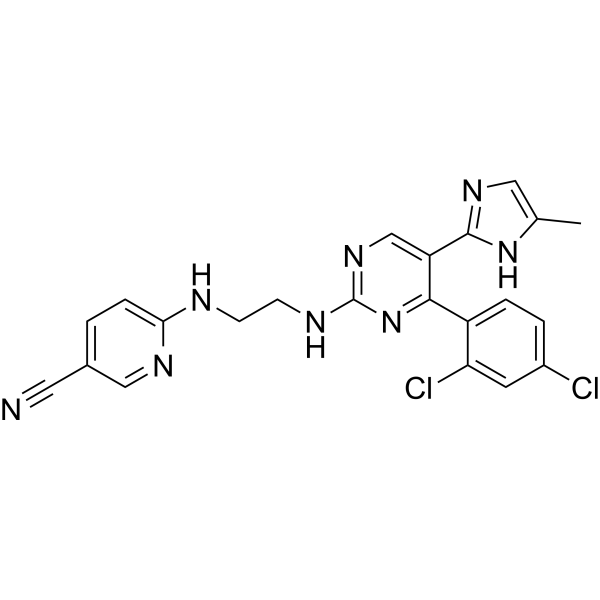
HY-10182
Laduviglusib -
HY-P7016A
GM-CSF Protein, Human -
HY-P7034
IL-15 Protein, Human -
HY-P7115A
TPO/Thrombopoietin Protein, Human (CHO, His) -
HY-P7040
IL-3 Protein, Human -
HY-P70576
IL-3 Protein, Human (His) -
HY-P7031
IL-11 Protein, Human


Biological Activity
Description
FLT3LG protein, a potent stimulator of early hematopoietic cell proliferation, activates FLT3 and synergizes with colony-stimulating factors and interleukins. As a homodimer, especially in isoform 2, it crucially promotes expansion and differentiation of hematopoietic progenitor cells. FLT3LG's collaborative signaling with other molecules underscores its significance in regulating hematopoiesis and maintaining hematopoietic system balance. FLT3LG Protein, Human is the recombinant human-derived FLT3LG protein, expressed by E. coli , with tag free.
Background
FLT3LG protein serves as a potent stimulator of early hematopoietic cell proliferation through the activation of FLT3, demonstrating synergistic effects when combined with various colony-stimulating factors and interleukins. This homodimeric protein, particularly in isoform 2, plays a crucial role in promoting the expansion and differentiation of hematopoietic progenitor cells. Its ability to activate FLT3 and collaborate with other signaling molecules underscores its significance in regulating hematopoiesis and maintaining the balance of the hematopoietic system.
Verified Bioactivity
1.Immobilized Human FLT3LG, No Tag at 1 μg/mL (100 μL/well) on the plate. Dose response curve for Human FLT3, hFc Tag with the EC50 of 20-100 ng/mL determined by ELISA.
2.The ED50 was determined by the dose-dependent stimulation of the proliferation of human AML5 cells is < 2.0 ng/mL.
3. Immobilized Human FLT3LG, No Tag at 2 μg/mL (100 μL/well) on the plate. Dose response curve for Human FLT3, hFc Tag with the EC50 of 30.8 ng/mL determined by ELISA.


Technical Parameters
-
Species Human
-
Source E. coli
-
Tag Tag Free
-
Accession
P49771-1 (T27-A181)
-
Gene ID2323
-
Molecular Construction
-
N-term
-
FLT3LG (T27-A181)
Accession # P49771-1 -
C-term
-
-
Protein Length
Extracellular Domain
-
Synonyms
FLT3LG; IMD125; Fms Related Receptor Tyrosine Kinase 3 Ligand; FLG3L; Fms-Related Tyrosine Kinase 3 Ligand; FLT3L; Fms Related Tyrosine Kinase 3 Ligand; Flt3L; Flt3 Ligand; FL; SL Cytokine
-
AA Sequence
TQDCSFQHSPISSDFAVKIRELSDYLLQDYPVTVASNLQDEELCGGLWRLVLAQRWMERLKTVAGSKMQGLLERVNTEIHFVTKCAFQPPPSCLRFVQTNISRLLQETSEQLVALKPWITRQNFSRCLELQCQPDSSTLPPPWSPRPLEATAPTA
-
Predicted Molecular Mass
17.6 kDa
-
Molecular Weight
Approximately 18 kDa, based on SDS-PAGE under reducing conditions.
-
Purity
≥ 95%, as determined by reducing SDS-PAGE.


Product Properties
Lyophilized powder
Lyophilized from a 0.22 μm filtered solution of PBS, pH 7.4, 8% trehalose.
< 1 EU/μg of protein by gel clotting method
It is not recommended to reconstitute to a concentration less than 100 μg/mL in ddH2O.
Stored at -20°C for 2 years from date of receipt. After reconstitution, it is stable at 4°C for 1 week or -20°C for longer (with carrier protein). It is recommended to freeze aliquots at -20°C or -80°C for extended storage.
Room temperature in continental US; may vary elsewhere.


Documentation
-
Data Sheet (236 KB)
-
SDS (251 KB)
- English - EN (251 KB)
- Français - FR (251 KB)
- Deutsch - DE (251 KB)
- Norwegian - NO (251 KB)
- Español - ES (251 KB)
- Swedish - SV (251 KB)
- Italian - IT (251 KB)
- Korean - KR (251 KB)
- Portuguese - PT (251 KB)
-
Handling Instructions (2659 KB)

Calculators
Concentration (start) × Volume (start) = Concentration (final) × Volume (final)


 Powered by Bioz

