



IL-3 Protein, Human (His)
Based on 4 publication(s) in Google Scholar
IL-3 protein is mainly secreted by T lymphocytes, mast cells and osteoblasts and is critical for the generation and differentiation of hematopoietic progenitor cells. It stimulates mature basophils, eosinophils and monocytes, promoting functional activation. IL-3 Protein, Human (His) is the recombinant human-derived IL-3 protein, expressed by E. coli , with N-6*His labeled tag.
- Species: Human
- Source: E. coli
-
Storage:Stored at -20°C for 2 years from date of receipt. After reconstitution, it is stable at 4°C for 1 week or -20°C for longer (with carrier protein). It is recommended to freeze aliquots at -20°C or -80°C for extended storage.


To place orders, for customer services and technical support, please contact: MedChemExpress USA
Tel: 609-228-6898 E-mail: [email protected] [email protected]


-
 Biological Activity
-
Technical Parameters
-
Product Properties
- Documentation
- Help & FAQs


-

HY-P70781
SCF Protein, Human -
HY-P7044
IL-6 Protein, Human -
HY-10182
Laduviglusib -
HY-10431
SB-431542 -
HY-P7110A
VEGF165 Protein, Human (HEK293) -
HY-P7007
BMP-4 Protein, Human -
HY-P7115A
TPO/Thrombopoietin Protein, Human (CHO, His) -
HY-P70445
IL-4 Protein, Human -
HY-P7050
M-CSF Protein, Human -
HY-P70311
Activin A Protein, Human/Mouse/Rat (HEK293) -
HY-P70488
M-CSF Protein, Human (223a.a, HEK293, His) -
HY-P7111
FLT3LG Protein, Human (CHO)


Biological Activity
Description
IL-3 protein is mainly secreted by T lymphocytes, mast cells and osteoblasts and is critical for the generation and differentiation of hematopoietic progenitor cells. It stimulates mature basophils, eosinophils and monocytes, promoting functional activation. IL-3 Protein, Human (His) is the recombinant human-derived IL-3 protein, expressed by E. coli , with N-6*His labeled tag.
Background
The cytokine IL-3, predominantly secreted by activated T-lymphocytes, mast cells, and osteoblastic cells, plays a crucial role in controlling the production and differentiation of hematopoietic progenitor cells into lineage-restricted cells. Additionally, IL-3 stimulates mature basophils, eosinophils, and monocytes, promoting their functional activation. Beyond its hematopoietic functions, IL-3 contributes to neural cell proliferation and survival. Moreover, it participates in bone homeostasis by inhibiting osteoclast differentiation through the prevention of NF-kappa-B nuclear translocation and activation. Mechanistically, IL-3 exerts its biological effects through a receptor composed of the IL3RA subunit and the signal transducing subunit IL3RB. Stimulation of this receptor leads to the rapid activation of JAK2 kinase activity, initiating a STAT5-mediated transcriptional program. Alternatively, IL-3 contributes to cell survival under oxidative stress in non-hematopoietic systems by activating pathways mediated by PI3K/AKT and ERK. The cytokine also interacts with IL3RA to modulate its diverse physiological effects.
Verified Bioactivity
1.The cell proliferation assay using TF-1 human erythroleukemic cells has an ED50 value of 0.05-0.3 ng/mL.
2.Loaded Human IL-3RA-Fc on Protein A Biosensor, can bind Human IL-3 with an affinity constant of 3.89 μM as determined in BLI assay.
3.Loaded Human IL-3RA-Fc-Avi on Protein A Biosensor, can bind Human IL-3 with an affinity constant of 3.74 μM as determined in BLI assay.
MCE Validation Data
-
Purity - SDS-PAGE
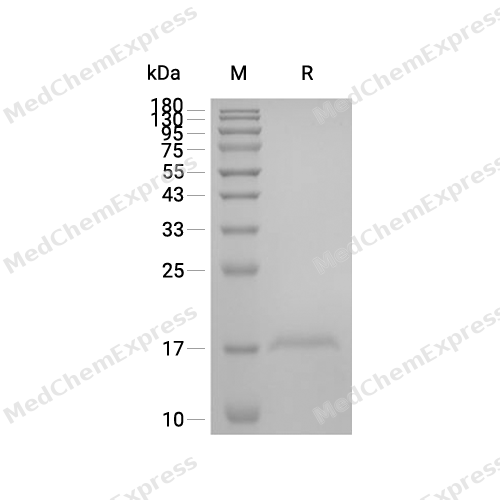
Purity - SDS-PAGE
-
Bioactivity - Cell-Based Assay
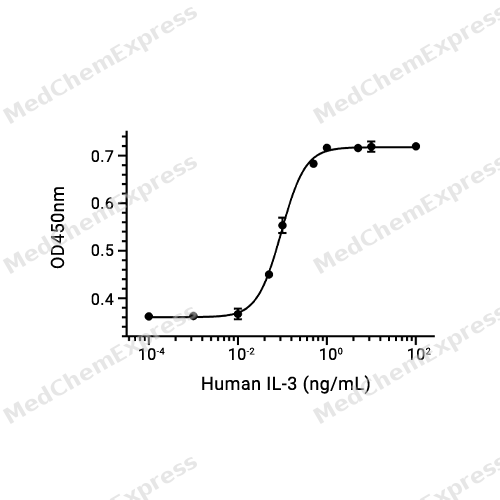
Bioactivity - Cell-Based Assay


Publications (4)
-
Journal Impact Factor
-
Most Recent
-
Nat Commun
Selective targeting of genome amplifications and repeat elements by CRISPR-Cas9 nickases to promote cancer cell death. [Abstract]2025 Jun 2;16(1):5126. PMID: 40456709 -
Commun Biol
Endothelial senescence drives intrinsic skin aging via the neuroimmune CGRP-mast cell axis in mice. [Abstract]2025 Nov 26;8(1):1696. PMID: 41299075 -
Cancer Sci
Integrated Transcriptomic and Functional Analyses Reveal lncRNA-miRNA-mRNA Axis in AML Relapse After Allo-HSCT. [Abstract]2026 May 18. PMID: 42151054 -
Stem Cell Res
Generation of a human induced pluripotent stem cell line (SJTUXHi002-A) from an individual with autism spectrum disorder carrying a heterozygous mutation in GRIA2. [Abstract]2022 Apr;60:102676. PMID: 35134694


Technical Parameters
-
Species Human
-
Source E. coli
-
Tag N-6*His
-
Accession
P08700 (A20-F152)
-
Molecular Construction
-
N-term
-
6*His
-
IL-3 (A20-F152)
Accession # P08700 -
C-term
-
-
Protein Length
Full Length of Mature Protein
-
Synonyms
IL3; Colony-Stimulating Factor, Multiple; Interleukin 3; P-Cell Stimulating Factor; IL-3; P-Cell-Stimulating Factor; Hematopoietic Growth Factor; Mast-Cell Growth Factor; MCGF; Mast Cell Growth Factor; Multipotential Colony-Stimulating Factor; MGC79398; I
-
AA Sequence
APMTQTTPLKTSWVNCSNMIDEIITHLKQPPLPLLDFNNLNGEDQDILMENNLRRPNLEAFNRAVKSLQNASAIESILKNLLPCLPLATAAPTRHPIHIKDGDWNEFRRKLTFYLKTLENAQAQQTTLSLAIF
-
Predicted Molecular Mass
16.6 kDa
-
Molecular Weight
Approximately 16 kDa, based on SDS-PAGE under reducing conditions.
-
Purity
≥ 95%, as determined by reducing SDS-PAGE.


Product Properties
Lyophilized powder
1.Lyophilized from a 0.22 μm filtered solution of PBS, pH 7.4.
2.Lyophilized from a 0.22 μm filtered solution of 20 mM PB, 5% sucrose, 0.05% Tween 80, pH 6.5.
3.Lyophilized from a 0.22 μm filtered solution of PBS, pH 6.2, 5% trehalose, 5% mannitol, 0.01% Tween 80.
Please refer to the lot-specific COA for specific buffer information.
<1 EU/μg, determined by LAL method.
It is not recommended to reconstitute to a concentration less than 100 μg/mL in ddH2O. For long term storage it is recommended to add a carrier protein (0.1% BSA, 5% HSA, 10% FBS or 5% Trehalose).
Stored at -20°C for 2 years from date of receipt. After reconstitution, it is stable at 4°C for 1 week or -20°C for longer (with carrier protein). It is recommended to freeze aliquots at -20°C or -80°C for extended storage.
Room temperature in continental US; may vary elsewhere.


Documentation
-
Data Sheet (236 KB)
-
SDS (251 KB)
- English - EN (251 KB)
- Français - FR (251 KB)
- Deutsch - DE (251 KB)
- Norwegian - NO (251 KB)
- Español - ES (251 KB)
- Swedish - SV (251 KB)
- Italian - IT (251 KB)
- Korean - KR (251 KB)
- Portuguese - PT (251 KB)
-
Handling Instructions (2659 KB)

Calculators
Concentration (start) × Volume (start) = Concentration (final) × Volume (final)


 Powered by Bioz

