



GAS6 Protein, Human (HEK293, His, solution)
Based on 3 publication(s) in Google Scholar
The GAS6 protein is a ligand for AXL, TYRO3 and MER receptors and affects a variety of cellular processes. GAS6/AXL signaling promotes endothelial cell survival, aids cytokine signaling in natural killer cell development, supports liver regeneration, affects gonadotropin-releasing hormone neuron survival and migration, modulates platelet activation, and regulates thrombotic responses. GAS6 Protein, Mouse (HEK293, His) is the recombinant human-derived GAS6 protein, expressed by HEK293 , with C-6*His labeled tag.
- Species: Human
- Source: HEK293
-
Storage:Stored at -80°C for 1 year from date of receipt. It is stable at -20°C for 3 months after opening. It is recommended to freeze aliquots at -80°C for extended storage. Avoid repeated freeze-thaw cycles.


To place orders, for customer services and technical support, please contact: MedChemExpress USA
Tel: 609-228-6898 E-mail: [email protected] [email protected]


-
 Biological Activity
-
Technical Parameters
-
Product Properties
- Documentation
- Help & FAQs




Biological Activity
Description
The GAS6 protein is a ligand for AXL, TYRO3 and MER receptors and affects a variety of cellular processes. GAS6/AXL signaling promotes endothelial cell survival, aids cytokine signaling in natural killer cell development, supports liver regeneration, affects gonadotropin-releasing hormone neuron survival and migration, modulates platelet activation, and regulates thrombotic responses. GAS6 Protein, Mouse (HEK293, His) is the recombinant human-derived GAS6 protein, expressed by HEK293 , with C-6*His labeled tag.
Background
GAS6, a ligand for tyrosine-protein kinase receptors AXL, TYRO3, and MER, is implicated in diverse cellular processes including cell growth, survival, adhesion, and migration. GAS6/AXL signaling contributes to endothelial cell survival under acidic conditions by preventing apoptosis, facilitates optimal cytokine signaling during human natural killer cell development, plays a role in hepatic regeneration, influences gonadotropin-releasing hormone neuron survival and migration, regulates platelet activation, and modulates thrombotic responses. Additionally, in microbial infections, GAS6 can act as a bridge between virus envelope phosphatidylserine and the TAM receptor tyrosine kinase Axl, facilitating viral entry through apoptotic mimicry. This unique function extends to its involvement in the entry processes of diverse viruses, including Dengue, Vaccinia, ebolavirus, and marburgvirus, highlighting the multifaceted roles of GAS6 in cellular and infectious contexts.
MCE Validation Data
-
Purity - SDS-PAGE
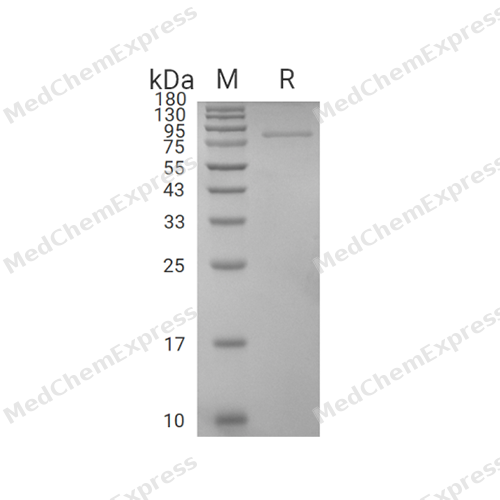
Purity - SDS-PAGE


Publications (3)
-
Journal Impact Factor
-
Most Recent
-
Cell
Comprehensive human proteome profiles across a 50-year lifespan reveal aging trajectories and signatures. [Abstract]2025 Oct 2;188(20):5763-5784.e26. PMID: 40713952 -
Mil Med Res
Single-cell transcriptomic dissection of the cellular and molecular events underlying the triclosan-induced liver fibrosis in mice. [Abstract]2023 Feb 22;10(1):7. PMID: 36814339 -
Mol Hum Reprod
GAS6-mediated dialogue between decidual stromal cells and macrophages is essential for early pregnancy maintenance by inducing M2-like polarization and cell proliferation of decidual macrophages. [Abstract]2022 Mar 8;28(3):gaac006. PMID: 35258594


Technical Parameters
-
Species Human
-
Source HEK293
-
Tag C-6*His
-
Accession
Q14393-2 (A31-A678)
-
Molecular Construction
-
N-term
-
GAS6 (A31-A678)
Accession # Q14393-2 -
6*His
-
C-term
-
-
Protein Length
Full Length of Isoform-2
-
Synonyms
GAS6; AXSF; Prev. AXLLG; DKFZp666G247; AXL Receptor Tyrosine Kinase Ligand; FLJ34709; Growth Arrest-Specific Protein 6; GAS-6; Growth Arrest Specific 6; AXL Stimulatory Factor
-
AA Sequence
ALLPAREATQFLRPRQRRAFQVFEEAKQGHLERECVEELCSREEAREVFENDPETDYFYPRYLDCINKYGSPYTKNSGFATCVQNLPDQCTPNPCDRKGTQACQDLMGNFFCLCKAGWGGRLCDKDVNECSQENGGCLQICHNKPGSFHCSCHSGFELSSDGRTCQDIDECADSEACGEARCKNLPGSYSCLCDEGFAYSSQEKACRDVDECLQGRCEQVCVNSPGSYTCHCDGRGGLKLSQDMDTCEDILPCVPFSVAKSVKSLYLGRMFSGTPVIRLRFKRLQPTRLVAEFDFRTFDPEGILLFAGGHQDSTWIVLALRAGRLELQLRYNGVGRVTSSGPVINHGMWQTISVEELARNLVIKVNRDAVMKIAVAGDLFQPERGLYHLNLTVGGIPFHEKDLVQPINPRLDGCMRSWNWLNGEDTTIQETVKVNTRMQCFSVTERGSFYPGSGFAFYSLDYMRTPLDVGTESTWEVEVVAHIRPAADTGVLFALWAPDLRAVPLSVALVDYHSTKKLKKQLVVLAVEHTALALMEIKVCDGQEHVVTVSLRDGEATLEVDGTRGQSEVSAAQLQERLAVLERHLRSPVLTFAGGLPDVPVTSAPVTAFYRGCMTLEVNRRLLDLDEAAYKHSDITAHSCPPVEPAAA
-
Predicted Molecular Mass
72.7 kDa
-
Molecular Weight
Approximately 80-90 kDa, based on SDS-PAGE under reducing conditions.
-
Glycosylation
Yes
-
Purity
≥ 95%, as determined by reducing SDS-PAGE.


Product Properties
Solution
Supplied as a 0.22 μm filtered solution of PBS, 10% Glycerol, pH 7.4.
<1 EU/μg, determined by LAL method.
Stored at -80°C for 1 year from date of receipt. It is stable at -20°C for 3 months after opening. It is recommended to freeze aliquots at -80°C for extended storage. Avoid repeated freeze-thaw cycles.
Shipping with dry ice.


Documentation
-
Data Sheet (239 KB)
-
SDS (252 KB)
- English - EN (252 KB)
- Français - FR (252 KB)
- Deutsch - DE (252 KB)
- Norwegian - NO (252 KB)
- Español - ES (252 KB)
- Swedish - SV (252 KB)
- Italian - IT (252 KB)
- Korean - KR (252 KB)
- Portuguese - PT (252 KB)
-
Handling Instructions (2659 KB)

Calculators
Concentration (start) × Volume (start) = Concentration (final) × Volume (final)


 Powered by Bioz

