



IFN-gamma Protein, Feline

Based on 1 Customer Validation
IFN-gamma (Interferon-gamma) is a type II interferon produced by immune cells such as T cells and NK cells, which can significantly activate antibacterial, antiviral and anti-tumor responses. Its main JAK-STAT signaling pathway is triggered by interaction with the receptor IFNGR1, affecting gene regulation. IFN-gamma Protein, Feline is the recombinant IFN-gamma protein, expressed by E. coli , with tag free.
- Species: Others
- Source: E. coli
-
Storage:Stored at -20°C for 2 years from date of receipt. After reconstitution, it is stable at 4°C for 1 week or -20°C for longer (with carrier protein). It is recommended to freeze aliquots at -20°C or -80°C for extended storage.


To place orders, for customer services and technical support, please contact: MedChemExpress USA
Tel: 609-228-6898 E-mail: [email protected] [email protected]


-
 Biological Activity
-
Technical Parameters
-
Product Properties
- Documentation
- Help & FAQs




Biological Activity
Description
IFN-gamma (Interferon-gamma) is a type II interferon produced by immune cells such as T cells and NK cells, which can significantly activate antibacterial, antiviral and anti-tumor responses. Its main JAK-STAT signaling pathway is triggered by interaction with the receptor IFNGR1, affecting gene regulation. IFN-gamma Protein, Feline is the recombinant IFN-gamma protein, expressed by E. coli , with tag free.
Background
IFN-gamma (Interferon-gamma), a type II interferon produced by immune cells such as T-cells and NK cells, assumes crucial roles in antimicrobial, antiviral, and antitumor responses by activating effector immune cells and enhancing antigen presentation. Its primary signaling occurs through the JAK-STAT pathway after interaction with its receptor IFNGR1, influencing gene regulation. Upon IFN-gamma binding, the IFNGR1 intracellular domain opens out, facilitating the association of downstream signaling components, including JAK2, JAK1, and STAT1, leading to STAT1 activation, nuclear translocation, and transcription of IFNG-regulated genes. Many of the induced genes are transcription factors, such as IRF1, capable of further driving the regulation of a subsequent wave of transcription. IFN-gamma plays a role in the class I antigen presentation pathway by inducing a replacement of catalytic proteasome subunits with immunoproteasome subunits, thereby increasing the quantity, quality, and repertoire of peptides for class I MHC loading. It enhances the efficiency of peptide generation by inducing the expression of the activator PA28, which associates with the proteasome and alters its proteolytic cleavage preference. Additionally, IFN-gamma up-regulates MHC II complexes on the cell surface by promoting the expression of several key molecules, such as cathepsins B/CTSB, H/CTSH, and L/CTSL, contributing to immune responses. Participating in the regulation of hematopoietic stem cells during development and under homeostatic conditions, IFN-gamma influences their development, quiescence, and differentiation. Existing as a homodimer, IFN-gamma interacts with IFNGR1 via its extracellular domain, a crucial interaction that promotes IFNGR1 dimerization, orchestrating its diverse and critical functions in immune responses and hematopoiesis.
Verified Bioactivity
1.Measured in an anti-viral assay using CRFK feline kidney epithelial cells infected with vesicular stomatitis virus (VSV). The ED50 for this effect is 0.15-0.9 ng/mL.
2.Measured by its ability to inhibit the proliferation of HT-29 human coloncancer cells. The ED50 for this effect is 0.1612 ng/mL, corresponding to a specificactivity is 6.203×10⁶ Unit/mg.
MCE Validation Data
-
Purity - SDS-PAGE
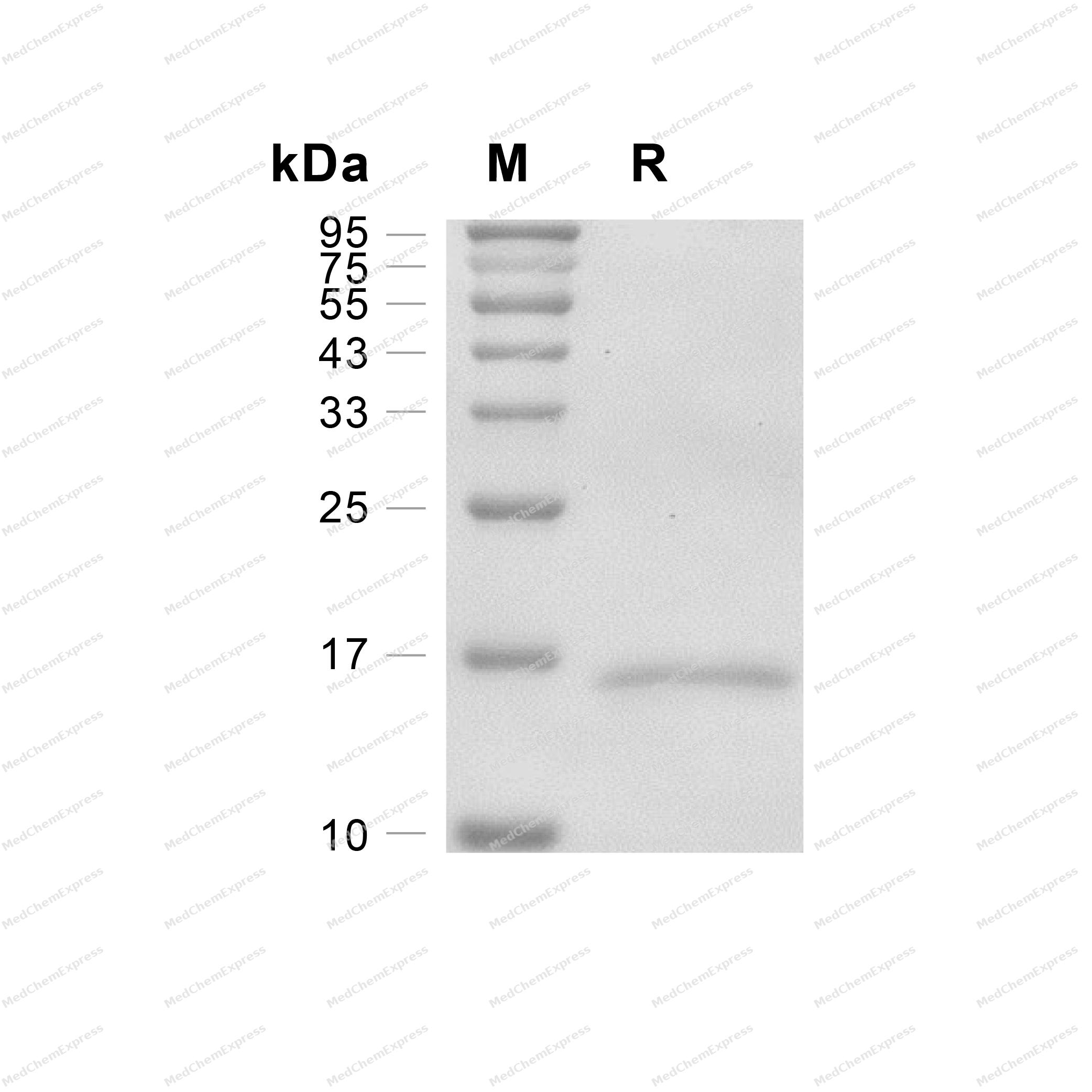
Purity - SDS-PAGE
-
Bioactivity - Cell-Based Assay
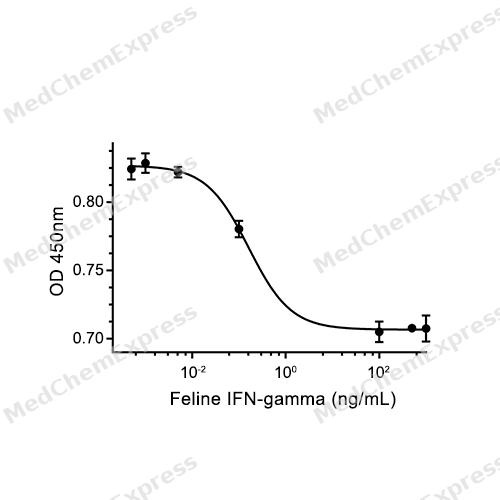
Bioactivity - Cell-Based Assay


Technical Parameters
-
Species Others
-
Source E. coli
-
Tag Tag Free
-
Accession
P46402 (Q24-K167)
-
Molecular Construction
-
N-term
-
IFN-gamma (Q24-K167)
Accession # P46402 -
C-term
-
-
Protein Length
Full Length of Mature Protein
-
Synonyms
IFNG; IMD69; Interferon Gamma; IFG; IFN-Gamma; IFI; Immune Interferon
-
AA Sequence
QAMFFKEIEELKGYFNASNPDVADGGSLFVDILKNWKEESDKTIIQSQIVSFYLKMFENLKDDDQRIQRSMDTIKEDMLDKLLNTSSSKRDDFLKLIQIPVNDLQVQRKAINELFKVMNDLSPRSNLRKRKRSQNLFRGRRASK
-
Predicted Molecular Mass
16.9 kDa
-
Molecular Weight
Approximately 16 kDa, based on SDS-PAGE under reducing conditions.
-
Purity
≥ 95%, as determined by reducing SDS-PAGE.


Product Properties
Lyophilized powder.
Lyophilized from a 0.22 μm filtered solution of 50 mM Tris-HCl, 300 mM NaCl, pH 7.5.
Note: For SPR assay, please replace the buffer. Primary amine components (e.g., Tris, imidazole) can affect protein-coupled chips.
<1 EU/μg, determined by LAL method.
It is not recommended to reconstitute to a concentration less than 100 μg/mL in ddH2O. For long term storage it is recommended to add a carrier protein (0.1% BSA, 5% HSA, 10% FBS or 5% Trehalose).
Stored at -20°C for 2 years from date of receipt. After reconstitution, it is stable at 4°C for 1 week or -20°C for longer (with carrier protein). It is recommended to freeze aliquots at -20°C or -80°C for extended storage.
Room temperature in continental US; may vary elsewhere.


Documentation
-
Data Sheet (261 KB)
-
SDS (252 KB)
- English - EN (252 KB)
- Français - FR (252 KB)
- Deutsch - DE (252 KB)
- Norwegian - NO (252 KB)
- Español - ES (252 KB)
- Swedish - SV (252 KB)
- Italian - IT (252 KB)
- Korean - KR (252 KB)
- Portuguese - PT (252 KB)
-
Handling Instructions (2659 KB)

Calculators
Concentration (start) × Volume (start) = Concentration (final) × Volume (final)


 Powered by Bioz

