



IFN-gamma R1/CD119 Protein, Mouse (HEK293, His)

Based on 1 Customer Validation
IFN-gamma R1 (CD119), one of the subunit of IFN-gamma receptor, is a receptor for IFN-gamma. IFN-gamma R1 forms the functional receptor with IFN-gamma R2. Upon binding with IFN-gamma, IFN-gamma R1 and IFN-gamma R2 oligomerize and transphosphorylate. Then, JAK1 and JAK2 are phosphorylated and activated, and STAT1 is recruited to the receptor complex. Phosphorylated STAT1 translocates to the nucleus, where it regulates the expression of IFN-responsive genes (e.g. CD54). IFN-gamma R1/CD119 Protein, Mouse (HEK293, His) is a recombinant mouse IFN-gamma R1 with C-terminal 6*His tag, which is produced in HEK293 cells.
- Species: Mouse
- Source: HEK293
-
Storage:Stored at -20°C for 2 years from date of receipt. After reconstitution, it is stable at 4°C for 1 week or -20°C for longer (with carrier protein). It is recommended to freeze aliquots at -20°C or -80°C for extended storage.


To place orders, for customer services and technical support, please contact: MedChemExpress USA
Tel: 609-228-6898 E-mail: [email protected] [email protected]


-
 Biological Activity
-
Technical Parameters
-
Product Properties
- Documentation
- References
- Help & FAQs




Biological Activity
Description
IFN-gamma R1 (CD119), one of the subunit of IFN-gamma receptor, is a receptor for IFN-gamma. IFN-gamma R1 forms the functional receptor with IFN-gamma R2. Upon binding with IFN-gamma, IFN-gamma R1 and IFN-gamma R2 oligomerize and transphosphorylate[1]. Then, JAK1 and JAK2 are phosphorylated and activated, and STAT1 is recruited to the receptor complex. Phosphorylated STAT1 translocates to the nucleus, where it regulates the expression of IFN-responsive genes (e.g. CD54)[2]. IFN-gamma R1/CD119 Protein, Mouse (HEK293, His) is a recombinant mouse IFN-gamma R1 with C-terminal 6*His tag, which is produced in HEK293 cells.
Background
IFN-gamma R1 (CD119), one of the subunit of IFN-gamma receptor, is a receptor for IFN-gamma. IFN-gamma R1 is constitutively expressed on the surface of almost all cells[1].
IFN-gamma R1 can associate with IFN-gamma R2 to form a functional receptor. Upon binding with IFN-gamma, IFNγR1 and IFNγR2 oligomerize and transphosphorylate[1]. Then, JAK1 and JAK2 are phosphorylated and activated, and STAT1 is recruited to the receptor complex. The phosphorylation of IFNγR1 creates a docking site for STAT1 and leads to the phosphorylation of STAT1. Phosphorylated STAT1 translocates to the nucleus, where it regulates the expression of IFN-responsive genes (e.g. CD54). IFN-gamma R1 deficiencies are associated with immune responses mediated by IFN-γ, and increased susceptibility to infections. IFN-gamma R1 signaling pathway is important in activating cancer cell death and inhibiting cancer progression[3]
Mouse IFN-gamma R1 consists of extracellular domain (A26-S254), helical domain (I255-Y275), and cytoplasmic domain (W276-S477). The sequence of amino acids in IFNAR1 differs in different species. Mouse IFN-gamma R1 shares 50% aa sequence identity with human.
IFN-gamma R1 plays a critical role in antimicrobial, antiviral, and antitumor responses[2].
In Vitro
IFN-gamma R1 (murine, 0-20 μg/mL, 4 h) suppresses AP(+)-exosome-mediated NO synthesis in RAW264.7 cells[4].
Verified Bioactivity
Measured by its binding ability in a functional ELISA. Immobilized Mouse IFNGR1 at 2 μg/mL (100 μl/well) can bind mouse IFN-gamma (HY-P7071). The ED50 for this effect is 98.32 ng/mL.
MCE Validation Data
-
Purity - SDS-PAGE
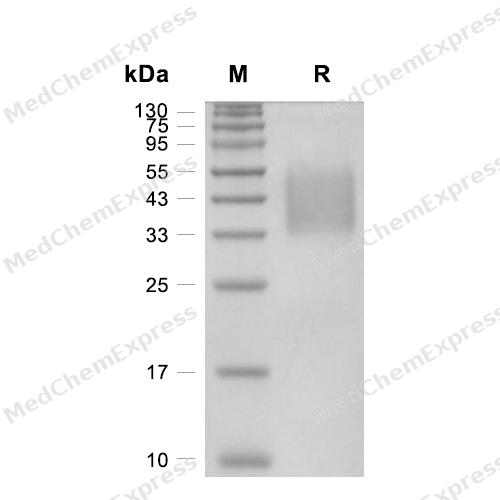
Purity - SDS-PAGE
-
Bioactivity - ELISA
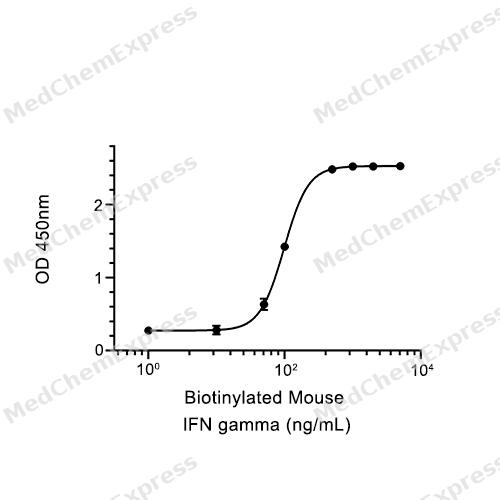
Bioactivity - ELISA


Technical Parameters
-
Species Mouse
-
Source HEK293
-
Tag C-6*His
-
Accession
P15261 (A26-D253)
-
Protein Length
Extracellular Domain
-
Synonyms
IFNGR1; IFN-Gamma-R1; Prev. IFNGR; Interferon Gamma Receptor 1 Isoform 2; CD119; Immune Interferon Receptor 1; Interferon-Gamma Receptor Alpha Chain; Antiviral Protein, Type 2; Interferon Gamma Receptor Alpha-Chain; AVP, Type 2; IFN-Gamma Receptor 1; IMD2
-
AA Sequence
ALTSTEDPEPPSVPVPTNVLIKSYNLNPVVCWEYQNMSQTPIFTVQVKVYSGSWTDSCTNISDHCCNIYEQIMYPDVSAWARVKAKVGQKESDYARSKEFLMCLKGKVGPPGLEIRRKKEEQLSVLVFHPEVVVNGESQGTMFGDGSTCYTFDYTVYVEHNRSGEILHTKHTVEKEECNETLCELNISVSTLDSRYCISVDGISSFWQVRTEKSKDVCIPPFHDDRKD
-
Molecular Weight
Approximately 38-55 kDa, based on SDS-PAGE under reducing conditions.
-
Glycosylation
Yes
-
Purity
≥ 95%, as determined by reducing SDS-PAGE.


Product Properties
Lyophilized powder
1.Lyophilized from a 0.22 μm filtered solution of 20 mM PB, 150 mM NaCl, pH 7.4.
2.Lyophilized from a 0.22 μm filtered solution of PBS, pH 7.4, 8% trehalose.
Please refer to the lot-specific COA for specific buffer information.
<1 EU/μg, determined by LAL method.
It is not recommended to reconstitute to a concentration less than 100 μg/mL in ddH2O. For long term storage it is recommended to add a carrier protein (0.1% BSA, 5% HSA, 10% FBS or 5% Trehalose).
Stored at -20°C for 2 years from date of receipt. After reconstitution, it is stable at 4°C for 1 week or -20°C for longer (with carrier protein). It is recommended to freeze aliquots at -20°C or -80°C for extended storage.
Room temperature in continental US; may vary elsewhere.


Documentation
-
Data Sheet (265 KB)
-
SDS (251 KB)
- English - EN (251 KB)
- Français - FR (251 KB)
- Deutsch - DE (251 KB)
- Norwegian - NO (251 KB)
- Español - ES (251 KB)
- Swedish - SV (251 KB)
- Italian - IT (251 KB)
- Korean - KR (251 KB)
- Portuguese - PT (251 KB)
-
Handling Instructions (2659 KB)


References
[1]. Castro F, et al. Interferon-Gamma at the Crossroads of Tumor Immune Surveillance or Evasion. Front Immunol. 2018 May 4;9:847. [Content Brief]
[2]. van de Vosse E, et al. IFN-γR1 defects: Mutation update and description of the IFNGR1 variation database. Hum Mutat. 2017 Oct;38(10):1286-1296. [Content Brief]
[3]. Ding H, et al. Role of interferon-gamma (IFN-γ) and IFN-γ receptor 1/2 (IFNγR1/2) in regulation of immunity, infection, and cancer development: IFN-γ-dependent or independent pathway. Biomed Pharmacother. 2022 Nov;155:113683. [Content Brief]
[4]. Goto Y, et al. Contribution of the exosome-associated form of secreted endoplasmic reticulum aminopeptidase 1 to exosome-mediated macrophage activation. Biochim Biophys Acta Mol Cell Res. 2018 Jun;1865(6):874-888. [Content Brief]

Calculators
Concentration (start) × Volume (start) = Concentration (final) × Volume (final)


 Powered by Bioz

