



IL-10R beta Protein, Human (HEK293, His-hFc)
Based on 1 Customer Validation
IL-10R beta protein is an IL10 cytokine surface receptor involved in IL10-mediated inflammation and immune regulation, as well as viral defense responses. IL-10R beta Protein, Human (HEK293, His-hFc) is expressed by HEK293 cells and with a His and -hFc tag at the C-terminus.
- Species: Human
- Source: HEK293
-
Storage:Stored at -80°C for 1 year from date of receipt. It is stable at -20°C for 3 months after opening. It is recommended to freeze aliquots at -80°C for extended storage. Avoid repeated freeze-thaw cycles.


To place orders, for customer services and technical support, please contact: MedChemExpress USA
Tel: 609-228-6898 E-mail: [email protected] [email protected]


-
 Biological Activity
-
Technical Parameters
-
Product Properties
- Documentation
- References
- Help & FAQs




Biological Activity
Description
IL-10R beta protein is an IL10 cytokine surface receptor involved in IL10-mediated inflammation and immune regulation, as well as viral defense responses. IL-10R beta Protein, Human (HEK293, His-hFc) is expressed by HEK293 cells and with a His and -hFc tag at the C-terminus[3].
Background
IL-10 receptor complex consists of a heterodimer of four transmembrane chains, two of which form IL-10R alpha and two of which form IL-10R beta. IL-10R beta, originally known as the orphan receptor CRF2-4, is an essential accessory subunit for the active interleukin 10 receptor complex[1].
IL-10R beta can bind to IL-10 via the JAK-STAT pathway, and activation of the IL-10 receptor complex leads to phosphorylation of the receptor-associated proteins TYK and JAK-1, and ultimately to activation of the transcription factors STAT3, STAT1, and STAT5, which regulate the expression of IL-10-responsive genes, including c-myc, bcl-2, and bcl-xL, initiating signal transduction[2].
IL-10R beta is expressed on most cell types and is also a shared cell surface receptor required for the activation of five class II cytokines (IL-10, IL-22, IL-26, IL-28 and IFNL1), which play a key role in host defense, immune regulation. Among them, the IFNLR1/IL10R beta dimer is the receptor for the cytokine ligands IFNL2 and IFNL3 and mediates their antiviral activity[3].
In Vitro
IL-1R beta expression levels increase steadily during neuronal differentiation in human neuronal cells (NT2-N) and can be co-expressed with IL-28Rα, affecting the biological function of cells for IFN-λ[4].
Verified Bioactivity
Immobilized Recombinant Human IL 28 R alpha /IFN lambda R1 at 5 μg/mL (100 μL/well) can bind Biotinylated Recombinant Human IL-10R beta .The ED50 for this effect is 1.967 μg/mL.
MCE Validation Data
-
Bioactivity - ELISA
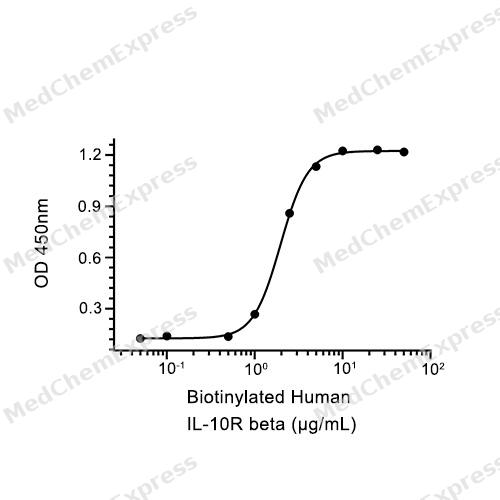
Bioactivity - ELISA


Technical Parameters
-
Species Human
-
Source HEK293
-
Tag C-hFc;C-His
-
Accession
Q08334 (M20-S220)
-
Molecular Construction
-
N-term
-
IL-10Rβ (M20-S220)
Accession # Q08334 -
hFc-His
-
C-term
-
-
Protein Length
Extracellular Domain
-
Synonyms
IL10RB; CDW210B; Prev. D21S58; IL-10 Receptor Subunit Beta; Prev. D21S66; IL-10R Subunit Beta; Prev. CRFB4; IL-10R Subunit 2; IL-10R2; IL-10RB; CRF2-4; Cytokine Receptor Family II, Member 4; Interleukin-10 Receptor Subunit Beta; Cytokine Receptor Class-II
-
AA Sequence
MVPPPENVRMNSVNFKNILQWESPAFAKGNLTFTAQYLSYRIFQDKCMNTTLTECDFSSLSKYGDHTLRVRAEFADEHSDWVNITFCPVDDTIIGPPGMQVEVLADSLHMRFLAPKIENEYETWTMKNVYNSWTYNVQYWKNGTDEKFQITPQYDFEVLRNLEPWTTYCVQVRGFLPDRNKAGEWSEPVCEQTTHDETVPS
-
Predicted Molecular Mass
51.7 kDa
-
Molecular Weight
Approximately 75-85 kDa, based on SDS-PAGE under reducing conditions, due to the glycosylation.
-
Glycosylation
Yes
-
Purity
≥ 90%, as determined by reducing SDS-PAGE.


Product Properties
Solution
Supplied as a 0.22 μm filtered solution of PBS, pH 7.4.
<1 EU/μg, determined by LAL method.
Stored at -80°C for 1 year from date of receipt. It is stable at -20°C for 3 months after opening. It is recommended to freeze aliquots at -80°C for extended storage. Avoid repeated freeze-thaw cycles.
Shipping with dry ice.


Documentation
-
Data Sheet (263 KB)
-
SDS (252 KB)
- English - EN (252 KB)
- Français - FR (252 KB)
- Deutsch - DE (252 KB)
- Norwegian - NO (252 KB)
- Español - ES (252 KB)
- Swedish - SV (252 KB)
- Italian - IT (252 KB)
- Korean - KR (252 KB)
- Portuguese - PT (252 KB)
-
Handling Instructions (2659 KB)


References
[1]. Sung-Il Yoon, et al. Structure and mechanism of receptor sharing by the IL-10R2 common chain. Structure. 2010 May 12;18(5):638-48. [Content Brief]
[2]. J Shi, et al. IL10 inhibits starvation-induced autophagy in hypertrophic scar fibroblasts via cross talk between the IL10-IL10R-STAT3 and IL10-AKT-mTOR pathways. Cell Death Dis. 2016 Mar 10;7(3):e2133. [Content Brief]
[3]. Paul Sheppard, et al. IL-28, IL-29 and their class II cytokine receptor IL-28R. Nat Immunol. 2003 Jan;4(1):63-8. [Content Brief]

Calculators
Concentration (start) × Volume (start) = Concentration (final) × Volume (final)


 Powered by Bioz

