



IL-13 Protein, Mouse (HEK293, His)
Based on 1 publication(s) in Google Scholar
IL-13 protein is a cytokine involved in allergic inflammation, immune response to parasites, and B cell proliferation. IL-13 Protein, Mouse (HEK293, His) is the recombinant mouse-derived IL-13 protein, expressed by HEK293 , with C-6*His labeled tag.
- Species: Mouse
- Source: HEK293
-
Storage:Stored at -20°C for 2 years from date of receipt. After reconstitution, it is stable at 4°C for 1 week or -20°C for longer (with carrier protein). It is recommended to freeze aliquots at -20°C or -80°C for extended storage.


To place orders, for customer services and technical support, please contact: MedChemExpress USA
Tel: 609-228-6898 E-mail: [email protected] [email protected]


-
 Biological Activity
-
Technical Parameters
-
Product Properties
- Documentation
- Help & FAQs




Biological Activity
Description
IL-13 protein is a cytokine involved in allergic inflammation, immune response to parasites, and B cell proliferation. IL-13 Protein, Mouse (HEK293, His) is the recombinant mouse-derived IL-13 protein, expressed by HEK293 , with C-6*His labeled tag.
Background
IL-13 Protein assumes pivotal roles in allergic inflammation and the immune response to parasite infection. It synergizes with IL2 in regulating interferon-gamma synthesis, stimulating B-cell proliferation, and activating eosinophils, basophils, and mast cells. Beyond its immunological functions, IL-13 plays a crucial role in controlling IL33 activity by modulating the production of transmembrane and soluble forms of interleukin-1 receptor-like 1/IL1RL1. It demonstrates the capacity to antagonize Th1-driven proinflammatory immune responses and downregulates the synthesis of various proinflammatory cytokines, including IL1, IL6, IL10, IL12, and TNF-alpha, partly through the suppression of NF-kappa-B. Not confined to hematopoietic cells, IL-13 also acts on nonhematopoietic cells such as endothelial cells, inducing vascular cell adhesion protein 1/VCAM1, which is crucial in the recruitment of eosinophils. Its biological effects are mediated through receptors comprising the IL4R chain and the IL13RA1 chain, activating JAK1 and TYK2, ultimately leading to the activation of STAT6. Besides IL13RA1, another receptor, IL13RA2, acts as a high-affinity decoy for IL-13, mediating internalization and depletion of extracellular IL-13. IL-13 interacts directly with IL13RA2, further illustrating the complexity of its regulatory mechanisms.
Verified Bioactivity
Measured in a cell proliferation assay using TF-1 human erythroleukemic cells. The ED50 for this effect is 1.796-51.29 ng/mL.
MCE Validation Data
-
Bioactivity - Cell-Based Assay
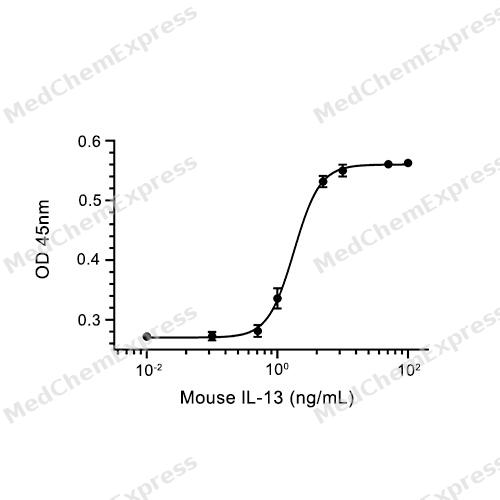
Bioactivity - Cell-Based Assay


Publications (1)
-
Journal Impact Factor
-
Most Recent
-
Adv Sci (Weinh)
Spatial Transcriptomics Reveals Transcriptomic and Immune Microenvironment Reprogramming during Thyroid Carcinoma Dedifferentiation. [Abstract]2025 Sep 4:e06925. PMID: 40908584


Technical Parameters
-
Species Mouse
-
Source HEK293
-
Tag C-6*His
-
Accession
P20109 (P22-F131)
-
Molecular Construction
-
N-term
-
IL-13 (P22-F131)
Accession # P20109 -
6*His
-
C-term
-
-
Protein Length
Full Length of Mature Protein
-
Synonyms
IL13; MGC116789; Interleukin 13; ALRH; IL-13; BHR1; Interleukin-13; Bronchial Hyperresponsiveness-1 (Bronchial Asthma); P600; Allergic Rhinitis; MGC116786; NC30; MGC116788
-
AA Sequence
PVPRSVSLPLTLKELIEELSNITQDQTPLCNGSMVWSVDLAAGGFCVALDSLTNISNCNAIYRTQRILHGLCNRKAPTTVSSLPDTKIEVAHFITKLLSYTKQLFRHGPF
-
Predicted Molecular Mass
13.1 kDa
-
Molecular Weight
Approximately 14-30 kDa, based on SDS-PAGE under reducing conditions.
-
Glycosylation
Yes
-
Purity
≥ 95%, as determined by reducing SDS-PAGE.


Product Properties
Lyophilized powder
Lyophilized from a 0.22 μm filtered solution of PBS, pH 7.4.
<1 EU/μg, determined by LAL method.
It is not recommended to reconstitute to a concentration less than 100 μg/mL in ddH2O. For long term storage it is recommended to add a carrier protein (0.1% BSA, 5% HSA, 10% FBS or 5% Trehalose).
Stored at -20°C for 2 years from date of receipt. After reconstitution, it is stable at 4°C for 1 week or -20°C for longer (with carrier protein). It is recommended to freeze aliquots at -20°C or -80°C for extended storage.
Room temperature in continental US; may vary elsewhere.


Documentation
-
Data Sheet (236 KB)
-
SDS (251 KB)
- English - EN (251 KB)
- Français - FR (251 KB)
- Deutsch - DE (251 KB)
- Norwegian - NO (251 KB)
- Español - ES (251 KB)
- Swedish - SV (251 KB)
- Italian - IT (251 KB)
- Korean - KR (251 KB)
- Portuguese - PT (251 KB)
-
Handling Instructions (2659 KB)

Calculators
Concentration (start) × Volume (start) = Concentration (final) × Volume (final)


 Powered by Bioz

