



IL-17A Protein, Rat (His)
Based on 1 publication(s) in Google Scholar
The IL-17A protein has important heterodimerization and homodimerization activities and is involved in a variety of processes, including responses to glucocorticoid stimulation and the regulation of cell death and transcription. IL-17A is present in the cytoplasm and extracellular space and has been implicated in diseases such as pancreatitis, inflammatory bowel disease, renal disease, and periodontal disease, and may serve as a biomarker. IL-17A Protein, Rat is the recombinant rat-derived IL-17A protein, expressed by E. coli.
- Species: Rat
- Source: E. coli
-
Storage:Stored at -20°C for 2 years from date of receipt. After reconstitution, it is stable at 4°C for 1 week or -20°C for longer (with carrier protein). It is recommended to freeze aliquots at -20°C or -80°C for extended storage.


To place orders, for customer services and technical support, please contact: MedChemExpress USA
Tel: 609-228-6898 E-mail: [email protected] [email protected]


-
 Biological Activity
-
Technical Parameters
-
Product Properties
- Documentation
- Help & FAQs




Biological Activity
Description
The IL-17A protein has important heterodimerization and homodimerization activities and is involved in a variety of processes, including responses to glucocorticoid stimulation and the regulation of cell death and transcription. IL-17A is present in the cytoplasm and extracellular space and has been implicated in diseases such as pancreatitis, inflammatory bowel disease, renal disease, and periodontal disease, and may serve as a biomarker. IL-17A Protein, Rat is the recombinant rat-derived IL-17A protein, expressed by E. coli.
Background
IL-17A Protein is predicted to play a crucial role in protein heterodimerization and homodimerization activities. It is involved in various biological processes, including the cellular response to glucocorticoid stimulus, positive regulation of necrotic cell death, and positive regulation of transcription by RNA polymerase II. This protein is found in both the cytoplasm and extracellular space. IL-17A is implicated in numerous diseases, including acute necrotizing pancreatitis, inflammatory bowel disease, lipoid nephrosis, lung diseases, and periodontal diseases, serving as a biomarker for these conditions. It is also associated with specific ailments such as anti-basement membrane glomerulonephritis, congestive heart failure, myocarditis, pleurisy, and uveitis. Furthermore, IL-17A's human ortholog, interleukin 17A, is linked to diseases like Mycobacterium avium complex disease, autoimmune diseases, bronchial diseases, macular degeneration, and rhinitis. Despite its low expression in the reference dataset, IL-17A remains a key player in immune response and disease pathology.
Verified Bioactivity
Measured by its ability to induce IL-6 secretion by NIH-3T3 mouse embryonic fibroblast cells. The ED50 for this effect is 0.7119 ng/mL, corresponding to a specific activity is 1.4×10⁶ U/mg.
MCE Validation Data
-
Purity - SDS-PAGE
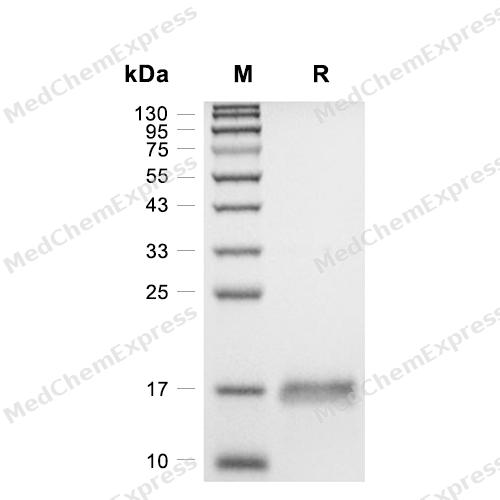
Purity - SDS-PAGE
-
Bioactivity - Cell-Based Assay
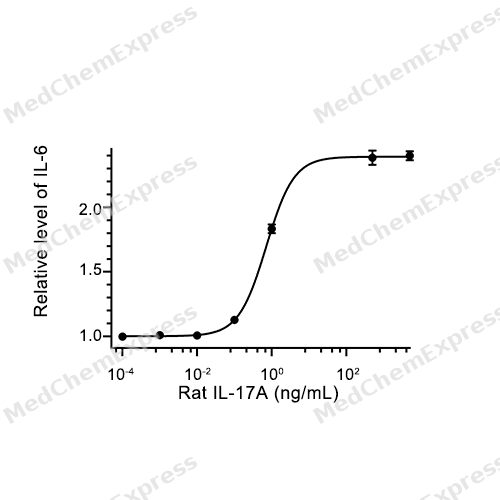
Bioactivity - Cell-Based Assay


Publications (1)
-
Journal Impact Factor
-
Most Recent
-
Adv Sci (Weinh)
Depletion of p75NTR in Schwann Cells Driven by Inflammation Mediates Cutaneous Pain in Psoriasis. [Abstract]2026 Jun;13(34):e23189. PMID: 41933938


Technical Parameters
-
Species Rat
-
Source E. coli
-
Tag N-6*His
-
Accession
NP_001100367 (A26-S158)
-
Molecular Construction
-
N-term
-
IL-17A (A26-S158)
Accession # NP_001100367 -
C-term
-
-
Protein Length
Full Length of Mature Protein
-
Synonyms
IL17A; Cytotoxic T-Lymphocyte-Associated Protein 8; Prev. CTLA8; Interleukin-17A; Prev. IL17; CTLA-8; IL-17A; Interleukin-17; IL-17; ILA17; Interleukin 17 (Cytotoxic T-Lymphocyte-Associated Serine Esterase 8); Interleukin 17A; Cytotoxic T-Lymphocyte-Assoc
-
AA Sequence
AVLIPQSSVCPNAEANNFLQNVKVNLKVLNSLSSKASSRRPSDYLNRSTSPWTLSRNEDPDRYPSVIWEAQCRHQRCVNAEGKLDHHMNSVLIQQEILVLKREPEKCPFTFRVEKMLVGVGCTCVSSIVRHAS
-
Predicted Molecular Mass
15 kDa
-
Molecular Weight
Approximately 17 kDa, based on SDS-PAGE under reducing conditions.
-
Purity
≥ 95%, as determined by reducing SDS-PAGE.


Product Properties
Lyophilized powder.
Lyophilized from a 0.22 μm filtered solution of PBS, pH 7.4.
<1 EU/μg, determined by LAL method.
It is not recommended to reconstitute to a concentration less than 100 μg/mL in ddH2O. For long term storage it is recommended to add a carrier protein (0.1% BSA, 5% HSA, 10% FBS or 5% Trehalose).
Stored at -20°C for 2 years from date of receipt. After reconstitution, it is stable at 4°C for 1 week or -20°C for longer (with carrier protein). It is recommended to freeze aliquots at -20°C or -80°C for extended storage.
Room temperature in continental US; may vary elsewhere.


Documentation
-
Data Sheet (236 KB)
-
SDS (251 KB)
- English - EN (251 KB)
- Français - FR (251 KB)
- Deutsch - DE (251 KB)
- Norwegian - NO (251 KB)
- Español - ES (251 KB)
- Swedish - SV (251 KB)
- Italian - IT (251 KB)
- Korean - KR (251 KB)
- Portuguese - PT (251 KB)
-
Handling Instructions (2659 KB)

Calculators
Concentration (start) × Volume (start) = Concentration (final) × Volume (final)


 Powered by Bioz

