



IL-5 Protein, Mouse (CHO)
Based on 1 Customer Validation
IL-5 Protein, Mouse (CHO) is a CHO cell derived hematopoietic growth factor expressed in Th2, mast cells and eosinophils.
- Species: Mouse
- Source: CHO
-
Storage:Stored at -20°C for 2 years from date of receipt. After reconstitution, it is stable at 4°C for 1 week or -20°C for longer (with carrier protein). It is recommended to freeze aliquots at -20°C or -80°C for extended storage.


To place orders, for customer services and technical support, please contact: MedChemExpress USA
Tel: 609-228-6898 E-mail: [email protected] [email protected]


-
 Biological Activity
-
Technical Parameters
-
Product Properties
- Documentation
- References
- Help & FAQs




Biological Activity
Description
IL-5 Protein, Mouse (CHO) is a CHO cell derived hematopoietic growth factor expressed in Th2, mast cells and eosinophils.
Background
Interleukin-5 (IL-5), which is produced primarily by type 2 T helper lymphocytes (Th2), is an eosinophil differentiation and activation factor. Antagonism of IL-5 activity is being explored as a potential treatment of a number of disease conditions associated with eosinophils in animal models[1]. Interleukin-5 (IL-5) which was previously named T cell replacing factor, B cell growth and differentiation factor, colony forming unit growth stimulating factor and eosinophil differentiation factor is produced predominantly by T cells. Mouse IL-5 is active as a growth factor on mouse but not human B cells. Mouse IL-5 stimulates the production and secretion of IgM and IgA by B cells in synergism with bacterial endotoxins. IL-5 has also been found to promote the generation of cytotoxic cells from human and mouse thymocytes. IL-5 is a potent growth promoter of early haemopoeitic progenitor cells. It stimulates the production of eosinophits from mouse, human and sheep in vitro and controls the production of eosinophils in vivo. Mouse IL-5 possesses eosinophil potentiating activity[2].
Verified Bioactivity
Measured in a cell proliferation assay using TF-1 human erythroleukemic cells. The ED50 for this effect is 0.1832-0.5 ng/mL, corresponding to a specific activity is 2×10⁶ - 5.46×10⁶ units/mg.
MCE Validation Data
-
Purity - SDS-PAGE
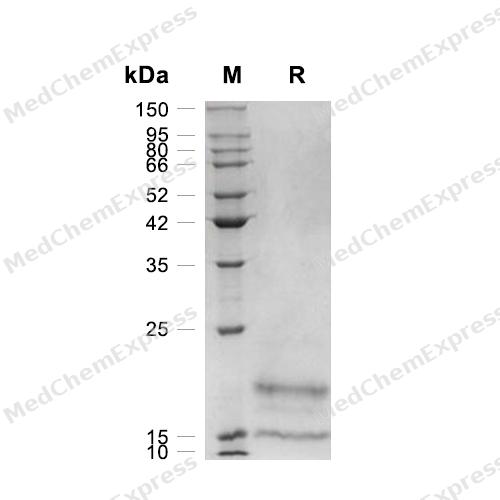
Purity - SDS-PAGE
-
Bioactivity - Cell-Based Assay
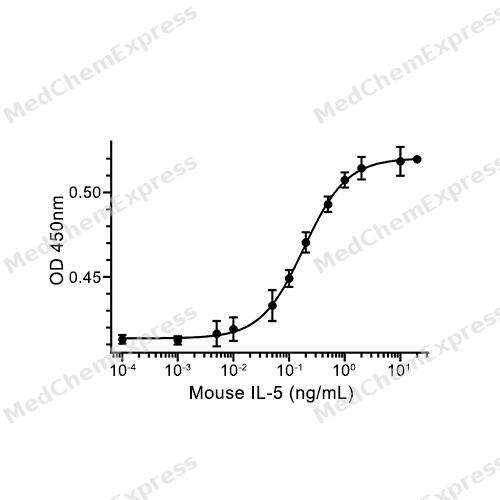
Bioactivity - Cell-Based Assay


Technical Parameters
-
Species Mouse
-
Source CHO
-
Tag Tag Free
-
Accession
P04401 (M21-G133)
-
Molecular Construction
-
N-term
-
IL-5 (M21-G133)
Accession # P04401 -
C-term
-
-
Protein Length
Full Length of Mature Protein
-
Synonyms
IL5; T-Cell Replacing Factor; Interleukin 5; EDF; Eosinophil Differentiation Factor; Colony-Stimulating Factor, Eosinophil; Interleukin-5; B-Cell Differentiation Factor I; IL-5; Interleukin 5 (Colony-Stimulating Factor, Eosinophil); TRF; B Cell Differenti
-
AA Sequence
MEIPMSTVVKETLTQLSAHRALLTSNETMRLPVPTHKNHQLCIGEIFQGLDILKNQTVRGGTVEMLFQNLSLIKKYIDRQKEKCGEERRRTRQFLDYLQEFLGVMSTEWAMEG
-
Molecular Weight
Approximately 15-20, based on SDS-PAGE under reducing conditions, due to the glycosylation.
-
Glycosylation
Yes
-
Purity
≥ 95%, as determined by reducing SDS-PAGE.


Product Properties
Lyophilized powder.
1.Lyophilized from a 0.22 μm filtered solution of PBS.
2.Lyophilized from a 0.22 μm filtered solution of 20 mM PB, 150 mM NaCl, pH 7.4.
Please refer to the lot-specific COA for specific buffer information.
<0.2 EU/μg, determined by LAL method.
It is not recommended to reconstitute to a concentration less than 100 μg/mL in ddH2O. For long term storage it is recommended to add a carrier protein (0.1% BSA, 5% HSA, 10% FBS or 5% Trehalose).
Stored at -20°C for 2 years from date of receipt. After reconstitution, it is stable at 4°C for 1 week or -20°C for longer (with carrier protein). It is recommended to freeze aliquots at -20°C or -80°C for extended storage.
Room temperature in continental US; may vary elsewhere.


Documentation
-
Data Sheet (262 KB)
-
SDS (252 KB)
- English - EN (252 KB)
- Français - FR (252 KB)
- Deutsch - DE (252 KB)
- Norwegian - NO (252 KB)
- Español - ES (252 KB)
- Swedish - SV (252 KB)
- Italian - IT (252 KB)
- Korean - KR (252 KB)
- Portuguese - PT (252 KB)
-
Handling Instructions (2659 KB)


References
[1]. Yang S, et al. Canine interleukin-5: molecular characterization of the gene and expression of biologically active recombinant protein. J Interferon Cytokine Res. 2001 Jun;21(6):361-7. [Content Brief]
[2]. Seow HF, et al. Cloning and sequencing of an ovine interleukin-5 cDNA. DNA Seq. 1996;6(6):331-5. [Content Brief]

Calculators
Concentration (start) × Volume (start) = Concentration (final) × Volume (final)


 Powered by Bioz

