



KGF/FGF-7 Protein, Human (Biotinylated, His)

Based on 1 Customer Validation
KGF/FGF-7 proteins coordinate embryonic development and regulate basic processes such as cell proliferation and differentiation. Its critical role extends to normal branching morphogenesis. KGF/FGF-7 Protein, Human (Biotinylated, His) is the recombinant human-derived KGF/FGF-7 protein, expressed by E. coli , with N-His labeled tag.
- Species: Human
- Source: E. coli
-
Storage:Stored at -80°C for 1 year from date of receipt. It is stable at -20°C for 3 months after opening. It is recommended to freeze aliquots at -80°C for extended storage. Avoid repeated freeze-thaw cycles.


To place orders, for customer services and technical support, please contact: MedChemExpress USA
Tel: 609-228-6898 E-mail: [email protected] [email protected]


-
 Biological Activity
-
Technical Parameters
-
Product Properties
- Documentation
- Help & FAQs




Biological Activity
Description
KGF/FGF-7 proteins coordinate embryonic development and regulate basic processes such as cell proliferation and differentiation. Its critical role extends to normal branching morphogenesis. KGF/FGF-7 Protein, Human (Biotinylated, His) is the recombinant human-derived KGF/FGF-7 protein, expressed by E. coli , with N-His labeled tag.
Background
KGF/FGF-7 Protein assumes a crucial role in orchestrating embryonic development, exhibiting regulatory control over fundamental processes encompassing cell proliferation and differentiation. Its essential contribution extends to the intricate realm of normal branching morphogenesis, where KGF/FGF-7 plays a pivotal role. As a growth factor specifically active on keratinocytes, it emerges as a potential major paracrine effector governing normal epithelial cell proliferation. The protein establishes key interactions, forming complexes with FGFBP1 and FGFR2, and its binding affinity with fibroblast growth factors (FGFs) and their receptors is augmented by heparan sulfate glycosaminoglycans, acting as critical coreceptors in these molecular interactions.
Verified Bioactivity
Measured in a cell proliferation assay using 4MBr5 rhesus monkey epithelial cells. The ED50 for this effect is 6-60 ng/mL.
MCE Validation Data
-
Purity - SDS-PAGE
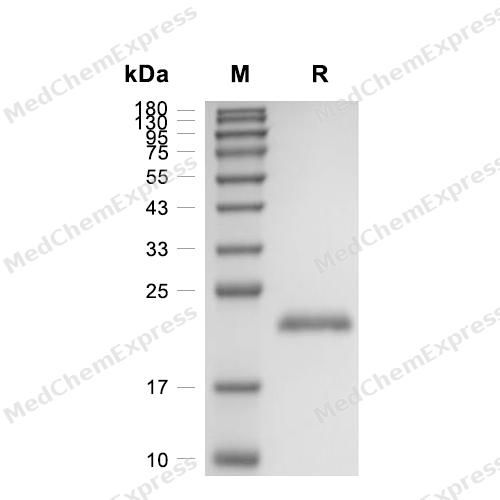
Purity - SDS-PAGE
-
Bioactivity - Cell-Based Assay
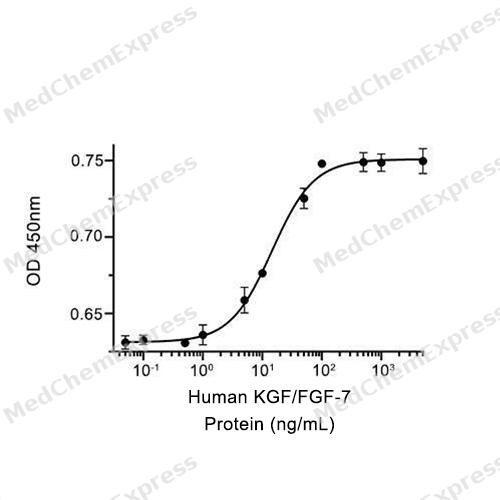
Bioactivity - Cell-Based Assay


Technical Parameters
-
Species Human
-
Source E. coli
-
Tag N-8*His
-
Accession
P21781-1 (C32-T194)
-
Molecular Construction
-
N-term
-
8*His
-
KGF/FGF-7 (C32-T194)
Accession # P21781-1 -
C-term
-
-
Protein Length
Full Length of Isoform-1
-
Conjugation
Biotin
-
Conjugate Method
The biotin is covalently conjugated to the primary amine groups of the protein using chemical labeling methods.
-
Synonyms
FGF7; HBGF-7; Fibroblast Growth Factor 7; FGF-7; KGF; Fibroblast Growth Factor 7 (Keratinocyte Growth Factor); Keratinocyte Growth Factor; Fibroblast Growth Factor; Heparin-Binding Growth Factor 7; FGF
-
AA Sequence
CNDMTPEQMATNVNCSSPERHTRSYDYMEGGDIRVRRLFCRTQWYLRIDKRGKVKGTQEMKNNYNIMEIRTVAVGIVAIKGVESEFYLAMNKEGKLYAKKECNEDCNFKELILENHYNTYASAKWTHNGGEMFVALNQKGIPVRGKKTKKEQKTAHFLPMAIT
-
Predicted Molecular Mass
20 kDa
-
Molecular Weight
Approximately 15-20 kDa, based on SDS-PAGE under reducing conditions.
-
Purity
≥ 95%, as determined by reducing SDS-PAGE.


Product Properties
Solution
Supplied as a 0.22 μm filtered solution of 50 mM Tris, 250 mM NaCl, pH 7.5.
Note: For SPR assay, please replace the buffer. Primary amine components (e.g., Tris, imidazole) can affect protein-coupled chips.
<1 EU/μg, determined by LAL method.
Stored at -80°C for 1 year from date of receipt. It is stable at -20°C for 3 months after opening. It is recommended to freeze aliquots at -80°C for extended storage. Avoid repeated freeze-thaw cycles.
Shipping with dry ice.


Documentation
-
Data Sheet (236 KB)
-
SDS (252 KB)
- English - EN (252 KB)
- Français - FR (252 KB)
- Deutsch - DE (252 KB)
- Norwegian - NO (252 KB)
- Español - ES (252 KB)
- Swedish - SV (252 KB)
- Italian - IT (252 KB)
- Korean - KR (252 KB)
- Portuguese - PT (252 KB)
-
Handling Instructions (2659 KB)

Calculators
Concentration (start) × Volume (start) = Concentration (final) × Volume (final)


 Powered by Bioz

