



CD4 Protein, Human (HEK293, His)
Based on 1 Customer Validation
CD4 Protein is an integrated membrane glycoprotein that plays various roles in immune responses and defending against internal and external attacks. The alpha-helix structure of CD4 Protein and HIV-1 Vpu can be involved in the binding and degradation of CD4 molecules. CD4 Protein participates in the differentiation/activation, cytokine expression, and cell migration in macrophages or NK cells through a TCR/LCK-independent pathway. CD4 Protein can enhance the host's immune response to viral infections and boost anti-tumor immunity. CD4 Protein, Human (HEK293, His) is a recombinant CD4 protein with a His tag, expressed in HEK293.
- Species: Human
- Source: HEK293
-
Storage:Stored at -20°C for 2 years from date of receipt. After reconstitution, it is stable at 4°C for 1 week or -20°C for longer (with carrier protein). It is recommended to freeze aliquots at -20°C or -80°C for extended storage.


To place orders, for customer services and technical support, please contact: MedChemExpress USA
Tel: 609-228-6898 E-mail: [email protected] [email protected]


-
 Biological Activity
-
Technical Parameters
-
Product Properties
- Documentation
- References
- Help & FAQs




Biological Activity
Description
CD4 Protein is an integrated membrane glycoprotein that plays various roles in immune responses and defending against internal and external attacks. The alpha-helix structure of CD4 Protein and HIV-1 Vpu can be involved in the binding and degradation of CD4 molecules. CD4 Protein participates in the differentiation/activation, cytokine expression, and cell migration in macrophages or NK cells through a TCR/LCK-independent pathway. CD4 Protein can enhance the host's immune response to viral infections and boost anti-tumor immunity. CD4 Protein, Human (HEK293, His) is a recombinant CD4 protein with a His tag, expressed in HEK293.
Background
CD4 Protein is expressed on T helper cells and cytotoxic lymphocytes, interacting with class II major histocompatibility complex (MHC) antigens to mediate cell adhesion[4]. The expression of CD4 Protein in NK cells can promote the production of cytokines TNF-α and γ-IFN. These cytokines act as important mediators that enhance the host's immune response to viral infections and boost anti-tumor immunity. Additionally, CD4 Protein can mediate the migration of NK cells towards the chemokine IL-16, allowing NK cells to move to the site of acute inflammation, thereby enhancing their innate immune response capability[2]. CD4 protein can trigger the activation of Src family kinases, ERK1/2, and MAPK-dependent pathways, leading to the differentiation of monocytes into macrophages and resulting in increased expression of TLR8, thereby regulating the innate immune response; it can also induce calcium flux and signal transduction by participating in the ERK/MAPK/NF-κB pathway[3]. CD4 Protein can be downregulated and degraded by Vpu, and this proteolytic activity requires the phosphorylation of the phosphate receptor sites Ser52 and Ser56, as well as the presence of a second helical structure in the distal cytoplasmic region of Vpu[1]. CD4 protein is closely related to diseases like tumors and viral infections[2].
In Vitro
The expression of CD4 Protein in NK cells can promote the production of cytokines TNF - α and γ - IFN and the migration of NK cells towards CD4 specific chemokine IL-16[2]. CD4 Protein connects with human monocytes, triggers macrophage differentiation, and enhances HIV infection[4].
In Vivo
CD4 Protein is expressed in a mouse model with endogenous CD4 gene disruption but human CD4 transgenic, thereby restoring helper T cell function[5].
Verified Bioactivity
1.Measured by the ability of the immobilized protein to support the adhesion of Hela human cervical epithelial carcinoma cells. The ED50 this effect is 1.335-1.418 μg/mL, corresponding to a specific activity is 705.22-749.06 units/mg.
2.Loaded Semzuvolimab (HY-P9998) on ProA biosensor, can bind CD4 Protein, Human (HEK293, His) with an affinity constant of 6.956E-09 M as determined in BLI assay.
MCE Validation Data
-
Purity - SDS-PAGE
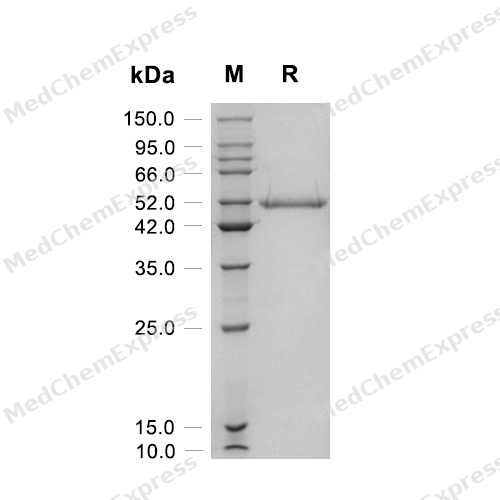
Purity - SDS-PAGE
-
Bioactivity - BLI
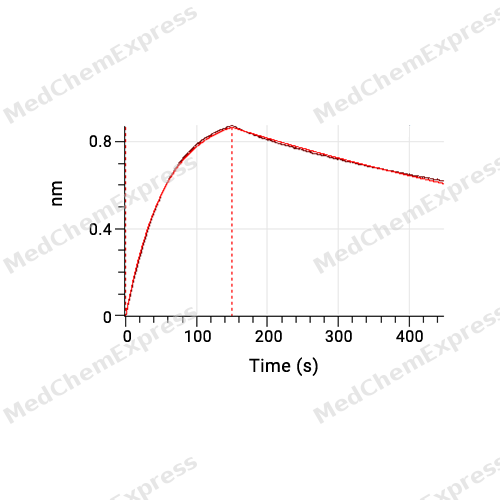
Bioactivity - BLI


Technical Parameters
-
Species Human
-
Source HEK293
-
Tag C-6*His
-
Accession
P01730 (K26-W390)
-
Molecular Construction
-
N-term
-
CD4 (K26-W390)
Accession # P01730 -
6*His
-
C-term
-
-
Protein Length
Partial Extracellular Domain
-
Synonyms
CD4; CD4 Receptor; CD4 Molecule; Surface Glycoprotein Variant; T-Cell Surface Glycoprotein CD4; CD4 Antigen; T-Cell Surface Antigen T4/Leu-3; CD4 Protein; Leu-3; CD4mut; T4; IMD79; CD4 Antigen (P55); OKT4D
-
AA Sequence
KKVVLGKKGDTVELTCTASQKKSIQFHWKNSNQIKILGNQGSFLTKGPSKLNDRADSRRSLWDQGNFPLIIKNLKIEDSDTYICEVEDQKEEVQLLVFGLTANSDTHLLQGQSLTLTLESPPGSSPSVQCRSPRGKNIQGGKTLSVSQLELQDSGTWTCTVLQNQKKVEFKIDIVVLAFQKASSIVYKKEGEQVEFSFPLAFTVEKLTGSGELWWQAERASSSKSWITFDLKNKEVSVKRVTQDPKLQMGKKLPLHLTLPQALPQYAGSGNLTLALEAKTGKLHQEVNLVVMRATQLQKNLTCEVWGPTSPKLMLSLKLENKEAKVSKREKAVWVLNPEAGMWQCLLSDSGQVLLESNIKVLPTW
-
Molecular Weight
Approximately 49-58 kDa, based on SDS-PAGE under reducing conditions, due to the glycosylation.
-
Glycosylation
Yes
-
Purity
≥ 95%, as determined by reducing SDS-PAGE.


Product Properties
Lyophilized powder.
Lyophilized from a 0.2 μm filtered solution of PBS, pH 7.4 or 20 mM PB, 150 mM NaCl, pH 7.4.
<1 EU/μg, determined by LAL method.
It is not recommended to reconstitute to a concentration less than 100 μg/mL in ddH2O. For long term storage it is recommended to add a carrier protein (0.1% BSA, 5% HSA, 10% FBS or 5% Trehalose).
Stored at -20°C for 2 years from date of receipt. After reconstitution, it is stable at 4°C for 1 week or -20°C for longer (with carrier protein). It is recommended to freeze aliquots at -20°C or -80°C for extended storage.
Room temperature in continental US;may vary elsewhere.


Documentation
-
Data Sheet (266 KB)
-
SDS (252 KB)
- English - EN (252 KB)
- Français - FR (252 KB)
- Deutsch - DE (252 KB)
- Norwegian - NO (252 KB)
- Español - ES (252 KB)
- Swedish - SV (252 KB)
- Italian - IT (252 KB)
- Korean - KR (252 KB)
- Portuguese - PT (252 KB)
-
Handling Instructions (2659 KB)


References
[1]. Tiganos E, et al. Putative alpha-helical structures in the human immunodeficiency virus type 1 Vpu protein and CD4 are involved in binding and degradation of the CD4 molecule. J Virol. 1997 Jun;71(6):4452-60. [Content Brief]
[2]. Bernstein HB, et al. CD4 expression on activated NK cells: ligation of CD4 induces cytokine expression and cell migration. J Immunol. 2006 Sep 15;177(6):3669-76. [Content Brief]
[3]. Zhen A, et al. CD4 ligation on human blood monocytes triggers macrophage differentiation and enhances HIV infection. J Virol. 2014 Sep 1;88(17):9934-46. [Content Brief]
[4]. Doyle C, et al. Interaction between CD4 and class II MHC molecules mediates cell adhesion. Nature. 1987 Nov 19-25;330(6145):256-9. [Content Brief]
[5]. Killeen N, et al. Regulated expression of human CD4 rescues helper T cell development in mice lacking expression of endogenous CD4. EMBO J. 1993 Apr;12(4):1547-53. [Content Brief]

Calculators
Concentration (start) × Volume (start) = Concentration (final) × Volume (final)


 Powered by Bioz

