



Serpin E1 Protein, Human (HEK293, His)
Based on 2 publication(s) in Google Scholar
Serpin E1 is a serine protease inhibitor that regulates various cellular processes by inhibiting TMPRSS7, tissue-type plasminogen activator (PLAT), and urokinase-type plasminogen activator (PLAU). During fibrinolysis, it downregulates PLAT to control thrombus degradation and acts as a PLAU inhibitor to regulate cell adhesion. Serpin E1 Protein, Human (HEK293, His) is the recombinant human-derived Serpin E1 protein, expressed by HEK293 , with C-6*His labeled tag.
- Species: Human
- Source: HEK293
-
Storage:Stored at -20°C for 2 years from date of receipt. After reconstitution, it is stable at 4°C for 1 week or -20°C for longer (with carrier protein). It is recommended to freeze aliquots at -20°C or -80°C for extended storage.


To place orders, for customer services and technical support, please contact: MedChemExpress USA
Tel: 609-228-6898 E-mail: [email protected] [email protected]


-
 Biological Activity
-
Technical Parameters
-
Product Properties
- Documentation
- Help & FAQs




Biological Activity
Description
Serpin E1 is a serine protease inhibitor that regulates various cellular processes by inhibiting TMPRSS7, tissue-type plasminogen activator (PLAT), and urokinase-type plasminogen activator (PLAU). During fibrinolysis, it downregulates PLAT to control thrombus degradation and acts as a PLAU inhibitor to regulate cell adhesion. Serpin E1 Protein, Human (HEK293, His) is the recombinant human-derived Serpin E1 protein, expressed by HEK293 , with C-6*His labeled tag.
Background
Serpin E1, a serine protease inhibitor, exerts its regulatory influence on various cellular processes. It inhibits TMPRSS7 and serves as the primary inhibitor for both tissue-type plasminogen activator (PLAT) and urokinase-type plasminogen activator (PLAU). In the context of fibrinolysis, Serpin E1 is crucial for down-regulating PLAT, contributing to the controlled degradation of blood clots. Simultaneously, as a PLAU inhibitor, it plays a role in modulating cell adhesion and spreading. Beyond its function as a protease inhibitor, Serpin E1 acts as a regulator of cell migration, impacting processes such as keratinocyte migration during cutaneous injury repair. Its involvement extends to cellular and replicative senescence, contributing to alveolar type 2 cell senescence in the lung. Furthermore, Serpin E1 participates in the regulation of cementogenic differentiation in periodontal ligament stem cells and influences odontoblast differentiation and dentin formation during odontogenesis. The protein engages in various interactions, forming a heterodimer with TMPRSS7 and interacting with multiple partners, including VTN, PPP1CB, PLAUR/uPAR, SORL1, and LRP1, among others, highlighting its multifaceted role in diverse cellular pathways.
Verified Bioactivity
Measured by its ability to inhibit uPA cleavage of a peptide substrate, N-carbobenzyloxy-Gly-Gly-Arg-7-amido-4-methylcoumarin (Z-GGR-AMC). The IC50 value is <15 nM, as measured under the described conditions.
MCE Validation Data
-
Purity - SDS-PAGE
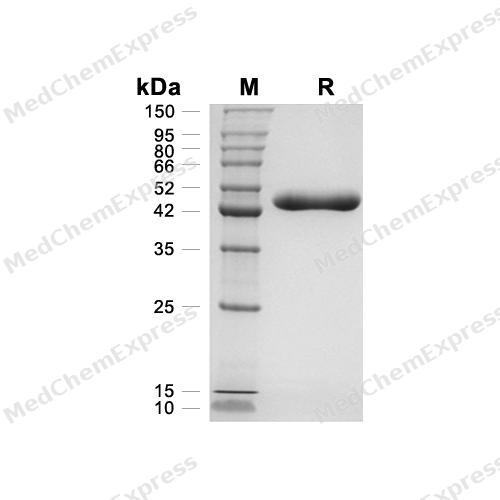
Purity - SDS-PAGE

Assay Procedure
Materials
Assay buffer: 50 mM Tris, 0.01% (v/v) Tween? 20, pH 8.5;
Serpin E1 Protein, Human (HEK293, His) (HY-P71077)
PLAU/uPA Protein, Human (411a.a, HEK293, His, solution) (uPA, HY-P71050)
Substrate: Z-Gly-Gly-Arg-AMC (HY-P0019A)
Procedure
1. Dilute Human uPA to 2 μg/mL with assay buffer.
2. Prepare different concentrations of Serpin E1 with assay buffer by making the following serial dilutions: 1500, 750, 375, 187.5, 125, 75, 50, 25, and 12.5 nM.
3. Equal volumes of Human Serpin E/PAI-1 curves were mixed with diluted Human uPA at 2 μg/mL. Include 2 controls containing only Human uPA and assay buffer.
4. Mix the above mixture and incubate for 15 minutes at room temperature.
5. After incubation, the mixture was diluted 10-fold in assay buffer.
6. Dilute the substrate to 200 μM with assay buffer.
7. In a 96-well plate, add 50 μL of reaction mixture and start the reaction with 50 μL of 20 μM substrate.
8. Excitation and emission wavelengths 380 nm and 460 nm were read in kinetic mode for 5 minutes.
9. The 50% inhibitory concentration (IC50) of Human Serpin E1 was derived by plotting RFU/min versus concentration with a 4-PL fit.


Publications (2)
-
Journal Impact Factor
-
Most Recent
-
Cancer Cell
PAI-1-driven SFRP2high cancer-associated fibroblasts hijack the abscopal effect of radioimmunotherapy. [Abstract]2025 May 12;43(5):856-874.e9. PMID: 40086438 -


Technical Parameters
-
Species Human
-
Source HEK293
-
Tag C-6*His
-
Accession
P05121-1 (V24-P402)
-
Molecular Construction
-
N-term
-
Serpin E1 (V24-P402)
Accession # P05121-1 -
6*His
-
C-term
-
-
Protein Length
Full Length of Isoform-1
-
Synonyms
SERPINE1; Endothelial Plasminogen Activator Inhibitor; Prev. PLANH1; Serpin E1; Prev. PAI1; PAI-1; PAI; Serpin Peptidase Inhibitor, Clade E (Nexin, Plasminogen Activator Inhibitor Type 1), Member 1; Serine (Or Cysteine) Proteinase Inhibitor, Clade E (Nexi
-
AA Sequence
VHHPPSYVAHLASDFGVRVFQQVAQASKDRNVVFSPYGVASVLAMLQLTTGGETQQQIQAAMGFKIDDKGMAPALRHLYKELMGPWNKDEISTTDAIFVQRDLKLVQGFMPHFFRLFRSTVKQVDFSEVERARFIINDWVKTHTKGMISNLLGKGAVDQLTRLVLVNALYFNGQWKTPFPDSSTHRRLFHKSDGSTVSVPMMAQTNKFNYTEFTTPDGHYYDILELPYHGDTLSMFIAAPYEKEVPLSALTNILSAQLISHWKGNMTRLPRLLVLPKFSLETEVDLRKPLENLGMTDMFRQFQADFTSLSDQEPLHVAQALQKVKIEVNESGTVASSSTAVIVSARMAPEEIIMDRPFLFVVRHNPTGTVLFMGQVMEP
-
Molecular Weight
Approximately 48 kDa, based on SDS-PAGE under reducing conditions.
-
Glycosylation
Yes
-
Purity
≥ 95%, as determined by reducing SDS-PAGE.


Product Properties
Lyophilized powder.
1.Lyophilized from a 0.22 μm filtered solution of 4 mM HCl.
2.Lyophilized from a 0.22 μm filtered solution of 20 mM HAC-NaAC, 150 mM NaCl, pH 5.5.
Please refer to the lot-specific COA for specific buffer information.
<1 EU/μg, determined by LAL method.
It is not recommended to reconstitute to a concentration less than 100 μg/mL in ddH2O. For long term storage it is recommended to add a carrier protein (0.1% BSA, 5% HSA, 10% FBS or 5% Trehalose).
Stored at -20°C for 2 years from date of receipt. After reconstitution, it is stable at 4°C for 1 week or -20°C for longer (with carrier protein). It is recommended to freeze aliquots at -20°C or -80°C for extended storage.
Room temperature in continental US;may vary elsewhere.


Documentation
-
Data Sheet (238 KB)
-
SDS (251 KB)
- English - EN (251 KB)
- Français - FR (251 KB)
- Deutsch - DE (251 KB)
- Norwegian - NO (251 KB)
- Español - ES (251 KB)
- Swedish - SV (251 KB)
- Italian - IT (251 KB)
- Korean - KR (251 KB)
- Portuguese - PT (251 KB)
-
Handling Instructions (2659 KB)

Calculators
Concentration (start) × Volume (start) = Concentration (final) × Volume (final)


 Powered by Bioz

