



TGM2/Transglutaminase 2 Protein, Human (sf9, His, solution)

Based on 1 Customer Validation
In summary, TGM2 is a multifunctional enzyme that plays crucial roles in various cellular processes. It acts as a protein-glutamine gamma-glutamyl transferase, mediating the cross-linking of proteins involved in cellular functions. TGM2/Transglutaminase 2 Protein, Human (sf9, His, solution) is the recombinant human-derived TGM2/Transglutaminase 2, expressed by Sf9 insect cells, with N-His labeled tag.
- Species: Human
- Source: Sf9 insect cells
-
Storage:Stored at -80°C for 1 year from date of receipt. It is stable at -20°C for 3 months after opening. It is recommended to freeze aliquots at -80°C for extended storage. Avoid repeated freeze-thaw cycles.


To place orders, for customer services and technical support, please contact: MedChemExpress USA
Tel: 609-228-6898 E-mail: [email protected] [email protected]


-
 Biological Activity
-
Technical Parameters
-
Product Properties
- Documentation
- Help & FAQs


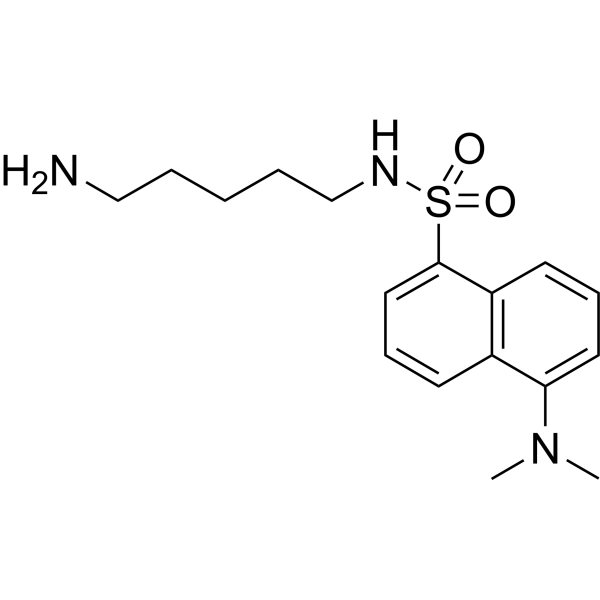


Biological Activity
Description
In summary, TGM2 is a multifunctional enzyme that plays crucial roles in various cellular processes. It acts as a protein-glutamine gamma-glutamyl transferase, mediating the cross-linking of proteins involved in cellular functions. TGM2/Transglutaminase 2 Protein, Human (sf9, His, solution) is the recombinant human-derived TGM2/Transglutaminase 2, expressed by Sf9 insect cells, with N-His labeled tag.
Background
Transglutaminase 2 (TGM2) is a calcium-dependent acyltransferase that facilitates the formation of covalent bonds between peptide-bound glutamine and various primary amines, leading to the cross-linking or amination of proteins. It plays a crucial role in diverse biological processes, including bone development, angiogenesis, wound healing, cellular differentiation, chromatin modification, and apoptosis. TGM2 acts as a protein-glutamine gamma-glutamyltransferase by mediating the cross-linking of various proteins involved in essential cellular functions. Under physiological conditions, its protein cross-linking activity is inhibited by GTP, with relief of inhibition in response to Ca(2+) during stress. When secreted, TGM2 catalyzes the cross-linking of extracellular matrix proteins, forming stable scaffolds. In apoptosis, TGM2 contributes to the condensation of the cytoplasm by promoting the cross-linking of cytoskeletal proteins and mediates the irreversible formation of scaffolds that stabilize dying cells before clearance by phagocytosis, preventing the leakage of harmful intracellular components. Additionally, TGM2 performs diverse protein post-translational modifications, including aminylation of serotonin, dopamine, noradrenaline, or histamine into glutamine residues, generating protein serotonylation, dopaminylation, noradrenalinylation, or histaminylation, respectively. It plays a key role in chromatin organization by mediating serotonylation and dopaminylation of histone H3. Moreover, TGM2 acts as a mediator of neurotransmission-independent roles of nuclear dopamine in ventral tegmental area (VTA) neurons, regulating relapse-related transcriptional plasticity in the reward system. It also regulates vein remodeling by mediating serotonylation and subsequent inactivation of ATP2A2/SERCA2. Furthermore, TGM2 acts as a protein deamidase, converting specific glutamine residues to glutamate, and may function as an isopeptidase cleaving previously formed cross-links. It can also participate in signaling pathways independently of its acyltransferase activity, acting as a signal transducer in alpha-1 adrenergic receptor-mediated stimulation of phospholipase C-delta (PLCD) activity, and is required for coupling alpha-1 adrenergic agonists to the stimulation of phosphoinositide lipid metabolism. TGM2 exhibits cytotoxic activity, inducing apoptosis independently of its acyltransferase activity.
Verified Bioactivity
Measured by its ability to form CBZ-Gln-Gly-Hydroxamate from CBZ-Gln-Gly (HY-W011203) and Hydroxylamine that incubate at 37°C for 2 h. The specific activity is > 1300 pmol/min/μg.
MCE Validation Data
-
Purity - SDS-PAGE
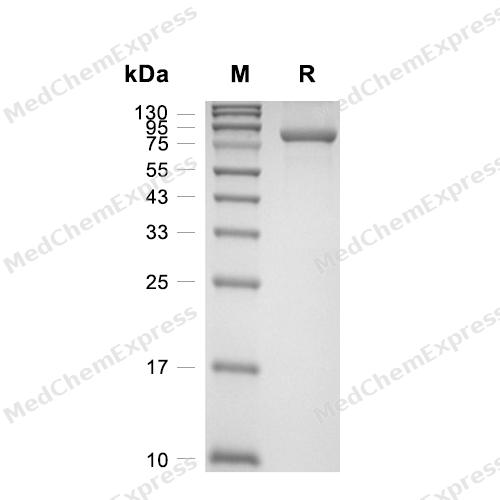
Purity - SDS-PAGE


Technical Parameters
-
Species Human
-
Source Sf9 insect cells
-
Tag N-His
-
Accession
P21980-1 (M1-A687)
-
Gene ID7052
-
Protein Length
Full Length of Isoform-1
-
Synonyms
TGM2; Transglutaminase C; Transglutaminase 2; Transglutaminase H; TGC; Transglutaminase-2; Protein-Glutamine Noradrenalinyltransferase TGM2; Heart G Alpha(H); Protein-Glutamine Gamma-Glutamyltransferase 2; HhG Alpha(H); Protein-Glutamine Histaminyltransfe
-
AA Sequence
MAEELVLERCDLELETNGRDHHTADLCREKLVVRRGQPFWLTLHFEGRNYEASVDSLTFSVVTGPAPSQEAGTKARFPLRDAVEEGDWTATVVDQQDCTLSLQLTTPANAPIGLYRLSLEASTGYQGSSFVLGHFILLFNAWCPADAVYLDSEEERQEYVLTQQGFIYQGSAKFIKNIPWNFGQFEDGILDICLILLDVNPKFLKNAGRDCSRRSSPVYVGRVVSGMVNCNDDQGVLLGRWDNNYGDGVSPMSWIGSVDILRRWKNHGCQRVKYGQCWVFAAVACTVLRCLGIPTRVVTNYNSAHDQNSNLLIEYFRNEFGEIQGDKSEMIWNFHCWVESWMTRPDLQPGYEGWQALDPTPQEKSEGTYCCGPVPVRAIKEGDLSTKYDAPFVFAEVNADVVDWIQQDDGSVHKSINRSLIVGLKISTKSVGRDEREDITHTYKYPEGSSEEREAFTRANHLNKLAEKEETGMAMRIRVGQSMNMGSDFDVFAHITNNTAEEYVCRLLLCARTVSYNGILGPECGTKYLLNLNLEPFSEKSVPLCILYEKYRDCLTESNLIKVRALLVEPVINSYLLAERDLYLENPEIKIRILGEPKQKRKLVAEVSLQNPLPVALEGCTFTVEGAGLTEEQKTVEIPDPVEAGEEVKVRMDLLPLHMGLHKLVVNFESDKLKAVKGFRNVIIGPA
-
Predicted Molecular Mass
77.2 kDa
-
Molecular Weight
Approximately 80 kDa, based on SDS-PAGE under reducing conditions.
-
Glycosylation
Yes
-
Purity
≥ 95%, as determined by reducing SDS-PAGE.


Product Properties
Solution
1.Supplied as a 0.22 μm filtered solution of 20 mM Tris, 300 mM NaCl, pH 7.5, 10% glycerol, 0.5 mM TCEP.
2.Supplied as a 0.22 μm filtered solution of PBS, pH 7.5, 0.5 mM TCEP, 2mM CaCl2, 10% glycerol.
Please refer to the lot-specific COA for specific buffer information.
Note: For SPR assay, please replace the buffer. Primary amine components (e.g., Tris, imidazole) can affect protein-coupled chips.
<1 EU/μg, determined by LAL method.
Stored at -80°C for 1 year from date of receipt. It is stable at -20°C for 3 months after opening. It is recommended to freeze aliquots at -80°C for extended storage. Avoid repeated freeze-thaw cycles.
Shipping with dry ice.


Documentation
-
Data Sheet (241 KB)
-
SDS (252 KB)
- English - EN (252 KB)
- Français - FR (252 KB)
- Deutsch - DE (252 KB)
- Norwegian - NO (252 KB)
- Español - ES (252 KB)
- Swedish - SV (252 KB)
- Italian - IT (252 KB)
- Korean - KR (252 KB)
- Portuguese - PT (252 KB)
-
Handling Instructions (2659 KB)

Calculators
Concentration (start) × Volume (start) = Concentration (final) × Volume (final)


 Powered by Bioz

