



RWJ-56110 dihydrochloride (Standard)
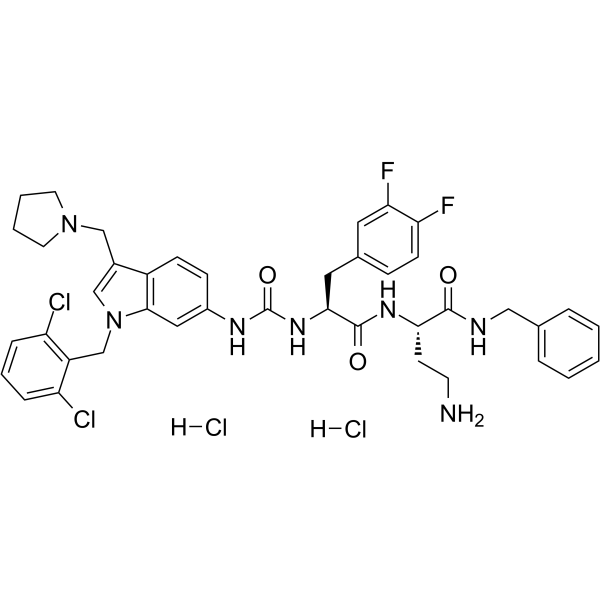
RWJ-56110 dihydrochloride (Standard) is the analytical standard of RWJ-56110 (dihydrochloride) (HY-108556A). This product is intended for research and analytical applications. RWJ-56110 dihydrochloride is a potent, selective, peptide-mimetic inhibitor of PAR-1 activation and internalization (binding IC50=0.44 uM) and shows no effect on PAR-2, PAR-3, or PAR-4. RWJ-56110 dihydrochloride inhibits the aggregation of human platelets induced by both SFLLRN-NH2 (IC50=0.16 μM) and thrombin (IC50=0.34 μM), quite selective relative to U46619 (HY-108566). RWJ-56110 dihydrochloride blocks angiogenesis and blocks the formation of new vessels in vivo. RWJ-56110 dihydrochloride induces cell apoptosis.
For research use only. We do not sell to patients.
- CAS No.: 2387505-58-8
- Formula: C41H45Cl4F2N7O3
- Molecular Weight:863.65
-
Storage:
Please store the product under the recommended conditions in the Certificate of Analysis.


To place orders, for customer services and technical support, please contact: MedChemExpress USA
Tel: 609-228-6898 E-mail: [email protected] [email protected]


-
 Product Information
-
Chemical Information
- Purity & Documentation
-
 Help & FAQs






Product Information
Information
Application
The compound is the grade of analytical standard, which is the reference standard supplied assay. It is commonly used in qualitative, quantitative and methodological research experiments in HPLC, GC and MS.


Chemical Information
-
CAS No. 2387505-58-8
-
Molecular Weight 863.65
-
Formula C41H45Cl4F2N7O3
-
SMILES
O=C(N[C@H](C(NCC1=CC=CC=C1)=O)CCN)[C@@H](NC(NC2=CC3=C(C=C2)C(CN4CCCC4)=CN3CC5=C(Cl)C=CC=C5Cl)=O)CC6=CC=C(F)C(F)=C6.[H]Cl.[H]Cl
-
Shipping
Room temperature in continental US; may vary elsewhere.
-
Storage
Please store the product under the recommended conditions in the Certificate of Analysis.


Purity & Documentation
References
[1]. Andrade-Gordon, et al.Design, synthesis, and biological characterization of a peptide-mimetic antagonist for a tethered-ligand receptor. oc Natl Acad Sci U S A. 1999 Oct 26;96(22):12257-62. [Content Brief]
[2]. Panagiota Zania, et al. Blockade of angiogenesis by small molecule antagonists to protease-activated receptor-1: association with endothelial cell growth suppression and induction of apoptosis. J Pharmacol Exp Ther. 2006 Jul;318(1):246-54. [Content Brief]

Calculators
Concentration (start) × Volume (start) = Concentration (final) × Volume (final)


RWJ-56110 dihydrochloride (Standard) Related Classifications
HY-108556AR Related Classifications
 Powered by Bioz