



Cinnamyl Alcohol
Based on 2 publication(s) in Google Scholar
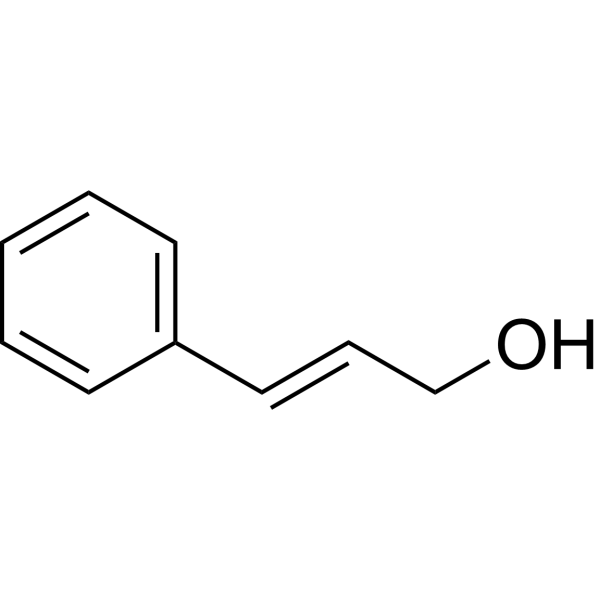
Cinnamyl Alcohol is an active component from chestnut flower, inhibits increased PPARγ expression, exhibits anti-obesity, antioxidant and anti-inflammatory activities.
For research use only. We do not sell to patients.
- Purity: 98.58%
- CAS No.: 104-54-1
- Formula: C9H10O
- Molecular Weight:134.18
-
Storage:Pure form -20°C, 3 years , 4°C, 2 years ; In solvent -80°C, 6 months , -20°C, 1 month


-
 Biological Activity
-
Chemical Information
-
Solvent & Solubility
- Purity & Documentation
- References
-
 Help & FAQs
-

Cell Cycle/DNA Damage Compound Library
HY-L004
-
Epigenetics Compound Library
HY-L005
-
Immunology/Inflammation Compound Library
HY-L007
-
Kinase Inhibitor Library
HY-L009
-
MAPK Compound Library
HY-L010
-
Membrane Transporter/Ion Channel Compound Library
HY-L011
-
Metabolism/Protease Compound Library
HY-L012
-
PI3K/Akt/mTOR Compound Library
HY-L015
-
Stem Cell Signaling Compound Library
HY-L017
-
TGF-beta/Smad Compound Library
HY-L018
-
Natural Product Library
HY-L021
-
Autophagy Compound Library
HY-L029
-
Anti-Aging Compound Library
HY-L034
-
Antioxidant Compound Library
HY-L037
-
Differentiation Inducing Compound Library
HY-L038
-
Reprogramming Compound Library
HY-L039
-
Oxygen Sensing Compound Library
HY-L045
-
Medicine Food Homology Compound Library
HY-L055
-
Glycolysis Compound Library
HY-L058
-
Cytoskeleton Compound Library
HY-L060
-
Glutamine Metabolism Compound Library
HY-L064
-
Traditional Chinese Medicine Active Compound Library
HY-L065
-
Neuroprotective Compound Library
HY-L070
-
Anti-Breast Cancer Compound Library
HY-L074
-
Anti-Lung Cancer Compound Library
HY-L075
-
Anti-Pancreatic Cancer Compound Library
HY-L077
-
Anti-Blood Cancer Compound Library
HY-L079
-
Anti-Cancer Metabolism Compound Library
HY-L083
-
Anti-Obesity Compound Library
HY-L087
-
Angiogenesis-Related Compound Library
HY-L088
-
Transcription Factor-Targeted Library
HY-L090
-
Lipid Metabolism Compound Library
HY-L091
-
Glucose Metabolism Compound Library
HY-L092
-
Food Additive Library
HY-L093
-
Food-Sourced Compound Library
HY-L094
-
Anti-Liver Cancer Compound Library
HY-L101
-
Anti-Colorectal Cancer Compound Library
HY-L103
-
Anti-inflammatory Traditional Chinese Medicine Active Compound Library
HY-L114
-
Plant-Sourced Natural Product Library
HY-L115
-
Potassium Channel Compound Library
HY-L119
-
Human Metabolite Library
HY-L123
-
Anti-Prostate Cancer Compound Library
HY-L124
-
Anti-Pulmonary Fibrosis Compound Library
HY-L125
-
Nuclear Receptor Compound Library
HY-L126
-
Cancer Stem Cells Compound Library
HY-L135
-
Pain-Related Compound Library
HY-L139
-
Mitochondrial Protection Compound Library
HY-L144
-
Metabolic Enzyme Compound Library
HY-L146
-
Membrane Protein-targeted Compound Library
HY-L149
-
Membrane Receptor-targeted Compound Library
HY-L150
-
Serine/Threonine Kinase Inhibitor Library
HY-L164
-
Ion Channel Compound Library
HY-L166
-
Extracellular Vesicles (EVs) Compound Library
HY-L168
-
Anti-Hematopathy Compound Library
HY-L171
-
Anti-Ovarian Cancer Compound Library
HY-L173
-
Multi-Target Compound Library
HY-L176
-
Radioprotector Library
HY-L178
-
Bioactive Compound Library Max
HY-L181
-
MCE Bioactive Compound Library
HY-L001V
-
Natural Product Library Plus
HY-L021P
-
Natural Product and Natural Product-Like Compound Library
HY-L021M
-
Bioactive Compound Library
HY-L001
-
Anti-Gastric Cancer Compound Library
HY-L184
-
Anti-Fibrosis Compound Library
HY-L185
-
Miao Ethnicity Medicine Compound Library
HY-L190
-
Heat-Clearing and Detoxification Traditional Chinese Medicine Compound Library
HY-L194
-
Protein Kinase Compound Library
HY-L196
-
Non-Alcoholic Fatty Liver Disease (NAFLD) Compound Library
HY-L199
-
RO5 Drug-like Natural Product Library
HY-L200
-
Cell Proliferation Compound Library
HY-L201
-
Flavor Compound Library
HY-L202
-
Lactic Acid Metabolic Compound Library
HY-L204
-
High-Throughput Bioactive Compound Library
HY-L205
-
High-Throughput Natural Product Library
HY-L206
-
Ancient Chinese Classical Formulas Traditional Chinese Medicine Active Compound Library
HY-L209
-
Mass Spectrometry Human Metabolite Library
HY-L215
-
Cosmetic Ingredient Compound Library
HY-L221
-
Diarrhea-Related Traditional Chinese Medicine Active Compound Library
HY-L224
-
Flavors and Fragrances Compound Library
HY-L242
-
Environmental Pollutant Compound Library
HY-L247
-
Lactylation Compound Library
HY-L249
-
Mass Spectrometry Natural Product Library
HY-L262
-
Drug Fragment Library
HY-L904


Publications Citing Use of MedChemExpress (MCE) Cinnamyl Alcohol
MoreAll AMPK Isoforms
More

Biological Activity
Cinnamyl Alcohol (0.5-1 µg/µL, 24 h) inhibits LPS (HY-D1056) and IFN-γ-induced NO production in cell RAW264.7 through inhibition of iNOS[4].
Cinnamyl Alcohol (0.4-2 mM, 24 h) activates K+ channels via the NO-cGMP-PKG pathway, inhibits Rho kinase, and attenuates Phenylephrine (HY-B0769)-induced vasoconstriction in rat thoracic aorta endothelial cells[3].
Cinnamyl Alcohol (25 µM, 24-48 h) downregulates the expressions of adipogenesis-related proteins PPARγ, C/EBPα, FABP4 and adipogenesis-related proteins C/EBPβ, C/EBPδ, cyclin B1/D1/E1, and CDK2/6, arrests cell cycle at G0/G1 phase in 3T3-L1 cells, and inhibits the lipid accumulation[2].
Cinnamyl Alcohol (25 µM, 60 min) activates the AMPKα phosphorylation, inhibits AKT and ERK1/2 signaling pathway[2].
MedChemExpress (MCE) has not independently confirmed the accuracy of these methods. They are for reference only.
-
Cell Line:3T3-L1
-
Concentration:25 µM
-
Incubation Time:16-20 h
-
Result:Downregulated expressions of PPARγ, C/EBPα, FABP4, C/EBPβ, C/EBPδ, cyclin B1/D1/E1, CDK2/6.
-
Cell Line:3T3-L1
-
Concentration:25 µM
-
Incubation Time:24-48 h
-
Result:Arrested cell cycle at G0/G1 phase.
-
Cell Line:RAW246.7
-
Concentration:0.5-1 µg/µL
-
Incubation Time:24 h
-
Result:Inhibited expression of iNOS.
MedChemExpress (MCE) has not independently confirmed the accuracy of these methods. They are for reference only.
-
Animal Model:Mouse E. coli-induced sepsis model[5]
-
Dosage:2 g/kg
-
Administration:po, single dose
-
Result:Reduced the inflammatory reaction in the liver, heart, lungs, and kidneys


Chemical Information
-
CAS No. 104-54-1
-
Appearance <30°C Solid,>33°C Liquid
-
Molecular Weight 134.18
-
Formula C9H10O
-
Color White to light yellow
-
SMILES
OC/C=C/C1=CC=CC=C1
-
Structure Classification
-
Initial Source
-
Shipping
Room temperature in continental US; may vary elsewhere.
-
Storage
Pure form -20°C 3 years 4°C 2 years In solvent -80°C 6 months -20°C 1 month


Publications (2)
-
Journal Impact Factor
-
Most Recent
-
PLoS Biol
2024 Jun 27;22(6):e3002672. PMID: 38935621 -
bioRxiv
An efficient behavioral screening platform classifies natural products and other chemical cues according to their chemosensory valence in C. elegans. [Abstract]2024 Apr 3:2023.06.02.542933. PMID: 37333363


Solvent & Solubility
DMSO : 200 mg/mL (1490.54 mM; Need ultrasonic; Hygroscopic DMSO has a significant impact on the solubility of product, please use newly opened DMSO)
H2O : 100 mg/mL (745.27 mM; Need ultrasonic)
Please refer to the solubility information to select the appropriate solvent. Once prepared, please aliquot and store the solution to prevent product inactivation from repeated freeze-thaw cycles.
Storage method and period of stock solution: -80°C, 6 months; -20°C, 1 month. When stored at -80°C, please use it within 6 months. When stored at -20°C, please use it within 1 month.
* Note: If you choose water as the stock solution, please dilute it to the working solution, then filter and sterilize it with a 0.22 μm filter before use.
Please refer to the solubility information to select the appropriate solvent. Once prepared, please aliquot and store the solution to prevent product inactivation from repeated freeze-thaw cycles.
Storage method and period of stock solution: -80°C, 6 months; -20°C, 1 month. When stored at -80°C, please use it within 6 months. When stored at -20°C, please use it within 1 month.
* Note: If you choose water as the stock solution, please dilute it to the working solution, then filter and sterilize it with a 0.22 μm filter before use.
Concentration (start) × Volume (start) = Concentration (final) × Volume (final)
Select the appropriate dissolution method based on your experimental animal and administration route.
- For the following dissolution methods, please ensure to first prepare a clear stock solution using an In Vitro approach and then sequentially add co-solvents:
- To ensure reliable experimental results, the clarified stock solution can be appropriately stored based on storage conditions. As for the working solution for In Vivo experiments, it is recommended to prepare freshly and use it on the same day.
- The percentages shown for the solvents indicate their volumetric ratio in the final prepared solution. If precipitation or phase separation occurs during preparation, heat and/or sonication can be used to aid dissolution.
Add each solvent one by one: 10% DMSO 40% PEG300 5% Tween-80 45% Saline
Solubility: ≥ 5 mg/mL (37.26 mM); Clear solution
This protocol yields a clear solution of ≥ 5 mg/mL (saturation unknown).
Taking 1 mL working solution as an example, add 100 μL DMSO stock solution (50.0 mg/mL) to 400 μL PEG300, and mix evenly; then add 50 μL Tween-80 and mix evenly; then add 450 μL Saline to adjust the volume to 1 mL.
Preparation of Saline: Dissolve 0.9 g sodium chloride in ddH₂O and dilute to 100 mL to obtain a clear Saline solution.
Add each solvent one by one: 10% DMSO 90% (20% SBE-β-CD in Saline)
Solubility: ≥ 5 mg/mL (37.26 mM); Clear solution
This protocol yields a clear solution of ≥ 5 mg/mL (saturation unknown).
Taking 1 mL working solution as an example, add 100 μL DMSO stock solution (50.0 mg/mL) to 900 μL 20% SBE-β-CD in Saline, and mix evenly.
Preparation of 20% SBE-β-CD in Saline (4°C, storage for one week): 2 g SBE-β-CD powder is dissolved in 10 mL Saline, completely dissolve until clear.
Please enter the basic information of animal experiments:
-
-
-
-
Recommended: Prepare an additional quantity of animals to account for potential losses during experiments.
Working solution concentration: 0.22 mg/mL
This product has good water solubility, please refer to the measured solubility data in water/PBS/Saline for details.


Purity & Documentation
-
Data Sheet (277 KB)
-
SDS (796 KB)
- English - EN (796 KB)
- Français - FR (796 KB)
- Deutsch - DE (796 KB)
- Norwegian - NO (796 KB)
- Español - ES (796 KB)
- Swedish - SV (796 KB)
- Italian - IT (796 KB)
- Portuguese - PT (796 KB)
-
Handling Instructions (2659 KB)
References
[1]. Hwang DI, et al. Cinnamyl Alcohol, the Bioactive Component of Chestnut Flower Absolute, Inhibits Adipocyte Differentiation in 3T3-L1 Cells by Downregulating Adipogenic Transcription Factors. Am J Chin Med. 2017;45(4):833-846. [Content Brief]
[2]. Choi YR, et al., Cinnamyl Alcohol Attenuates Adipogenesis in 3T3-L1 Cells by Arresting the Cell Cycle. Int J Mol Sci. 2024 Jan 5;25(2):693. [Content Brief]
[3]. Kang YH, et al., Cinnamyl alcohol attenuates vasoconstriction by activation of K⁺ channels via NO-cGMP-protein kinase G pathway and inhibition of Rho-kinase. Exp Mol Med. 2012 Dec 31;44(12):749-55. [Content Brief]
[5]. Zou L, et al., The anti-inflammatory effects of cinnamyl alcohol on sepsis-induced mice via the NLRP3 inflammasome pathway. Ann Transl Med. 2022 Jan;10(2):48. [Content Brief]


Complete Stock Solution Preparation Table
Please refer to the solubility information to select the appropriate solvent. Once prepared, please aliquot and store the solution to prevent product inactivation from repeated freeze-thaw cycles.
Storage method and period of stock solution: -80°C, 6 months; -20°C, 1 month. When stored at -80°C, please use it within 6 months. When stored at -20°C, please use it within 1 month.
| Optional Solvent | Concentration Solvent Mass | 1 mg | 5 mg | 10 mg | 25 mg |
|---|---|---|---|---|---|
| H2O / DMSO | 1 mM | 7.4527 mL | 37.2634 mL | 74.5268 mL | 186.3169 mL |
| 5 mM | 1.4905 mL | 7.4527 mL | 14.9054 mL | 37.2634 mL | |
| 10 mM | 0.7453 mL | 3.7263 mL | 7.4527 mL | 18.6317 mL | |
| 15 mM | 0.4968 mL | 2.4842 mL | 4.9685 mL | 12.4211 mL | |
| 20 mM | 0.3726 mL | 1.8632 mL | 3.7263 mL | 9.3158 mL | |
| 25 mM | 0.2981 mL | 1.4905 mL | 2.9811 mL | 7.4527 mL | |
| 30 mM | 0.2484 mL | 1.2421 mL | 2.4842 mL | 6.2106 mL | |
| 40 mM | 0.1863 mL | 0.9316 mL | 1.8632 mL | 4.6579 mL | |
| 50 mM | 0.1491 mL | 0.7453 mL | 1.4905 mL | 3.7263 mL | |
| 60 mM | 0.1242 mL | 0.6211 mL | 1.2421 mL | 3.1053 mL | |
| 80 mM | 0.0932 mL | 0.4658 mL | 0.9316 mL | 2.3290 mL | |
| 100 mM | 0.0745 mL | 0.3726 mL | 0.7453 mL | 1.8632 mL |
* Note: If you choose water as the stock solution, please dilute it to the working solution, then filter and sterilize it with a 0.22 μm filter before use.


 Powered by Bioz