
238 Results for "

diffuse

" in MedChemExpress (MCE) Product Catalog:
Products (238)

238 Results for "diffuse" in MCE Product Catalog:

Cat. No.: HY-L125
2,810 compounds

Pulmonary fibrosis (PF), also known as diffuse interstitial pulmonary fibrosis, is a very common end-stage manifestation of several diseases, including idiopathic pulmonary fibrosis (IPF), pulmonary hypertension, and scleroderma, characterised by excessive matrix deposition and destruction of the lung architecture, finally leading to respiratory insufficiency. PF has become a global disease with significantly increased incidence rate, and the most common form of pulmonary fibrosis is idiopathic pulmonary fibrosis (IPF).

Lung fibrosis is a complex disease, a multitude of signal factors and signaling pathways is disrupted in this complex disease, such as TGF-β, Wnt, VEGF and PI3K–Akt. MCE offers a unique collection of 2,810 compounds with identified and potential anti-pulmonary fibrosis activity. MCE Anti-Pulmonary Fibrosis Compound Library is a useful tool for anti-pulmonary fibrosis drugs screening and other related research.

Cat. No.: HY-173333
CAS No.: 3081688-77-6
Research Areas:  

Cancer

PROTAC SMARCA2/4 degrader-38 is a SMARCA2/4 degrader (SMARCA2: DC50 = 3.0 nM; SMARCA4: 4.0 nM). PROTAC SMARCA2/4 degrader-38 binds to SMARCA2 and SMARCA4 bromodomains to induce degradation via the ubiquitin-proteasome system. PROTAC SMARCA2/4 degrader-38 induces G0/G1 phase cell cycle arrest and cell apoptosis in hematological cancer cells, blocks oncogenic activity of MYC and other disease-related genes in acute myeloid leukemia cells and inhibits proliferation of hematological cancer cell lines. PROTAC SMARCA2/4 degrader-38 can be used for the research of acute myeloid leukemia, diffuse large B-cell lymphoma, breast cancer, ovarian cancer, colorectal cancer, liver cancer, lung cancer .
loading...
    loading...
Cat. No.: HY-D3401
CAS No.: 3121511-17-6
Research Areas:  

Others

LHA585 is a fluorescent probe targeting the lipid hydrogen abstraction process for the early detection of ferroptosis (Ferroptosis). Its detection mechanism relies on the reactivity of its own 4-phenyl-3-methylbut-2-enyl moiety with biologically relevant oxidative radicals, including peroxyl radicals (ROO·), alkoxyl radicals (RO·), hydroxyl radicals (HO·), and peroxynitrite anions (ONOO−); upon hydrogen abstraction from this structure, radical rearrangement and radical cleavage occur, releasing a xanthene radical which converts into a highly fluorescent rhodamine dye in biological environments, thereby achieving a fluorescence turn-on ratio of up to 360-fold. LHA585 is non-fluorescent in its native state, possesses excellent membrane permeability due to its non-polar property, and the rhodamine dye generated after oxidation diffuses into mitochondria. The excitation wavelength of LHA585 is 561 nm, and its emission wavelength ranges from 570 to 620 nm .
loading...
    loading...
Cat. No.: HY-P990954
CAS No.: 2850355-94-9
Synonyms: IMM-0306
Target:  

CD47 CD20

Research Areas:  

Cancer

Amulirafusp alfa (IMM-0306) is a fusion protein of CD20 monoclonal antibody (mAb) with the CD47 binding domain of SIRPα, with human CD20 Kd 2.45 nM and human CD47 Kd 4.91 nM. Amulirafusp alfa binds to CD20 and CD47 on B cells, engages FcɣR, blocks CD47-SIRPα interaction, activates macrophages, NK cells, and complement cascade, mediates phagocytosis and cytotoxicity, inhibits apoptosis of Jurkat-CSR cells, reverses IL-16 tumor-promoting effects, and binds human/cynomolgus CD47 but not mouse/rat CD47. Amulirafusp alfa can be used for the research of hematological malignancies, relapsed or refractory CD20-positive B-cell non-Hodgkin’s lymphoma, relapsed or refractory B-cell non-Hodgkin lymphoma, and activated B-cell-like diffuse large B-cell lymphoma .
loading...
    loading...
Cat. No.: HY-181410
CAS No.: 3093642-41-9
Research Areas:  

Cancer

PROTAC EZH2 Degrader-41 is an EZH2-targeting PROTAC and cIAP E3 ubiquitin ligase recruiter. PROTAC EZH2 Degrader-41 induces EZH2 degradation via ubiquitination and proteasomal breakdown. PROTAC EZH2 Degrader-41 exerts antiproliferative effects in lymphoma cells. PROTAC EZH2 Degrader-41 can be used for the research of lymphoma .
loading...
    loading...
Cat. No.: HY-183336
CAS No.: 2770979-81-0
Research Areas:  

Cancer

MEDS700 is a blood-brain barrier permeable inhibitor of human dihydroorotate dehydrogenase (hDHODH) with an IC50 of 1.5 nM. MEDS700 induces apoptosis and differentiation, and inhibits proliferation of cancer cells. MEDS700 can be used in research on acute myeloid leukemia and other conditions .
loading...
    loading...
Cat. No.: HY-182671
CAS No.: 2409965-28-0
Target:  

PI3K Btk Apoptosis

Research Areas:  

Cancer

SRX3305 is an BTK/PI3K/BRD4 inhibitor with IC50s of 6.5 nM, 15 nM, and 4 nM toward BTK, PI3Kɑ and PI3Kδ, respectively. SRX3305 attenuates chronic lymphocytic leukemia (CLL) and mantle cell lymphoma (MCL) cell proliferation and promotes apoptosis in a dose-dependent fashion. SRX3305 yields potent anti-tumor effects but spares healthy bystander cells. SRX3305 inhibits the activation-induced proliferation of primary CLL cells in vitro and effectively blocks microenvironment-mediated survival signals. SRX3305 blocks CLL cell migration toward CXCL-12 and CXCL-13. SRX3305 maintains its anti-tumor effects in Ibrutinib (HY-10997)-resistant CLL cells. SRX3305 can be used for research in CLL, diffuse large B-cell lymphoma (DLBCL) and MCL .
loading...
    loading...
Cat. No.: HY-P9959
CAS No.: 635715-01-4
Synonyms: CMC-544; PF-5208773; WAY-207294
Research Areas:  

Cancer

Inotuzumab ozogamicin (CMC-544) is an antibody-targeted chemotherapy agent composed of a humanized anti-CD22 antibody Inotuzumab (HY-P99264) conjugated to Calicheamicin (HY-19609). Inotuzumab ozogamicin and G544 bind human CD22 with similar affinities (Kd ≈ 150 pM). Inotuzumab ozogamicin has demonstrated efficacy against CD22 + B-cell non-Hodgkin’s lymphoma. Inotuzumab ozogamicin can be used in the research of acute lymphoblastic leukemia .
loading...
    loading...
Cat. No.: HY-P9959A
CAS No.: 635715-01-4
Synonyms: CMC-544 (solution); PF-5208773 (solution); WAY-207294 (solution)
Research Areas:  

Cancer

Inotuzumab ozogamicin solution (CMC-544 solution) is an antibody-targeted chemotherapy agent composed of a humanized anti-CD22 antibody conjugated to Calicheamicin (HY-19609). Inotuzumab ozogamicin solution and G544 bind human CD22 with similar affinities (Kd ≈ 150 pM). Inotuzumab ozogamicin solution has demonstrated efficacy against CD22 + B-cell non-Hodgkin’s lymphoma. Inotuzumab ozogamicin solution can be used in the research of acute lymphoblastic leukemia .
loading...
    loading...
Cat. No.: HY-W176557
CAS No.: 877459-36-4
Target:  

Aquaporin Amyloid-β

Research Areas:  

Neurological Disease

TGN-073 is an orally active, blood-brain barrier-permeable aquaporin 4 (AQP4) modulator. TGN-073 increases the uptake and distribution of brain MRI tracers in the brain parenchyma and reduces the levels of insoluble amyloid β-40 and β-42. TGN-073 can be used in research related to Alzheimer's disease, dementia, traumatic brain injury and pain .
loading...
    loading...
Cat. No.: HY-114773
CAS No.: 216596-71-3
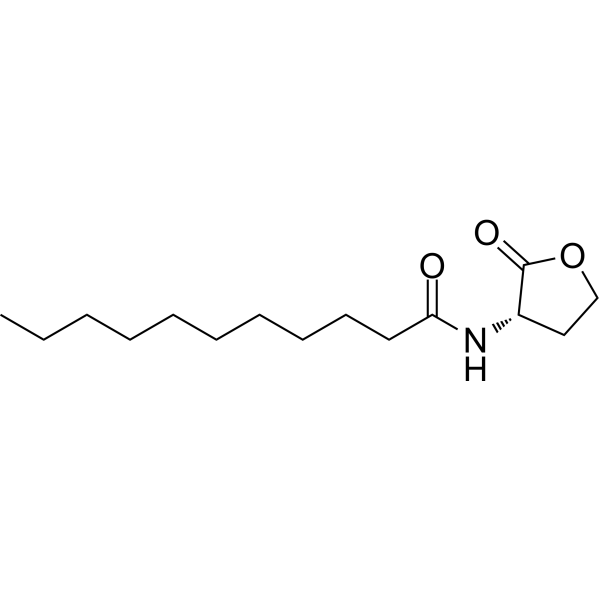
Quorum sensing is a regulatory system used by bacteria to control gene expression in response to increased cell density. This regulatory process manifests itself in a variety of phenotypes, including biofilm formation and virulence factor production. Coordinated gene expression is achieved through the production, release and detection of small diffusible signaling molecules called autoinducers. N-acylated homoserine lactones (AHLs) comprise a class of such autoinducers, each of which generally consists of a fatty acid coupled to a homoserine lactone (HSL). Modulation of bacterial quorum-sensing signaling systems to suppress pathogenesis represents a new approach to antimicrobial research for infectious diseases. AHLs differ in acyl length (C4-C18), C3 substitution (hydrogen, hydroxyl, or oxo group), and the presence or absence of one or more carbon-carbon double bonds in the fatty acid chain. These differences confer signaling specificity through the affinity of the LuxR family of transcriptional regulators. C11-HSL has a rare odd-numbered acyl carbon chain and may be a minor quorum-sensing signaling molecule in Pseudomonas aeruginosa strains.
loading...
    loading...
Cat. No.: HY-P11779
CAS No.: 2768774-89-4
Ac-RKAA-PABC-MMAE is a Drug-Linker Conjugates for ADC. Ac-RKAA-PABC-MMAE consists of the ADC Cytotoxin MMAE (HY-15162) and a linker. Ac-RKAA-PABC-MMAE can be used for synthesis of ADCs .
loading...
    loading...
Cat. No.: HY-W127393
CAS No.: 177158-21-3
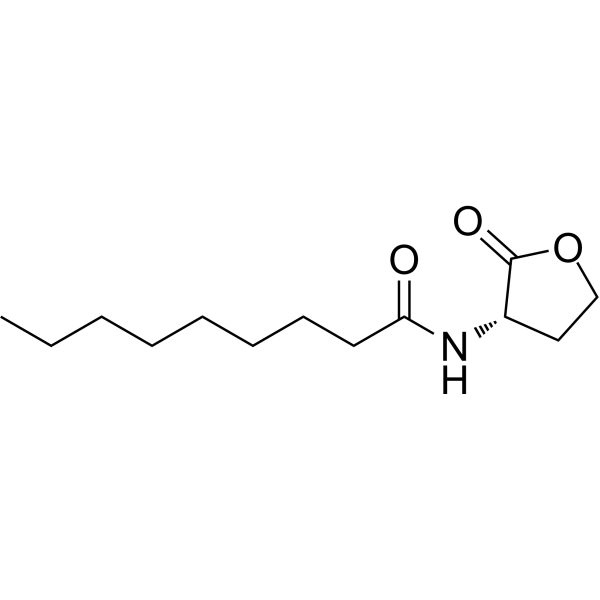
Quorum sensing is a regulatory system used by bacteria to control gene expression in response to increased cell density. This regulatory process manifests itself in a variety of phenotypes, including biofilm formation and virulence factor production. Coordinated gene expression is achieved through the production, release and detection of small diffusible signaling molecules called autoinducers. N-acylated homoserine lactones (AHLs) comprise a class of such autoinducers, each of which generally consists of a fatty acid coupled to a homoserine lactone (HSL). Modulation of bacterial quorum-sensing signaling systems to suppress pathogenesis represents a new approach to antimicrobial research for infectious diseases. AHLs differ in acyl length (C4-C18), C3 substitution (hydrogen, hydroxyl, or oxo group), and the presence or absence of one or more carbon-carbon double bonds in the fatty acid chain. These differences confer signaling specificity through the affinity of the LuxR family of transcriptional regulators. C9-HSL is a rare odd-numbered acyl carbon chain produced by wild-type Erwinia carotovora strain SCC 3193 grown in nutrient-rich Luria-Bertani broth (LB) medium.
loading...
    loading...
Cat. No.: HY-P991028
CAS No.: 2892667-02-4
Synonyms: AZD0486; TNB-486

Research Areas:  

Cancer

Surovatamig (AZD0486; TNB-486) is a fully human anti-CD19/CD3 IgG4 bispecific antibody. Surovatamig triggers T cell activation, releases cytotoxic granules, and induces T cell-dependent cellular cytotoxicity and tumor cell lysis. Surovatamig can reduces release of pro-inflammatory cytokines including IL-2, IFNγ, TNF. Surovatamig can be used for the research of cancer, such as B cell non-Hodgkin lymphoma .
loading...
    loading...
Cat. No.: HY-109565B
CAS No.: 1799328-50-9
Synonyms: ASTX660 dihydrochloride
Target:  

Apoptosis TNF Receptor IAP

Research Areas:  

Cancer

Tolinapant dihydrochloride (ASTX660 dihydrochloride) is an orally active cIAP1/2 and XIAP antagonist, with an IC50 of < 40 nM against XIAP and an IC50 of <12 nM against cIAP1. Tolinapant dihydrochloride triggers TNFα-dependent Apoptosis in cancer cells. Tolinapant dihydrochloride inhibits tumor growth in mouse xenograft models. Tolinapant dihydrochloride can be used in research related to breast cancer, melanoma, lymphoma, multiple myeloma, acute lymphoblastic leukemia and advanced solid tumors .
loading...
    loading...
Cat. No.: HY-126686
CAS No.: 2259318-51-7
Purity:  99.54%
Research Areas:  

Cancer

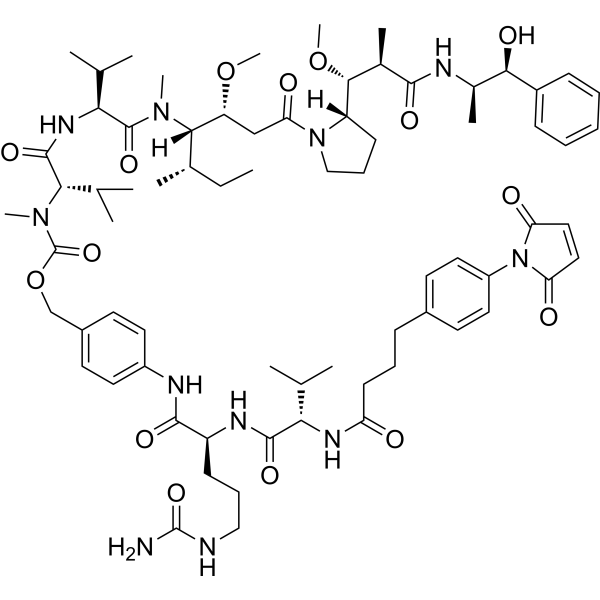
Mal-Phe-C4-VC-PAB-MMAE is a drug-linker conjugate for ADC composed of MMAE conjugated to the Mal-Phe-C4-VC-PAB linker. Mal-Phe-C4-VC-PAB-MMAE can be used to synthesize ROR1-targeting antibody-drug conjugates (ADCs) for research on ROR1-expressing cancers .
loading...
    loading...
Cat. No.: HY-13902R
CAS No.: 1232416-25-9
Synonyms: VE-822 (Standard); VX-970 (Standard); M6620 (Standard)
Berzosertib (Standard) is the analytical standard of Berzosertib (HY-13902). This product is intended for research and analytical applications. Berzosertib (VE-822) is an orally active, CNS-penetrant, and selective ATR Kinase inhibitor. Berzosertib blocks ATR Kinase activity, abrogates G2/M cell cycle checkpoint, impairs DNA damage repair. Berzosertib induces apoptosis, inhibnits conlony migration, inhibits cell proliferation, and activates cGAS-STING axes in cancer cells. Berzosertib can be used for the research of cancers, such as head and neck squamous cell carcinoma, and colorectal cancer .
loading...
    loading...
Cat. No.: HY-P11779A
Ac-RKAA-PABC-MMAE TFA is a Drug-Linker Conjugates for ADC. Ac-RKAA-PABC-MMAE TFA consists of the ADC Cytotoxin MMAE (HY-15162) and a linker. Ac-RKAA-PABC-MMAE TFA can be used for synthesis of ADCs .
loading...
    loading...

