



151 Results for "

LAP

" in MedChemExpress (MCE) Product Catalog:
Products (151)

151 Results for "LAP" in MCE Product Catalog:

Cat. No.: HY-101226
CAS No.: 66515-29-5
Purity:  ≥98.0%
Target:  

mGluR

Research Areas:  

Neurological Disease

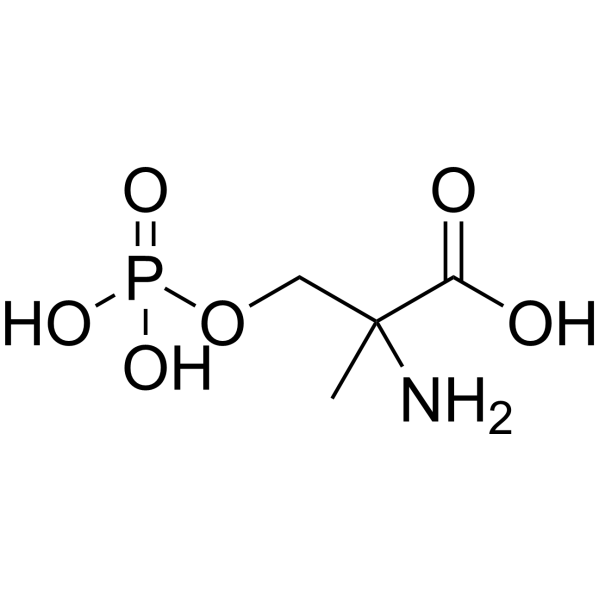
MSOP is a selective group III metabotropic glutamate receptor antagonist with apparent KD of 51 μM for the L-AP4-sensitive presynaptic mGluR.
loading...
    loading...
Cat. No.: HY-P990667
CAS No.: 1439902-67-6
Synonyms: BG00011

Target:  

Integrin TGF-beta/Smad

Research Areas:  

Inflammation/Immunology Cancer

STX-100 (BG00011) is a humanized monoclonal antibody targeting αVβ6 integrin. STX-100 specifically binds αVβ6 integrin, blocks latent TGF-β activation via latency-associated peptide (LAP) interaction prevention, and reduces profibrotic responses. STX-100 can be used for the research of idiopathic pulmonary fibrosis, and cancer .
loading...
    loading...
Cat. No.: HY-158229
Synonyms: HepMA
Heparin Methacrylate (HepMA) is methacrylated heparin and is an ideal tissue engineering scaffold material and 3D printing bioink . Heparin Methacrylate needs to self-assemble into fibrous hydrogel under the action of photoinitiator LAP (HY-44076), and target bioactive adhesion sites, play an inherent supporting role for tissue cells and biodegradable activity.
Application: cell culture, biological 3D printing, tissue engineering, etc.
loading...
    loading...
Cat. No.: HY-158222A
Synonyms: AlgMA (MW 300000)
Research Areas:  

Others

Alginate Methacryloyl (MW 300000) is a methacryloyl alginate with potential for use as a tissue engineering scaffold and 3D printing ink. Alginate Methacryloyl (MW 300000) is biocompatible, non-immunogenic, has low toxicity and is capable of physical cross-linking with divalent cations such as calcium . Alginate Methacryloyl (MW 300000) needs to self-assemble into fibrous hydrogel under the action of photoinitiator LAP (HY-44076), and target bioactive adhesion sites, play an inherent supporting role for tissue cells and biodegradable activity.
Application: cell culture, biological 3D printing, tissue engineering, etc.
loading...
    loading...
Cat. No.: HY-158225
Synonyms: Col1MA
Methacrylated Type I collagen (Col1MA) is a methacrylated tissue engineering scaffold material that retains the basic properties of natural collagen . Methacrylated Type I collagen needs to self-assemble into fibrous hydrogel under the action of photoinitiator LAP (HY-44076), and target bioactive adhesion sites, play an inherent supporting role for tissue cells and biodegradable activity.
Application: cell culture, biological 3D printing, tissue engineering, etc.
loading...
    loading...
Cat. No.: HY-158220A
Synonyms: HAMA (MW 150 kDa)
Hyaluronic acid Methacryloyl (HAMA) MW 150 kDa is methacrylated hyaluronic acid that is biocompatible. Hyaluronic acid Methacryloyl is also used as a 3D printing hydrogel ink, which has the characteristics of fast photosensitive response, fast gelation speed and stable hydrogel performance. Hyaluronic acid Methacryloyl can quickly induce gelation with lithium phenyl-2,4,6-trimethylbenzoylphosphinate (LAP) under UV irradiation. The combination of Hyaluronic acid Methacryloyl and tissue-specific extracellular matrix (ECM) materials (such as pancreatic extracellular matrix (pECM)) will become an important source material for organoid culture .
loading...
    loading...
Cat. No.: HY-158222
Synonyms: AlgMA (MW 50000)
Alginate Methacryloyl (MW 50000) is a methacryloyl alginate with potential for use as a tissue engineering scaffold and 3D printing ink. Alginate Methacryloyl (MW 50000) is biocompatible, non-immunogenic, has low toxicity and is capable of physical cross-linking with divalent cations such as calcium . Alginate Methacryloyl (MW 50000) needs to self-assemble into fibrous hydrogel under the action of photoinitiator LAP (HY-44076), and target bioactive adhesion sites, play an inherent supporting role for tissue cells and biodegradable activity.
Application: cell culture, biological 3D printing, tissue engineering, etc.
loading...
    loading...
Cat. No.: HY-101241
CAS No.: 169209-65-8
Target:  

mGluR

Research Areas:  

Neurological Disease

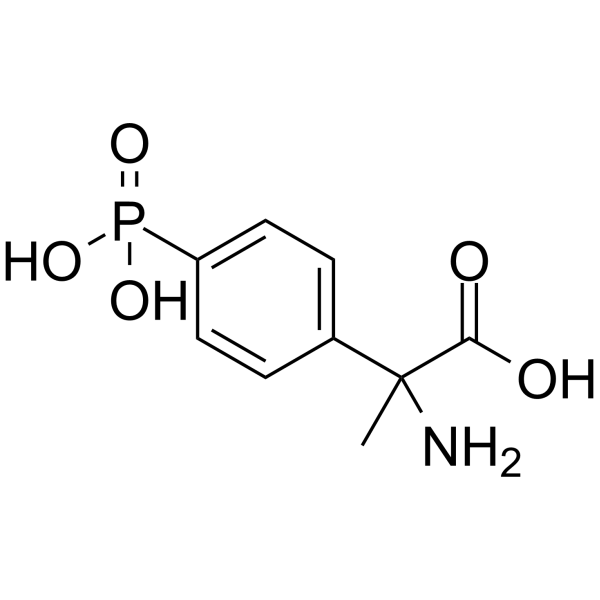
MPPG is a potent and selective L-AP4-sensitive receptor antagonist with an kD value of 9.2 μM, being tested on the neonatal rat spinal cord .
loading...
    loading...
Cat. No.: HY-108546
CAS No.: 23052-80-4
Synonyms: 3-Phosphono-L-alanine
Target:  

mGluR

Research Areas:  

Neurological Disease

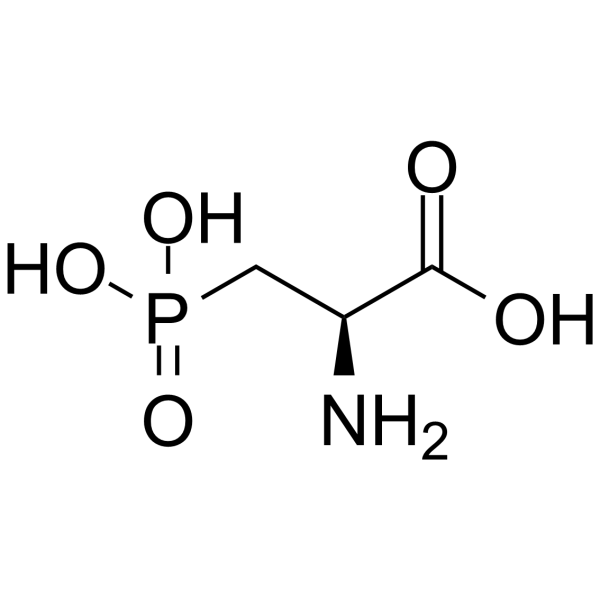
L-AP3, metabotropic glutamate receptor (mGluR) antagonist, inhibits D-phosphoserine and L-phosphoserine with IC50s of 368 μM and 2087 μM, respectively .
loading...
    loading...
Cat. No.: HY-RS14435
Research Areas:  

Others

TGFB1 Human Pre-designed siRNA Set A contains three designed siRNAs for TGFB1 gene (Human), as well as a negative control, a positive control, and a FAM-labeled negative control.

loading...
    loading...
Cat. No.: HY-P3971
CAS No.: 162559-45-7
Target:  

TGF-beta/Smad

Research Areas:  

Inflammation/Immunology

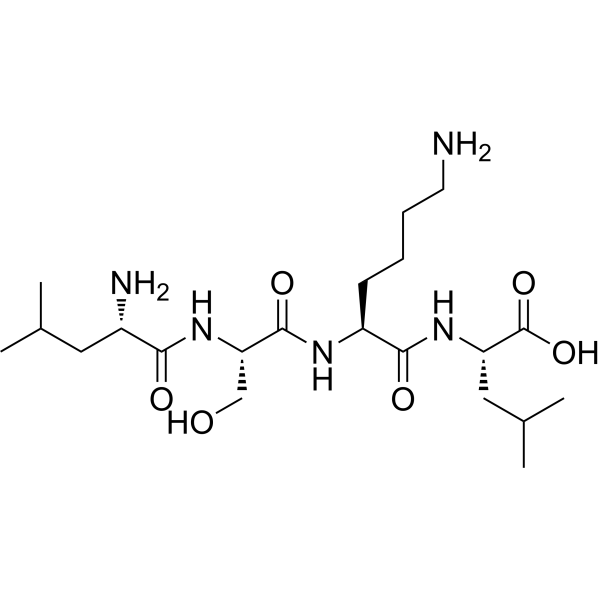
H-Leu-Ser-Lys-Leu-OH (LSYL) is a latency-associated peptide at the amino terminus of LAP, with inhibitory effect on TGF-β1 activation. H-Leu-Ser-Lys-Leu-OH, binding with KRFK (HY-P3970), can block the signal transduction of TGF-β1, and prevent the progression of hepatic damage and fibrosis .
loading...
    loading...
Cat. No.: HY-158228
Synonyms: PLMA
Poly-L-lysine Methacryloyl (PLMA) is methacrylated polylysine. When Poly-L-lysine Methacryloyl is cross-linked on polyetheretherketone (PEEK) through UV-induced cross-linking, it can improve the hydrophilicity of PEEK and retain its own degradation bioinertness . Poly-L-lysine Methacryloyl needs to self-assemble into fibrous hydrogel under the action of photoinitiator LAP (HY-44076), and target bioactive adhesion sites, play an inherent supporting role for tissue cells and biodegradable activity.
Application: cell culture, biological 3D printing, tissue engineering, etc.
loading...
    loading...
Cat. No.: HY-158223
Synonyms: CMCSMA
Carboxymethyl chitosan Methacryloyl (CMCSMA) is methacrylated carboxymethyl chitosan with properties as a 3D printing ink. A composite hydrogel made of Carboxymethyl chitosan Methacryloyl can effectively accelerate bone healing in an infectious microenvironment after implantation in a rat model of Staphylococcus aureus-infected femoral defect . Carboxymethyl chitosan Methacryloyl needs to self-assemble into fibrous hydrogel under the action of photoinitiator LAP (HY-44076), and target bioactive adhesion sites, play an inherent supporting role for tissue cells and biodegradable activity.
Application: cell culture, biological 3D printing, tissue engineering, etc.
loading...
    loading...
Cat. No.: HY-158217
Synonyms: Gelatin Methacryloyl, 30% methacrylation, Green Fluorescent
Green Fluorescent Gelatin Methacryloyl (Green Fluorescent GelMA) is methacryloyl gelatin (GelMA) with green fluorescence, which is obtained by "grafting" fluorescent molecules on GelMA. Green Fluorescent Gelatin Methacryloyl acts as a scaffold and can be used to engineer tissue analogs from the vasculature to cartilage and bone, allowing cells to proliferate and spread . GelMA, 30% methacrylation, Green Fluorescent needs to self-assemble into fibrous hydrogel under the action of photoinitiator LAP (HY-44076), and target bioactive adhesion sites, play an inherent supporting role for tissue cells and biodegradable activity.
Application: cell culture, biological 3D printing, tissue engineering, etc.
loading...
    loading...
Cat. No.: HY-158217A
Synonyms: Gelatin Methacryloyl, 60% methacrylation, Green Fluorescent
Green Fluorescent Gelatin Methacryloyl (Green Fluorescent GelMA) is methacryloyl gelatin (GelMA) with green fluorescence, which is obtained by "grafting" fluorescent molecules on GelMA. Green Fluorescent Gelatin Methacryloyl acts as a scaffold and can be used to engineer tissue analogs from the vasculature to cartilage and bone, allowing cells to proliferate and spread . GelMA, 60% methacrylation, Green Fluorescent needs to self-assemble into fibrous hydrogel under the action of photoinitiator LAP (HY-44076), and target bioactive adhesion sites, play an inherent supporting role for tissue cells and biodegradable activity.
Application: cell culture, biological 3D printing, tissue engineering, etc.
loading...
    loading...
Cat. No.: HY-P11334
CAS No.: 850131-23-6
Cyanostatin B, a cyanobacterial lipopeptide, is a leucine aminopeptidase M (LAP) inhibitor (IC50 = 12 ng/mL). Cyanostatin B is a weak inhibitor of protein phosphatase (PP2A) and also exhibits weak inhibitory activity against angiotensin-converting enzyme (ACE), with an IC50 value of 130 μg/mL. Cyanostatin B demonstrates both cytotoxic and genotoxic effects on human hepatocytes, although non-toxic to Artemia salina. Cyanostatin B inhibits the proliferation of HepG2 cells, induces DNA single-strand breaks, and causes genomic instability. .
loading...
    loading...
Cat. No.: HY-P990460

Target:  

TGF-beta/Smad

Research Areas:  

Inflammation/Immunology

Anti-LAP Antibody is a humanized antibody expressed in CHO cells, targeting LAP. The Anti-LAP Antibody features a huIgG2 heavy chain and a huκ light chain, with a predicted molecular weight (MW) of 150 kDa. For isotype control of the Anti-LAP Antibody, you can refer to Human IgG2 kappa, Isotype Control (HY-P99002).
loading...
    loading...
Cat. No.: HY-16141R
CAS No.: 188968-51-6
Synonyms: EMD 121974 (Standard)
Cilengitide (Standard) (EMD 121974 (Standard)) is the analytical standard of Cilengitide (HY-16141). This product is intended for research and analytical applications. Cilengitide (EMD 121974) is an integrin (integrin) inhibitor with blood-brain barrier permeability, with IC50 values against human targets as follows: 0.61 nM for αvβ3, 8.4 nM for αvβ5, 14.9 nM for α5β1, 5400 nM for αIIbβ3, 2050 nM for αvβ6, 2350 nM for αvβ8. Cilengitide inhibits the binding of integrins to vitronectin, fibronectin, fibrinogen and LAP (TGF-β), and serves as an internal standard for solid-phase integrin binding assays. Cilengitide inhibits tumor cell viability, induces apoptosis, reduces the phosphorylation levels of STAT3, AKT and mTOR, downregulates the expression of PD-L1, inhibits cell viability and angiogenesis, regulates anti-tumor immune responses and slows tumor growth. Cilengitide can be used in research related to glioblastoma, melanoma, advanced solid tumors and refractory brain tumors .
loading...
    loading...
Cat. No.: HY-101756
CAS No.: 150779-71-8
Synonyms: SDZ-LAP 977
Target:  

EGFR

Research Areas:  

Cancer

SDZ 281-977 is a derivative of the EGF receptor tyrosine kinase inhibitor Lavendustin A.
loading...
    loading...
Cat. No.: HY-RS07520
Research Areas:  

Others

LAP3 Human Pre-designed siRNA Set A contains three designed siRNAs for LAP3 gene (Human), as well as a negative control, a positive control, and a FAM-labeled negative control.

loading...
    loading...

