34 Results for "

caffeic

" in MedChemExpress (MCE) Product Catalog:
Products (34)

34 Results for "caffeic" in MCE Product Catalog:

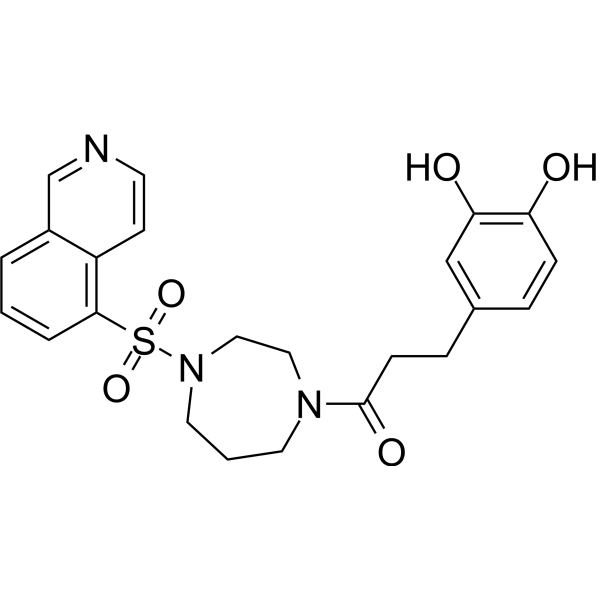
Cat. No.: HY-145294
CAS No.: 3031515-48-4
Target:  

ROCK

Research Areas:  

Neurological Disease

ROCK2-IN-5 (compound 1d) is a hybrid compound containing structural fragments of the Rho kinase inhibitor fasudil and the NRF2 inducers caffeic and ferulic acids. ROCK2-IN-5 has good multitarget profile and good tolerability. ROCK2-IN-5 has the potential for thr research of Amyotrophic lateral sclerosis (ALS) with a SOD1 mutation .
loading...
    loading...
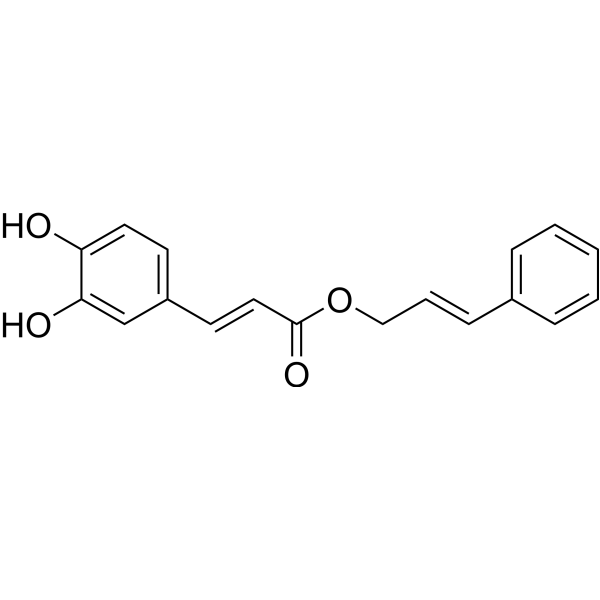
Cat. No.: HY-N8434
CAS No.: 115610-32-7
Target:  

Others

Cinnamyl caffeate is a caffeic acid ester that can be isolated from Slovenian Propolis .
loading...
    loading...
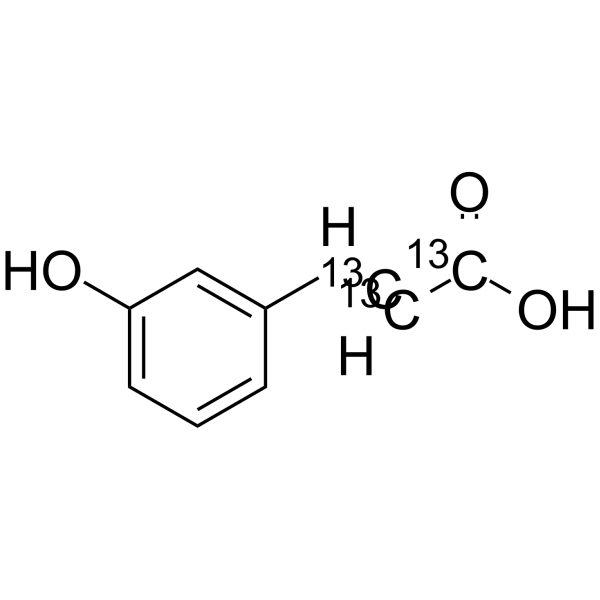
Cat. No.: HY-113357S
CAS No.: 1261170-79-9
m-Coumaric acid- 13C3 is the 13C-labeled m-Coumaric acid. m-Coumaric acid is a polyphenol metabolite from caffeic acid, formed by the gut microflora and the amount in human biofluids is diet-dependant.
loading...
    loading...
Cat. No.: HY-W1058007
CAS No.: 115610-29-2
(E)-Caffeic acid phenethyl ester is an inhibitor of iNOS and NF-κB. (E)-Caffeic acid phenethyl ester blocks the activation of iNOS by inhibiting NF-κB, and suppresses iNOS promoter activity at the NF-κB site. (E)-Caffeic acid phenethyl ester inhibits nitric oxide production in activated macrophages. (E)-Caffeic acid phenethyl ester is applicable to anti-inflammatory research .
loading...
    loading...
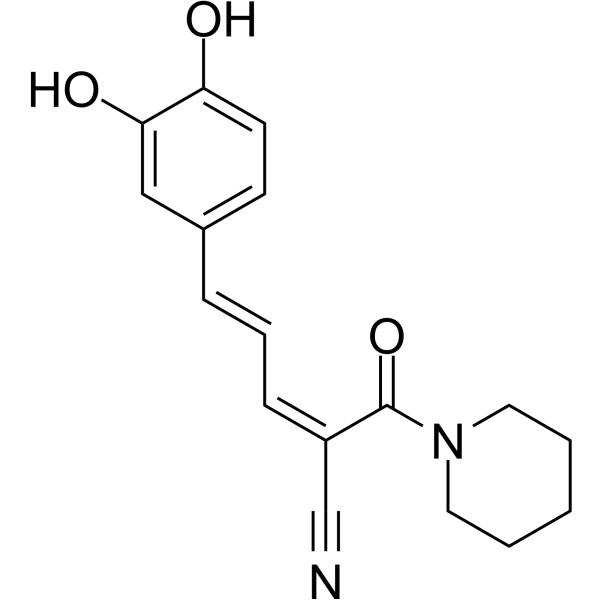
Cat. No.: HY-151390
CAS No.: 3033106-46-3
Target:  

Monoamine Oxidase COMT

Research Areas:  

Neurological Disease

hMAO-B/MB-COMT-IN-2 is a dual MAO-B/MB-COMT inhibitor (IC50s: 4.27 μΜ for hMAO-B, 2.69 μΜ for MB-COMT). hMAO-B/MB-COMT-IN-2 protects cells against oxidative damage. hMAO-B/MB-COMT-IN-2 can be used in the research of neurodegeneration disease, such as Parkinson’s Disease (PD) .
loading...
    loading...
Cat. No.: HY-W746884
CAS No.: 118971-61-2
2-Methyl-2-butenyl (E)-Caffeate is a type of caffeic acid ester compound. The petroleum ether and chloroform extracts containing 2-Methyl-2-butenyl (E)-Caffeate have inhibitory effects on acetylcholinesterase (AChE) and butyrylcholinesterase (BChE). The ether extract containing 2-Methyl-2-butenyl (E)-Caffeate exhibits strong antioxidant properties. 2-Methyl-2-butenyl (E)-Caffeate can be used in the research of Alzheimer's disease .
loading...
    loading...
Cat. No.: HY-N20683
CAS No.: 1115299-27-8
2,5-Dicaffeoylglucaric acid is a depside of caffeic acid with glucaric acid that can be found in the dried aerial parts of Eupatorium perfoliatum L. (Asteraceae) .
loading...
    loading...
Cat. No.: HY-N16847
CAS No.: 119644-16-5
Target:  

Others

3-Methyl-3-butenyl (E)-Caffeate is a caffeic acid ester compound found in Algerian propolis. Algerian propolis has antioxidant and anticholinesterase activities .
loading...
    loading...
Cat. No.: HY-N18680
CAS No.: 84082-61-1
Category:  

Extract

Target:  

Others

Melissa officinalis extract is rich in various bioactive compounds, such as citronellol, geraniol, glycosides, caffeic acid derivatives, flavonoids, and triterpenoids. Melissa officinalis extract can be used in research on conditions such as nervous tension, anxiety, insomnia, and menstrual disorders.
loading...
    loading...
Cat. No.: HY-W095774
CAS No.: 127033-74-3
Target:  

MMP

Research Areas:  

Cancer

(E)-N-(3-Methoxyphenyl) cinnamamide (Compound 5h) is a weakly selective inhibitor of MMP-2 and MMP-9, with weak inhibitory activity against hMMP-2 and hMMP-9, showing IC50 values of 1674.81 nM and 1658.63 nM, respectively, and low selectivity for MMP-1. (E)-N-(3-Methoxyphenyl) cinnamamide is applicable for cancer research .
loading...
    loading...
Cat. No.: HY-116284A
CAS No.: 7000-27-3
Synonyms: Methyl β-D-glucoside hemihydrate
Target:  

Drug Intermediate

Research Areas:  

Others

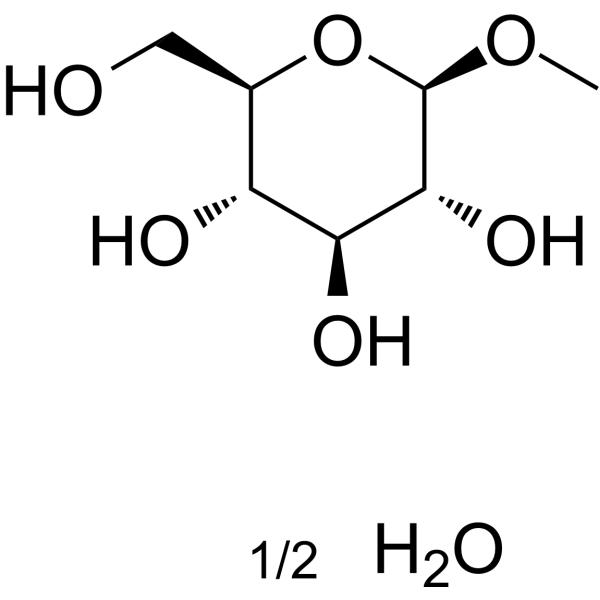
Methyl β-D-glucopyranoside (Methyl β-D-glucoside) hemihydrate is a model glycosyl acceptor for enzymatic glycosylation reactions. Methyl β-D-glucopyranoside hemihydrate participates in glycoside synthesis and can react with acyl donors such as caffeic acid esters under the catalysis of specific enzymes (such as Lipozyme TL IM) to achieve acylation modification. Methyl β-D-glucopyranoside hemihydrate can be used in organic synthesis and biocatalysis research, especially the efficient enzymatic preparation of medicinal glycosides (such as Robustaside B (HY-N2720), 6-O-caffeoyl salidroside) .
loading...
    loading...
Cat. No.: HY-179699
Target:  

Caspase Apoptosis

Research Areas:  

Cancer

Procaspase-3 activator 1 is a potent procaspase-3 activator. Procaspase-3 activator directly activates procaspase-3 through zinc chelation, thereby inducing apoptosis and inhibiting cancer cell proliferation. Procaspase-3 activator 1 can be used for the research of non-small cell lung cancer (NSCLC) and melanoma .
loading...
    loading...
Cat. No.: HY-116284R
CAS No.: 709-50-2
Synonyms: Methyl β-D-glucoside (Standard)
Research Areas:  

Others

Methyl β-D-glucopyranoside (Methyl β-D-glucoside) (Standard) is the analytical standard of Methyl β-D-glucopyranoside. This product is intended for research and analytical applications. Methyl β-D-glucopyranoside is a model glycosyl acceptor for enzymatic glycosylation reactions. Methyl β-D-glucopyranoside participates in glycoside synthesis and can react with acyl donors such as caffeic acid esters under the catalysis of specific enzymes (such as Lipozyme TL IM) to achieve acylation modification. Methyl β-D-glucopyranoside can be used in organic synthesis and biocatalysis research, especially the efficient enzymatic preparation of medicinal glycosides (such as Robustaside B (HY-N2720), 6-O-caffeoyl salidroside).
loading...
    loading...
Cat. No.: HY-160236B
Target:  

Drug Metabolite

Research Areas:  

Neurological Disease

3-(3-Sulfooxyphenyl) propanoic acid disodium is a metabolite of Echinacoside (HY-N0020). 3-(3-Sulfooxyphenyl) propanoic acid disodium promotes neural, psychological and brain health, enhances the proliferation, function and activity of brain cells, and facilitates extinction learning. 3-(3-Sulfooxyphenyl) propanoic acid disodiumis can be used in research related to anxiety disorders, post-traumatic stress disorder, extinction learning deficits, autism, as well as neurodegenerative diseases including Parkinson's disease and Alzheimer's disease .
loading...
    loading...

