36 Results for "

point mutations

" in MedChemExpress (MCE) Product Catalog:
Products (36)

36 Results for "point mutations" in MCE Product Catalog:

Cat. No.: HY-E70773
Target:  

RET

Research Areas:  

Cancer

Rearranged during transfection (RET) is a transmembrane receptor protein tyrosine kinase (PTK) activated normally by forming ternary complexes with its cognate ligands and co-receptors. RET alterations by point mutations and gene fusions were found in diverse cancers. RET M918T is a mutant of RET. RET M918T Recombinant Human Active Protein Kinase is a recombinant RET M918T protein that can be used to study RET M918T-related functions .
loading...
    loading...
Cat. No.: HY-E70774
Target:  

RET

Research Areas:  

Cancer

Rearranged during transfection (RET) is a transmembrane receptor protein tyrosine kinase (PTK) activated normally by forming ternary complexes with its cognate ligands and co-receptors. RET alterations by point mutations and gene fusions were found in diverse cancers. RET R749T is a mutant of RET. RET R749T Recombinant Human Active Protein Kinase is a recombinant RET R749T protein that can be used to study RET R749T-related functions .
loading...
    loading...
Cat. No.: HY-E70775
Target:  

RET

Research Areas:  

Cancer

Rearranged during transfection (RET) is a transmembrane receptor protein tyrosine kinase (PTK) activated normally by forming ternary complexes with its cognate ligands and co-receptors. RET alterations by point mutations and gene fusions were found in diverse cancers. RET R813Q is a mutant of RET. RET R813Q Recombinant Human Active Protein Kinase is a recombinant RET R813Q protein that can be used to study RET R813Q-related functions .
loading...
    loading...
Cat. No.: HY-E70777
Target:  

RET

Research Areas:  

Cancer

Rearranged during transfection (RET) is a transmembrane receptor protein tyrosine kinase (PTK) activated normally by forming ternary complexes with its cognate ligands and co-receptors. RET alterations by point mutations and gene fusions were found in diverse cancers. RET V804E is a mutant of RET. RET V804E Recombinant Human Active Protein Kinase is a recombinant RET V804E protein that can be used to study RET V804E-related functions .
loading...
    loading...
Cat. No.: HY-E70779
Target:  

RET

Research Areas:  

Cancer

Rearranged during transfection (RET) is a transmembrane receptor protein tyrosine kinase (PTK) activated normally by forming ternary complexes with its cognate ligands and co-receptors. RET alterations by point mutations and gene fusions were found in diverse cancers. RET V804M is a mutant of RET. RET V804M Recombinant Human Active Protein Kinase is a recombinant RET V804M protein that can be used to study RET V804M-related functions .
loading...
    loading...
Cat. No.: HY-E70780
Target:  

RET

Research Areas:  

Cancer

Rearranged during transfection (RET) is a transmembrane receptor protein tyrosine kinase (PTK) activated normally by forming ternary complexes with its cognate ligands and co-receptors. RET alterations by point mutations and gene fusions were found in diverse cancers. RET Y791F is a mutant of RET. RET Y791F Recombinant Human Active Protein Kinase is a recombinant RET Y791F protein that can be used to study RET Y791F-related functions .
loading...
    loading...
Cat. No.: HY-E70781
Target:  

RET

Research Areas:  

Cancer

Rearranged during transfection (RET) is a transmembrane receptor protein tyrosine kinase (PTK) activated normally by forming ternary complexes with its cognate ligands and co-receptors. RET alterations by point mutations and gene fusions were found in diverse cancers. RET Y806H is a mutant of RET. RET Y806H Recombinant Human Active Protein Kinase is a recombinant RET Y806H protein that can be used to study RET Y806H-related functions .
loading...
    loading...
Cat. No.: HY-E70859
Target:  

RET

Research Areas:  

Cancer

Rearranged during transfection (RET) is a transmembrane receptor protein tyrosine kinase (PTK) activated normally by forming ternary complexes with its cognate ligands and co-receptors. RET alterations by point mutations and gene fusions were found in diverse cancers. RET L790F is a mutant of RET. RET L790F Recombinant Human Active Protein Kinase is a recombinant RET L790F protein that can be used to study RET L790F-related functions .
loading...
    loading...
Cat. No.: HY-P2307
CAS No.: 847829-41-8
Target:  

iGluR NO Synthase

Research Areas:  

Neurological Disease

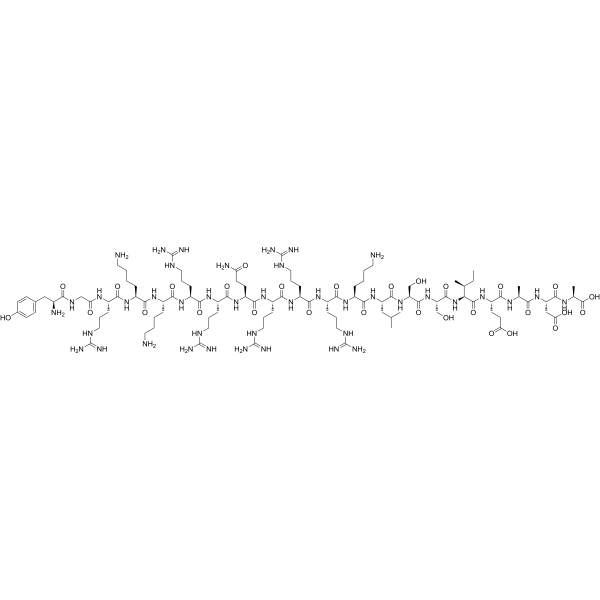
Tat-NR2BAA is the control peptide of Tat-NR2B9c (HY-P0117), inactive. The sequence of Tat-NR2BAA is similar to Tat-NR2B9c, but it has a double-point mutation in the COOH terminal tSXV motif, making it incapable of binding PSD-95. Tat-NR2B9c is a membrane-permeant peptide and disrupts PSD-95/NMDAR binding, correlate with uncoupling NR2B- and/or NR2A-type NMDARs from PSD-95 .
loading...
    loading...
Cat. No.: HY-P2307A
Target:  

iGluR NO Synthase

Research Areas:  

Neurological Disease

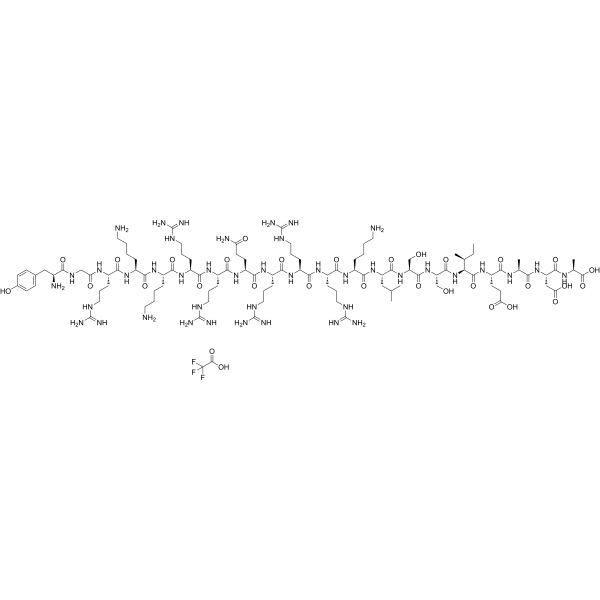
Tat-NR2BAA TFA is the control peptide of Tat-NR2B9c (HY-P0117), inactive. The sequence of Tat-NR2BAA TFA is similar to Tat-NR2B9c, but it has a double-point mutation in the COOH terminal tSXV motif, making it incapable of binding PSD-95. Tat-NR2B9c is a membrane-permeant peptide and disrupts PSD-95/NMDAR binding, correlate with uncoupling NR2B- and/or NR2A-type NMDARs from PSD-95 .
loading...
    loading...
Cat. No.: HY-Y1010S
CAS No.: 1246819-20-4
Synonyms: Glycidol-d5
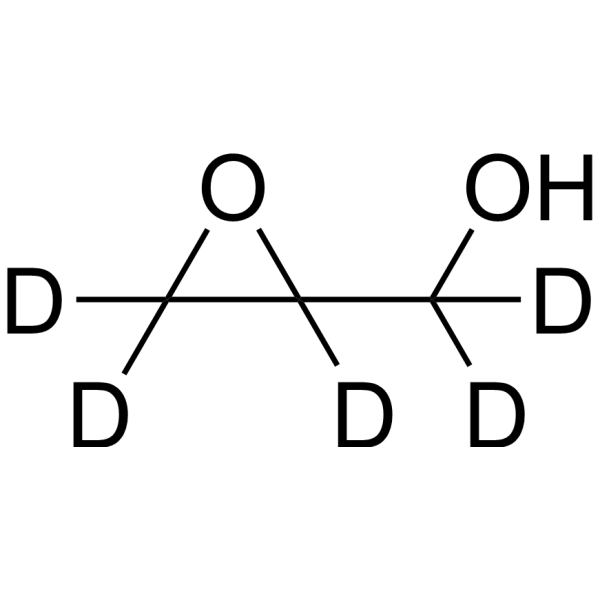
Oxiran-2-ylmethanol-d5 is the deuterium labeled Oxiran-2-ylmethanol (Glycidol) (HY-Y1010). Oxiran-2-ylmethanol is an ester product. Oxiran-2-ylmethanol induces base pair point mutations in bacterial strains and structural chromosome aberrations in cultured cells. Oxiran-2-ylmethanol forms N-(2,3-dihydroxypropyl)valine hemoglobin adducts. Oxiran-2-ylmethanol acts as an animal carcinogen but does not significantly induce micronucleated immature erythrocytes in animal bone marrow. Oxiran-2-ylmethanol enables anionic polymerization to produce linear poly(glycidol). Oxiran-2-ylmethanol can be used for cancer-related research .
loading...
    loading...
Cat. No.: HY-Y1010R
CAS No.: 556-52-5
Synonyms: Glycidol (Standard)
Research Areas:  

Cancer

Oxiran-2-ylmethanol (Standard) is the analytical standard of Oxiran-2-ylmethanol (Glycidol) (HY-Y1010). This product is intended for research and analytical applications. Oxiran-2-ylmethanol is an ester product. Oxiran-2-ylmethanol induces base pair point mutations in bacterial strains and structural chromosome aberrations in cultured cells. Oxiran-2-ylmethanol forms N-(2,3-dihydroxypropyl)valine hemoglobin adducts. Oxiran-2-ylmethanol acts as an animal carcinogen but does not significantly induce micronucleated immature erythrocytes in animal bone marrow. Oxiran-2-ylmethanol enables anionic polymerization to produce linear poly(glycidol). Oxiran-2-ylmethanol can be used for cancer-related research .
loading...
    loading...
Cat. No.: HY-101977A
CAS No.: 2097002-59-8
Synonyms: (R,S)-LOXO-195
Target:  

Trk Receptor

Research Areas:  

Cancer

(R,S)-Selitrectinib ((R,S)-LOXO-195) (compound 17) is a Trk inhibitor with activity against cancers harboring Trk inhibitor-resistant point mutations in NTRK1, NTRK2, or NTRK3 genes. (R,S)-Selitrectinib can be used for the research of trk inhibitor-resistant cancer .
loading...
    loading...
Cat. No.: HY-E70894
Target:  

Endogenous Metabolite

Research Areas:  

Metabolic Disease

α,γ-Homocysteinase, Trichomonas vaginalis is a pyridoxal-5’-phosphate dependent enzyme. α,γ-Homocysteinase, Trichomonas vaginalis is a mutant of homocysteinase from Trichomonas vaginalis encoded by mgl1 gene, containing three point mutations, such as; Phe47Leu, Asp172Glu, Ser308Tyr. α,γ-Homocysteinase, Trichomonas vaginalis can metabolize homocysteine into α-keto butyrate, hydrogen sulfide and ammonia.
loading...
    loading...
Cat. No.: HY-117908
CAS No.: 1281861-06-0
Research Areas:  

Infection

DSM267 is a triazolopyrimidine inhibitor of Plasmodium falciparum dihydroorotate dehydrogenase (PfDHODH), with an IC50 of 38 nM, while its IC50 against human DHODH exceeds 100000 nM. DSM267 is used for the in vitro systematic screening and characterization of the resistance evolution pathways of Plasmodium falciparum to DHODH inhibitors .
loading...
    loading...
Cat. No.: HY-P991839

Target:  

CD19

Research Areas:  

Cancer

Anti-CD19 Antibody (FMC63) is an antibody that binds to CD19, with a human Kd value ranging from 0.42 nM to 149 nM. Anti-CD19 Antibody (FMC63) mediates tumor cell killing, cytokine secretion, stable CAR expression, T cell activation and memory differentiation. Anti-CD19 Antibody (FMC63) fails to eliminate lymphoma cells carrying CD19 point mutations or co-expressing FMC63-CAR19, induces higher levels of activation-induced cell death, and reduces cell persistence. Anti-CD19 Antibody (FMC63) can be used in research related to B-cell non-Hodgkin's lymphoma, B-cell acute lymphoblastic leukemia, relapsed or refractory diffuse large B-cell lymphoma, etc .
loading...
    loading...

