51 Results for "

LC3-II

" in MedChemExpress (MCE) Product Catalog:
Products (51)

51 Results for "LC3-II" in MCE Product Catalog:

Cat. No.: HY-158108
Research Areas:  

Cancer

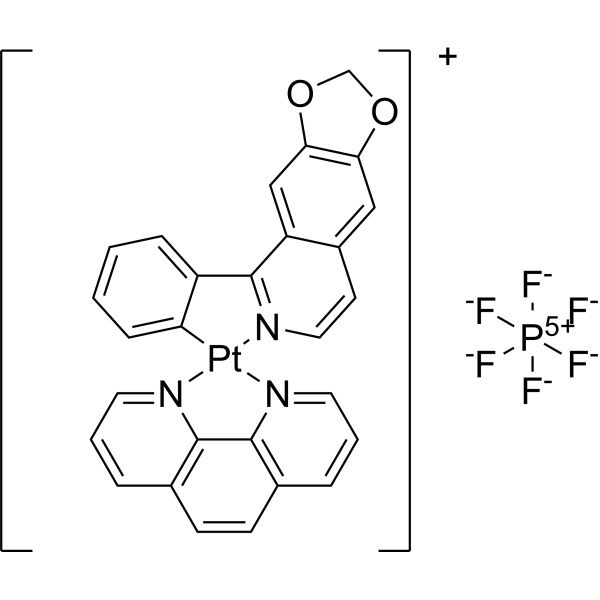
anti-TNBC agent-6 (compound pt-3) is a potent anti-TNBC agent. anti-TNBC agent-6 shows cytotoxic activity. anti-TNBC agent-6 induces autophagy and ferroptosis. anti-TNBC agent-6 enhances intracellular ROS accumulatio. anti-TNBC agent-6 shows anti tumor activity and has the potential for the research of breast cancer .
loading...
    loading...
Cat. No.: HY-185682
CAS No.: 1382354-26-8
Research Areas:  

Cancer

NCO-141 is a selective SIRT2 inhibitor with an IC50 of 0.5 μM. NCO-141 induces cell apoptosis via caspase activation and mitochondrial superoxide anion production. NCO-141 induces cell autophagy by increasing LC3-II levels and autophagosome accumulation. NCO-141 is applicable to relevant research on leukemia .
loading...
    loading...
Cat. No.: HY-184717
Target:  

Atg4 Autophagy

Research Areas:  

Cancer

Atg4B-IN-3 (compound a25) is a ATG4B inhibitor with a Kd value of 18.01 nM against the human target. Atg4B-IN-3 stably regulates the closed conformation of the loop, prevents substrates from accessing the catalytic site Cys74, and thereby inhibits the proteolytic activity of ATG4B. Atg4B-IN-3 blocks autophagic flux, reduces LC3-II levels, promotes p62 accumulation, disrupts autophagy homeostasis and enhances cell death. Atg4B-IN-3 inhibits cell proliferation, migration and clonogenic survival capacity. Atg4B-IN-3 can be used in studies related to esophageal squamous cell carcinoma .
loading...
    loading...
Cat. No.: HY-183870
CAS No.: 1382354-18-8
NCO-90 is a selective SIRT2 inhibitor with an IC50 of 1.0 μM. NCO-90 induces Apoptosis via Caspase activation and mitochondrial superoxide anion production, and also induces Autophagic cell death by increasing LC3-II levels and autophagosome accumulation. NCO-90 exhibits anticancer activity against leukemia. NCO-90 can be used in research related to acute lymphoblastic leukemia and acute myeloid leukemia .
loading...
    loading...
Cat. No.: HY-165539
CAS No.: 221238-83-1
SMER10 is a small-molecule enhancer that can induce autophagy. SMER10 can increase the number of EGFP-LC3 positive autophagosoms in COS-7 and HeLa cells, promoting the conversion of LC3-I to autophagosome-associated LC3-II. SMER10 can efficiently promote the degradation of autophagy substrates, including the mutant huntingtin protein (EGFP-HDQ74) associated with Huntington's disease and the A53T α-synuclein protein associated with Parkinson's disease. SMER10 exerts neuroprotective effect .
loading...
    loading...
Cat. No.: HY-182054
Research Areas:  

Cancer

Topoisomerase ll/ME-1-IN-1 (Compound 7a) is a Topoisomerase ll and ME-1 inhibitor with an IC50 of 5.03 μM against Topoisomerase ll. Topoisomerase ll/ME-1-IN-1 functionally inhibits the activity of Topoisomerase II and functionally blocks the activity of ME-1. Topoisomerase ll/ME-1-IN-1 induces Autophagy by upregulating the expression of Beclin-1 and LC3-II. Topoisomerase ll/ME-1-IN-1 promotes Apoptosis. Topoisomerase ll/ME-1-IN-1 exhibits antiproliferative activity against breast cancer cells and shows no toxicity to normal mammary epithelial cells. Topoisomerase ll/ME-1-IN-1 can be used in studies related to breast cancer (including triple-negative breast cancer) .
loading...
    loading...
Cat. No.: HY-181062
Research Areas:  

Cancer

VWK147 is a second-generation HSP90 C-terminal domain (CTD) inhibitor. VWK147 targets the CTD dimerization interface, prevents HSP90 CTD dimerization, disrupts co-chaperone PPID binding to HSP90 CTD, and inhibits HSP90 chaperone function dependent on dimerization. VWK147 reduces protein levels of HSP90 client proteins ULK1, RIPK1, and CDK4 without inducing a heat shock response. VWK147 induces cell death, including apoptosis, in Cisplatin (HY-17394)-sensitive and -resistant urothelial carcinoma cells. VWK147 induces LC3-II accumulation, inhibits autophagosome-lysosome fusion to block canonical autophagy, and induces non-canonical LC3 lipidation independent of ULK1 and PIK3C3 complexes. VWK147 can be used for the research of urothelial carcinoma .
loading...
    loading...
Cat. No.: HY-RS27792
Research Areas:  

Others

Map1lc3a Rat Pre-designed siRNA Set A contains three designed siRNAs for Map1lc3a gene (Rat), as well as a negative control, a positive control, and a FAM-labeled negative control.
loading...
    loading...
Cat. No.: HY-183732
CAS No.: 2841473-85-4
Target:  

Autophagy

Research Areas:  

Others

ATG5 PPI-IN-2 is a selective inhibitor of ATG5-TECAIR protein-protein interaction, with a IC50 of 19.16 μM. ATG5 PPI-IN-2 also acts as an Autophagy inhibitor .
loading...
    loading...
Cat. No.: HY-183737
CAS No.: 2841473-83-2
Target:  

Autophagy

Research Areas:  

Infection Cancer

ATG5/TECAIR-IN-1 is a ATG5-TECAIR interaction inhibitor with an IC50 of 20.79 μM. ATG5/TECAIR-IN-1 inhibits autophagy. TG5/TECAIR-IN-1 is applicable to research on modulating protein-protein interactions to intervene in autophagy-related diseases, such as infectious diseases and cancers .
loading...
    loading...
Cat. No.: HY-184501
CAS No.: 486440-74-8
Research Areas:  

Cancer

UE01 is an orally active, selective small-molecule modulator targeting both ULK1/ERK1/2. UE01 activates hULK1 with an EC50 of 695.30 nM and a KD of 114.3 nM for ULK1; it inhibits hERK1 with an IC50 of 179.90 nM and a KD of 114 nM for ERK1; it shows weak binding to ERK2 with a KD of 2.8 mM. UE01 induces the conformational transition of ULK1 from an inactive to an active state, enhances the phosphorylation of ULK1 Ser317 and mAtg13 Ser355, and reduces the phosphorylation of ULK1 Ser757. UE01 competitively occupies the ATP-binding pocket of ERK1, inhibits ERK1 kinase activity, and reduces the activity of the ERK1/2 signaling pathway. UE01 induces complete autophagy flux and apoptosis, upregulates Atg5, Atg7, LC3-II/LC3-I, Bax, cytochrome C (Cyt c), Cleaved-Caspase 3, Cleaved-PARP1 and E-cadherin, downregulates p62, Bcl-2, MMP-2 and MMP-9, reduces the phosphorylation of Exo70 Ser250, and promotes the proteasome-dependent degradation of Cav-1, thereby inhibiting EMT-related phenotypes and extracellular matrix degradation. UE01 can be used in studies related to triple-negative breast cancer .
loading...
    loading...

