122 Results for "

bioactive molecules

" in MedChemExpress (MCE) Product Catalog:
Products (122)

122 Results for "bioactive molecules" in MCE Product Catalog:

Cat. No.: HY-N0003R
CAS No.: 35354-74-6
Synonyms: NSC 293100 (Standard)
Honokiol (Standard) is the analytical standard of Honokiol. This product is intended for research and analytical applications. Honokiol is a bioactive, biphenolic phytochemical that possesses potent antioxidative, anti-inflammatory, antiangiogenic, and anticancer activities by targeting a variety of signaling molecules. It inhibits the activation of Akt. Honokiol can readily cross the blood brain barrier .
loading...
    loading...
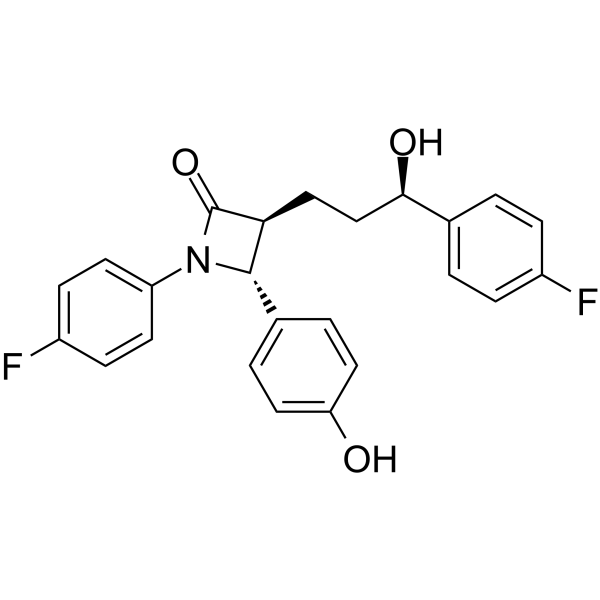
Cat. No.: HY-135388
CAS No.: 1376614-99-1
Synonyms: ent-SCH 58235
Target:  

Drug Metabolite

Research Areas:  

Others

ent-Ezetimibe (ent-SCH 58235) is the RRS enantiomer of Ezetimibe (HY-17376). Ezetimibe is an NPC1L1 inhibitor and a potent Nrf2 activator .
loading...
    loading...
Cat. No.: HY-B1402G
CAS No.: 2203-97-6
Synonyms: Hydrocortisone 21-hemisuccinate (GMP)
Hydrocortisone hemisuccinate GMP (Hydrocortisone 21-hemisuccinate GMP) is a GMP-grade version of Hydrocortisone hemisuccinate (HY-B1402). GMP-grade small molecules can be used as auxiliary reagents in cell therapy. Hydrocortisone hemisuccinate (Hydrocortisone 21-hemisuccinate), a glucocorticoid, is an orally active steroidal anti-inflammatory agent (SAID) with anti-inflammatory and immunomodulatory activities. Hydrocortisone hemisuccinate inhibits the bioactivity of IL-6 and IL-3 with IC50 values of 6.7 and 21.4 μM, respectively. Hydrocortisone hemisuccinate can be used in the study of ulcerative colitis (UC) and recurrent oral ulcers . .
loading...
    loading...
Cat. No.: HY-N14232
CAS No.: 487-34-3
Inactone is a bioactive molecule of 3-glutarimidyl group that inhibits large ribosomal subunit .
loading...
    loading...
Cat. No.: HY-150352
Dextran-COOH is a dextran derivative with carboxyl (–COOH) functional groups introduced into the molecular chain. Dextran-COOH can be covalently coupled with a variety of bioactive molecules, drugs, small molecule ligands, fluorescent probes and other functional materials .
loading...
    loading...
Cat. No.: HY-P10418
Target:  

c-Myc

Research Areas:  

Cancer

VGN50 is a bioactive molecule that mimics the function of K-Rta and down-regulates MYC-mediated gene transcription. VGN50 has antitumor activity .
loading...
    loading...
Cat. No.: HY-W412215
CAS No.: 69458-20-4
TTMAPP is a photocatalyst with the activity of promoting organic reactions. TTMAPP is widely used in chemical synthesis, especially in oxidation and reduction reactions. TTMAPP can also be used as a synthetic intermediate for bioactive molecules, which is of great significance for compound development.
loading...
    loading...
Cat. No.: HY-N4227
CAS No.: 76758-18-4
Conicasterol is a 4-mercaptosteroid with significant cytotoxic activity. Conicasterol showed an IC50 value of 6.23 μg/mL in a test on a human breast adenocarcinoma cell line (MCF-7). Conicasterol's antitumor activity makes it a potential bioactive lead molecule .
loading...
    loading...
Cat. No.: HY-W023557
CAS No.: 1072-87-3
Synonyms: 3-Methylmaleimide; 2-Methylmaleimide
Target:  

Drug Intermediate

Research Areas:  

Others

Citraconimide is a 3-methylmaleimide derivative. Citraconimide has thiol affinity and can undergo highly regioselective addition with a variety of alkyl thiols. Citraconimide derivatives show growth inhibitory activity against HeLa cells. Citraconimide can be modified by N-substitution, halogenation and other reactions for use in bioactive molecule design and drug development research .
loading...
    loading...
Cat. No.: HY-78139R
CAS No.: 609-06-3
Synonyms: L-(-)-Xylose (Standard)
L-Xylose (Standard) (L-(-)-Xylose (Standard)) is the analytical standard of L-Xylose (HY-78139). This product is intended for research and analytical applications. L-Xylose (L-(-)-Xylose) is a rare sugar and the levorotatory form of Xylose (HY-N0537). L-Xylose can be used as a raw material for the synthesis of various drugs and bioactive molecules .
loading...
    loading...
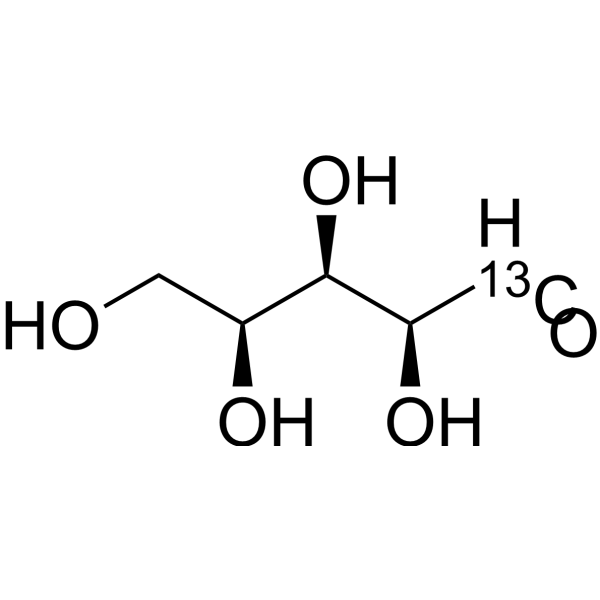
Cat. No.: HY-78139S
CAS No.: 178101-87-6
Synonyms: L-(-)-Xylose-1-13C
L-Xylose-1- 13C (L-(-)-Xylose-1- 13C) is the 13C labeled L-Xylose (HY-78139). L-Xylose (L-(-)-Xylose) is a rare sugar and the levorotatory form of Xylose (HY-N0537). L-Xylose can be used as a raw material for the synthesis of various drugs and bioactive molecules .
loading...
    loading...
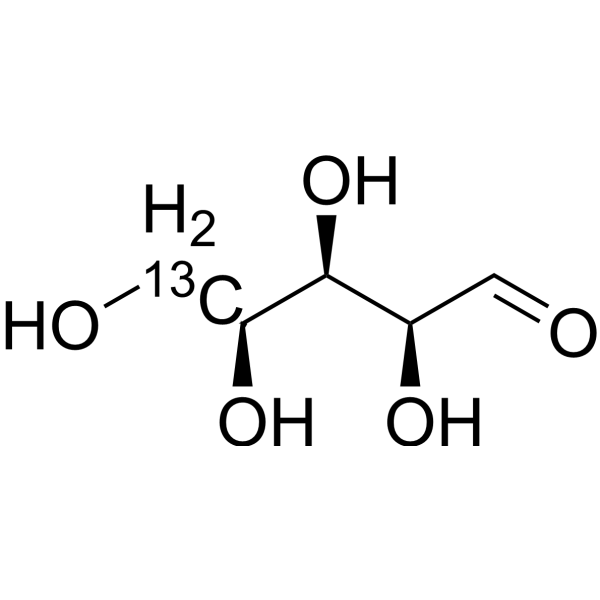
Cat. No.: HY-78139S2
CAS No.: 478506-64-8
Synonyms: L-(-)-Xylose-5-13C
L-Xylose-5- 13C (L-(-)-Xylose-5- 13C) is the 13C labeled L-Xylose (HY-78139). L-Xylose (L-(-)-Xylose) is a rare sugar and the levorotatory form of Xylose (HY-N0537). L-Xylose can be used as a raw material for the synthesis of various drugs and bioactive molecules .
loading...
    loading...
Cat. No.: HY-W698686
CAS No.: 36271-49-5
β-Galactosyl-C18-ceramide is a bioactive molecule that promotes the regulation of nerve cells, regulates protein kinase C activity, and affects hormone receptors. β-Galactosyl-C18-ceramide is widely used in neuroscience research to explore its effects on nerve cell growth and function. The regulatory function of β-Galactosyl-C18-ceramide makes it a potential application prospect in compound development and disease inhibition.
loading...
    loading...
Cat. No.: HY-158219
Synonyms: GelMA, 30% methacrylation, blue fluorescent
Gelatin Methacryloyl (GelMA), 30% methacrylation, blue fluorescent is methacrylated gelatin (GelMA) with blue fluorescence, which is obtained by "grafting" fluorescent molecules on GelMA. Gelatin Methacryloyl, 30% methacrylation, blue fluorescent has a scaffolding effect and can be used to design tissue analogs from vasculature to cartilage and bone, allowing cell proliferation and spreading. Gelatin Methacryloyl, 30% methacrylation, blue fluorescent needs to be self-assembled into fibrous hydrogels under the action of the photoinitiator LAP (HY-44076), and target bioactive adhesion sites, exert inherent support for tissue cells and biodegradation activity.
Application direction: cell culture, biological 3D printing, tissue engineering, etc.
loading...
    loading...
Cat. No.: HY-158219A
Synonyms: GelMA, 60% methacrylation, blue fluorescent
Research Areas:  

Others

Gelatin Methacryloyl (GelMA), 60% methacrylation, blue fluorescent is methacrylated gelatin (GelMA) with blue fluorescence, which is obtained by "grafting" fluorescent molecules on GelMA. Gelatin Methacryloyl, 60% methacrylation, blue fluorescent has a scaffolding effect and can be used to design tissue analogs from vasculature to cartilage and bone, allowing cell proliferation and spreading. Gelatin Methacryloyl, 30% methacrylation, blue fluorescent needs to be self-assembled into fibrous hydrogels under the action of the photoinitiator LAP (HY-44076), and target bioactive adhesion sites, exert inherent support for tissue cells and biodegradation activity.
Application direction: cell culture, biological 3D printing, tissue engineering, etc.
loading...
    loading...
Cat. No.: HY-158219B
Synonyms: GelMA, 90% methacrylation, blue fluorescent
Research Areas:  

Others

Gelatin Methacryloyl (GelMA), 90% methacrylation, blue fluorescent is methacrylated gelatin (GelMA) with blue fluorescence, which is obtained by "grafting" fluorescent molecules on GelMA. Gelatin Methacryloyl, 90% methacrylation, blue fluorescent has a scaffolding effect and can be used to design tissue analogs from vasculature to cartilage and bone, allowing cell proliferation and spreading. Gelatin Methacryloyl, 30% methacrylation, blue fluorescent needs to be self-assembled into fibrous hydrogels under the action of the photoinitiator LAP (HY-44076), and target bioactive adhesion sites, exert inherent support for tissue cells and biodegradation activity.
Application direction: cell culture, biological 3D printing, tissue engineering, etc.
loading...
    loading...
Cat. No.: HY-W008034S
CAS No.: 1325307-52-5
Synonyms: Fmoc-L-Trp(Boc)-OH-13C11,15N2
Fmoc-Trp(Boc)-OH- 13C11, 15N2 (Fmoc-L-Trp(Boc)-OH- 13C11, 15N2) is the 13C-labeled and 15N-labeled Fmoc-Trp(Boc)-OH (HY-W008034). Fmoc-Trp(Boc)-OH (Fmoc-L-Trp(Boc)-OH) is an amino acid derivative with protective groups. Fmoc-Trp(Boc)-OH can self-assemble into stable and pH-responsive spherical nanoparticles, which can load and release bioactive molecules, with good biocompatibility and high cell uptake rate. Fmoc-Trp(Boc)-OH can be used in research on drug delivery .
loading...
    loading...
Cat. No.: HY-W698686S
CAS No.: 145176-92-7
Research Areas:  

Others

β-Galactosyl-C18-ceramide-d35 is deuterium labeled β-Galactosyl-C18-ceramide. β-Galactosyl-C18-ceramide is a bioactive molecule that promotes the regulation of nerve cells, regulates protein kinase C activity, and affects hormone receptors. β-Galactosyl-C18-ceramide is widely used in neuroscience research to explore its effects on nerve cell growth and function. The regulatory function of β-Galactosyl-C18-ceramide makes it a potential application prospect in compound development and disease inhibition .
loading...
    loading...
Cat. No.: HY-L181
30,147 compounds

Bioactive small molecules are important sources of lead compounds and effective tools for drug screening. Because the target of active small molecules is clear, it is conducive to the study of mechanism. In addition, due to the large structural differences between the individual active molecules, it is easier to obtain a greater variety of lead compounds.

MCE integrates the Bioactive Compound Library (HY-L001) and Novel Bioactive Compound Library (HY-L111) to form the Bioactive Compound Library Max. Bioactive Compound Library Max contains novel active small molecules, molecules that have entered the clinical stage and the market, and small molecules that have been verified by cell experiments or biochemical experiments, which fundamentally expands the number of compound libraries in the library and improves the structural diversity, and is an effective tool to start drug screening and mechanism research.

MCE can provide a library of 30,147 mitophagy compounds, which can be used for drug development and mechanism research in cancer, immunity, infection and other hot research fields.

Cat. No.: HY-150352A
Dextran-COOH (MW 10 kDa) is a dextran derivative with carboxyl (–COOH) functional groups introduced into the molecular chain. Dextran-COOH can be covalently coupled with a variety of bioactive molecules, drugs, small molecule ligands, fluorescent probes and?other?functional?materials.
loading...
    loading...

