673 Results for "

K-Ras

" in MedChemExpress (MCE) Product Catalog:
Products (673)

673 Results for "K-Ras" in MCE Product Catalog:

Cat. No.: HY-147099
Purity:  97.8%
Target:  

PROTACs FKBP

Research Areas:  

Cancer

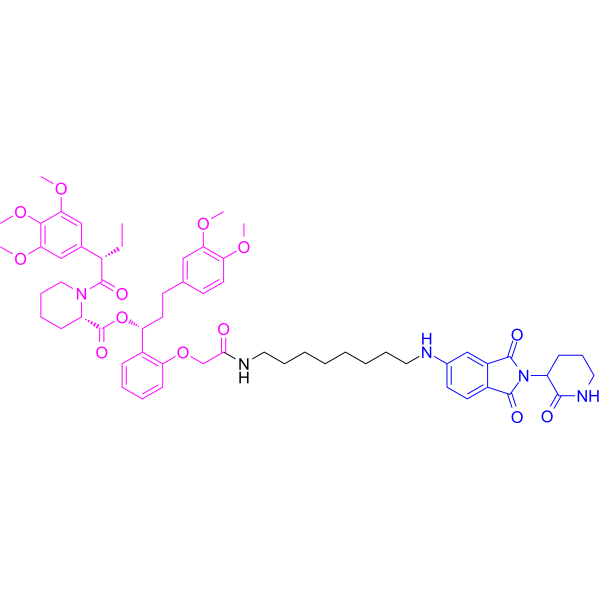
dTAG-47-NEG is an inactive bifunctional negative control PROTAC and also the diastereomer of dTAGV-1 (HY-145514D). dTAG-47-NEG does not reduce the level of BCL11A-FKBP12 F36V, nor does it induce the degradation of BCL11A-FKBP12 F36V, proteins tagged with FKBP12 F36V, wild-type FKBP12, FKBP12 F36V-KRAS G12V or FKBP12 F36V-EWS/FLI. dTAG-47-NEG exerts no antiproliferative effect in cancer cells .
loading...
    loading...
Cat. No.: HY-153858
CAS No.: 2470433-36-2
PHI-501 is a dual inhibitor targeting RAF/DDR. PHI-501 exhibits significant anti-proliferative effects in melanoma cell lines and significantly inhibits the colony formation of drug-resistant cells. PHI-501 strongly inhibits ERK and AKT phosphorylation. PHI-501 downregulates the gene sets in drug-resistant cells of TNFA-NFKB, IL6-JAK-STAT3, and KRAS signaling pathways as well as the epithelial-mesenchymal transition (EMT) signaling pathways. PHI-501 demonstrates significant anti-tumor effects in the SK-MEL3DR xenograft model. PHI-501 can be used for research on the problem of drug resistance in melanoma .
loading...
    loading...
Cat. No.: HY-159190
CAS No.: 2409140-12-9
Research Areas:  

Cancer

HRX-0233 is an orally potent MAP2K4 inhibitor. HRX-0233 inhibits the MAP2K4-JNK-JUN signaling pathway, blocks the feedback activation of receptor tyrosine kinases, and sustains the inhibitory effect on KRAS signaling. HRX-0233 exerts synergistic inhibition on the mTORC1 and MAPK pathways. When combined with Ipatasertib (HY-15186) or Sotorasib (HY-114277), it produces synergistic antiproliferative, pro-apoptotic (apoptosis) and antitumor effects, and shows good tolerability in mouse models. HRX-0233 can be used in CRISPR knockout screens to identify vulnerability-related genes. HRX-0233 is applicable to research related to prostate cancer, non-small cell lung cancer and colorectal cancer .
loading...
    loading...
Cat. No.: HY-P705318
Purity:  ≥ 95%, as determined by reducing SDS-PAGE.
Synonyms: HLA-A; MHC Class 1 Antigen; Major Histocompatibility Complex, Class I, A; MHC ClassI Antigen; HLA Class I Histocompatibility Antigen, A Alpha Chain; Lymphocyte Antigen; MHC Class I Antigen HLA-A Heavy Chain; HLA-A*6602 Antigen; Leukocyte Antigen Class I-A
Species:  
Human
Source:  
HEK293
loading...
    loading...
Cat. No.: HY-P705320
Purity:  ≥ 95%, as determined by reducing SDS-PAGE.
Synonyms: HLA-A; MHC Class 1 Antigen; Major Histocompatibility Complex, Class I, A; MHC ClassI Antigen; HLA Class I Histocompatibility Antigen, A Alpha Chain; Lymphocyte Antigen; MHC Class I Antigen HLA-A Heavy Chain; HLA-A*6602 Antigen; Leukocyte Antigen Class I-A
Species:  
Human
Source:  
HEK293
loading...
    loading...
Cat. No.: HY-P705321
Purity:  ≥ 95%, as determined by reducing SDS-PAGE.
Synonyms: HLA-A; MHC Class 1 Antigen; Major Histocompatibility Complex, Class I, A; MHC ClassI Antigen; HLA Class I Histocompatibility Antigen, A Alpha Chain; Lymphocyte Antigen; MHC Class I Antigen HLA-A Heavy Chain; HLA-A*6602 Antigen; Leukocyte Antigen Class I-A
Species:  
Human
Source:  
HEK293
loading...
    loading...
Cat. No.: HY-P705322
Purity:  ≥ 95%, as determined by reducing SDS-PAGE.
Synonyms: HLA-A; MHC Class 1 Antigen; Major Histocompatibility Complex, Class I, A; MHC ClassI Antigen; HLA Class I Histocompatibility Antigen, A Alpha Chain; Lymphocyte Antigen; MHC Class I Antigen HLA-A Heavy Chain; HLA-A*6602 Antigen; Leukocyte Antigen Class I-A
Species:  
Human
Source:  
HEK293
loading...
    loading...
Cat. No.: HY-P705349
Purity:  ≥ 90%, as determined by reducing SDS-PAGE.
Synonyms: HLA-A; MHC Class 1 Antigen; Major Histocompatibility Complex, Class I, A; MHC ClassI Antigen; HLA Class I Histocompatibility Antigen, A Alpha Chain; Lymphocyte Antigen; MHC Class I Antigen HLA-A Heavy Chain; HLA-A*6602 Antigen; Leukocyte Antigen Class I-A
Species:  
Human
Source:  
HEK293
loading...
    loading...
Cat. No.: HY-P705357
Purity:  ≥ 90%, as determined by reducing SDS-PAGE.
Synonyms: HLA-A; MHC Class 1 Antigen; Major Histocompatibility Complex, Class I, A; MHC ClassI Antigen; HLA Class I Histocompatibility Antigen, A Alpha Chain; Lymphocyte Antigen; MHC Class I Antigen HLA-A Heavy Chain; HLA-A*6602 Antigen; Leukocyte Antigen Class I-A
Species:  
Human
Source:  
HEK293
loading...
    loading...
Cat. No.: HY-174088
CDK4/6/BRD4-IN-2 (Compound PJ2) is a dual inhibitor of CDK4/6 and BRD4 with IC50 values for CDK4, CDK6, BRD4 (BD1), and BRD4 (BD2) of 168.75, 292.45, 23.17, and 3.12 nM respectively. CDK4/6/BRD4-IN-2 has a strong inhibitory effect on non-small cell lung cancer (NSCLC) cell lines. CDK4/6/BRD4-IN-2 induces cell cycle arrest, senescence and apoptosis through ROS-mediated DNA damage. CDK4/6/BRD4-IN-2 can also effectively inhibit the migration and invasion of NCI-H358 cells. CDK4/6-IN-2 can be used for the study of KRAS-mutated NSCLC .
loading...
    loading...
Cat. No.: HY-N0427
CAS No.: 6873-13-8
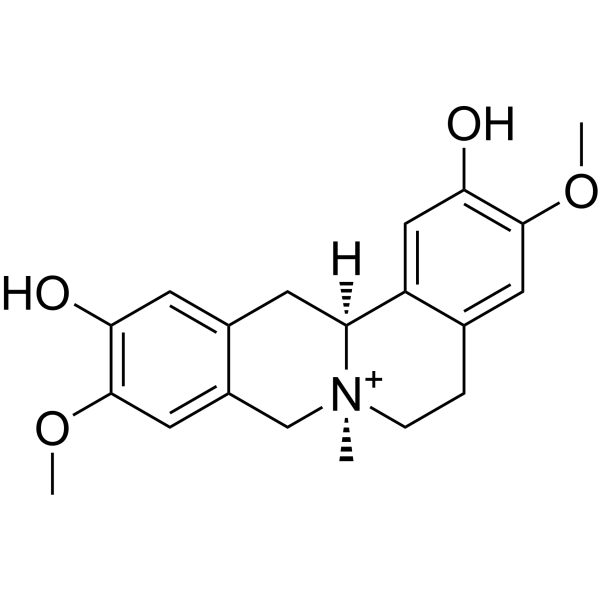
Phellodendrine is an orally active plant alkaloid. Phellodendrine inhibits the proliferation of KRAS-mutated pancreatic cancer cells by suppressing macropinocytosis and glutamine metabolism, inducing ROS accumulation and mitochondrial apoptosis. Phellodendrine promotes autophagy by activating the AMPK/mTOR pathway, alleviating intestinal damage in ulcerative colitis. Phellodendrine can alleviate gouty arthritis by inhibiting the IL-6/STAT3 signaling pathway. Phellodendrine suppresses allergic reactions by altering the conformation of MRGPRB3/MRGPRX2 protein, thereby inhibiting the activation of PKC and subsequent downstream MAPK and NF-κB signaling. Phellodendrine inhibits the AKT/NF-κB pathway and down-regulates the expression of COX-2, thereby protecting zebrafish embryos from oxidative stress. Phellodendrine has an anti-major depressive disorder (MDD) effect by down-regulating CHRM1, HTR1A, and the PI3K/Akt signaling pathway .
loading...
    loading...
Cat. No.: HY-N0735R
CAS No.: 104112-82-5
Phellodendrine chloride (Standard) is the analytical standard of Phellodendrine chloride (HY-N0735). Phellodendrine chloride is an orally active plant alkaloid. Phellodendrine chloride inhibits the proliferation of KRAS-mutated pancreatic cancer cells by suppressing macropinocytosis and glutamine metabolism, inducing ROS accumulation and mitochondrial apoptosis. Phellodendrine chloride promotes autophagy by activating the AMPK/mTOR pathway, alleviating intestinal damage in ulcerative colitis. Phellodendrine chloride can alleviate gouty arthritis by inhibiting the IL-6/STAT3 signaling pathway. Phellodendrine chloride suppresses allergic reactions by altering the conformation of MRGPRB3/MRGPRX2 protein, thereby inhibiting the activation of PKC and subsequent downstream MAPK and NF-κB signaling. Phellodendrine chloride inhibits the AKT/NF-κB pathway and down-regulates the expression of COX-2, thereby protecting zebrafish embryos from oxidative stress. Phellodendrine chloride has an anti-major depressive disorder (MDD) effect by down-regulating CHRM1, HTR1A, and the PI3K/Akt signaling pathway.
loading...
    loading...
Cat. No.: HY-L951
505 compounds

Macrocyclic scaffolds are increasingly valued in modern drug discovery for their exceptional activity against undruggable targets (proteases, kinases, PPIs). 2026 marks a key commercial breakthrough for oral macrocyclic peptides: enlicitide, the world’s first oral PCSK9 macrocyclic peptide, has received FDA approval. Macrocyclic candidates targeting KRAS and other classic undruggable targets have also entered clinical development, validating macrocyclization as an effective strategy to overcome druggability barriers.

Two core R&D directions lead current macrocyclic drug design: AI-driven de novo generation and structural optimization of small-molecule macrocycles, and macrocyclic peptides based on sequence design and conformational engineering. Macrocycle druggability hinges on embedded linkers, which determine cyclization efficiency, final conformation and drug-like properties. Bifunctional reaction orthogonality is the core linker selection criterion. Our linker library enables stepwise intramolecular cyclization with suppressed side reactions, accommodates varied ring sizes, and covers three key reaction systems: amide condensation, nucleophilic substitution and CuAAC click chemistry.

Built on classical macrocyclization systems, the library is processed through reaction classification, bifunctional orthogonality evaluation, novelty clustering and redundancy removal, with PROTAC long-chain and ADC cleavable linkers explicitly excluded. Featuring rigid, semi-rigid and flexible scaffolds, it is widely applicable to small-molecule macrocycle synthesis and linear peptide cyclization.

