245 Results for "

Control compound

" in MedChemExpress (MCE) Product Catalog:
Products (245)

245 Results for "Control compound" in MCE Product Catalog:

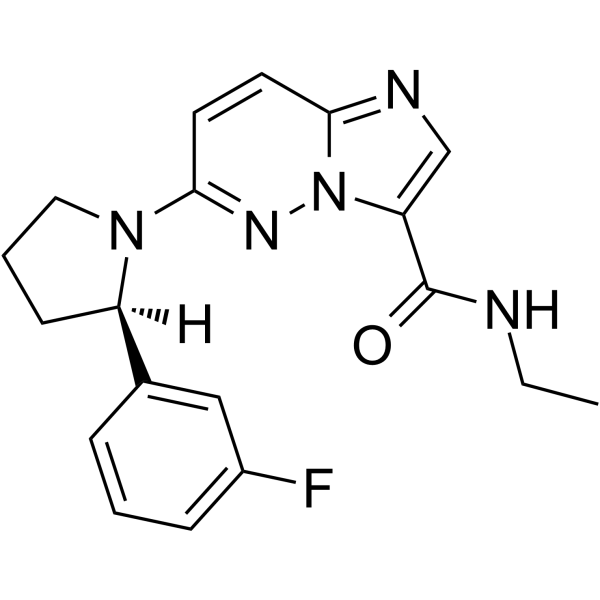
Cat. No.: HY-146521
CAS No.: 1365213-20-2
Target:  

Trk Receptor

Research Areas:  

Cancer

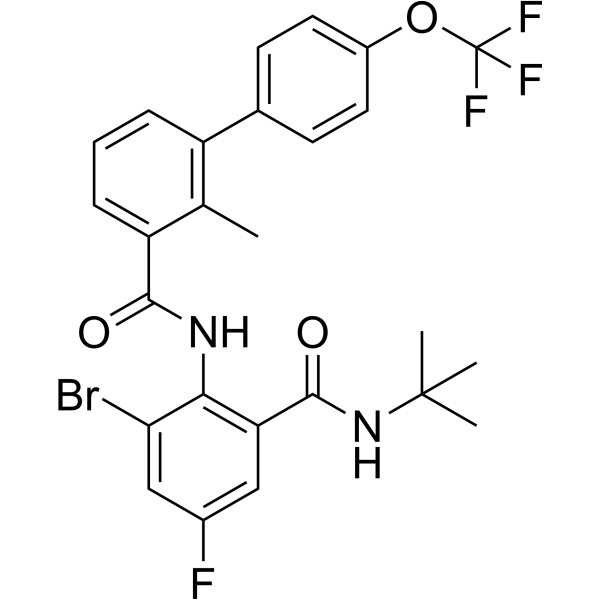
TRK-IN-15 is a potent inhibitor of TRK. Protein kinases play a critical role in the control of cell growth and differentiation and are responsible for the control of a wide variety of cellular signal transduction processes. TRK-IN-15 has the potential for the research of TRK-related diseases (extracted from patent WO2012034091A1, compound X-55) .
loading...
    loading...
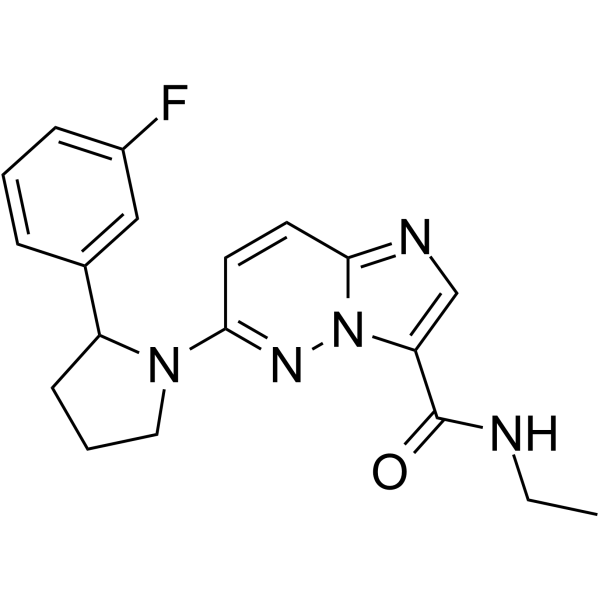
Cat. No.: HY-146522
CAS No.: 1365212-81-2
Target:  

Trk Receptor

Research Areas:  

Cancer

TRK-IN-16 is a potent inhibitor of TRK. Protein kinases play a critical role in the control of cell growth and differentiation and are responsible for the control of a wide variety of cellular signal transduction processes. TRK-IN-16 has the potential for the research of TRK-related diseases (extracted from patent WO2012034091A1, compound X-21) .
loading...
    loading...
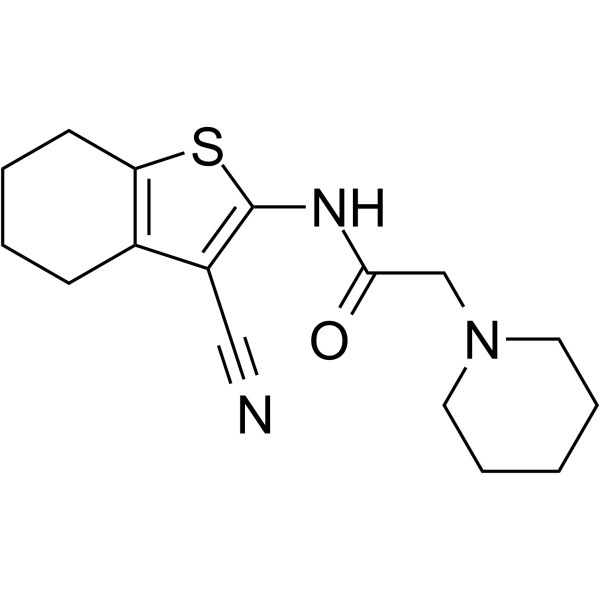
Cat. No.: HY-147107
CAS No.: 58125-33-0
Target:  

Insecticide

Research Areas:  

Others

OfHex1-IN-2 (compound I-79) is a potent β-N-acetylhexosaminidase OfHex1 inhibitor. OfHex1-IN-2 can be used in control of insect .
loading...
    loading...
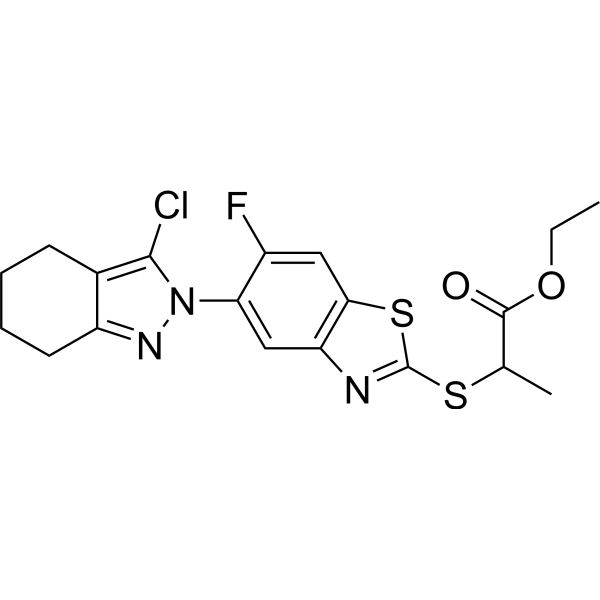
Cat. No.: HY-149312
CAS No.: 1879036-82-4
Research Areas:  

Others

PPO-IN-3 (Compound 8ad) is a PPO inhibitor with an KI value of 0.67 nM. PPO-IN-3 has post-emergence herbicidal activity. PPO-IN-3 can be used for weed control .
loading...
    loading...
Cat. No.: HY-149615
CAS No.: 2573134-85-5
Target:  

Fungal

Research Areas:  

Infection

Antibacterial agent 157 (compound B12) is a fungicidal agent. Antibacterial agent 157 can influence the protein synthesis of Botrytis cinerea. Antibacterial agent 157 can be used for gray mold resistance control research .
loading...
    loading...
Cat. No.: HY-129303
CAS No.: 779282-36-9
Target:  

Endogenous Metabolite

Research Areas:  

Metabolic Disease

AP39 (Item No. 17100) is a compound used to increase the levels of hydrogen sulfide (H2S) within mitochondria. It consists of a mitochondria-targeting motif (triphenylphosphonium) coupled to an H2S-donating moiety (dithiolethione) by an aliphatic linker. AP219 is a control compound for AP39, containing the triphenylphosphonium scaffold but lacking the H2S-releasing portion.
loading...
    loading...
Cat. No.: HY-107961R
CAS No.: 33564-31-7
Diflorasone diacetate (Standard) is the analytical standard of Diflorasone diacetate. This product is intended for research and analytical applications. Diflorasone diacetate is an anti-inflammatory steroid compound used as locally or topically agent. Diflorasone diacetate is being used for skin disorders to control corticosteroid-responsive dermatoses .
loading...
    loading...
Cat. No.: HY-159016
CAS No.: 3094092-93-7
Target:  

PROTACs

Research Areas:  

Cancer

SIAIS630121-NC (compound 630121-NC) is a negative control for NAMPT (nicotinamide phosphoribosyltransferase) PROTAC degrader SIAIS630121. SIAIS630121-NC shows no NAMPT degradation capability at all .
loading...
    loading...
Cat. No.: HY-B1340R
CAS No.: 6804-07-5
Carbadox (Standard) is the analytical standard of Carbadox. This product is intended for research and analytical applications. Carbadox is a quinoxaline-di-N-oxide antibiotic compound which is widely fed to nursery-age pigs to control enteric diseases and improve feed efficiency.
loading...
    loading...
Cat. No.: HY-N13154
CAS No.: 189759-03-3
Malolactomycin C (compound 1) is a macrolide antifungal antibiotic isolated from Streptomyces strain KP-3144. Malolactomycin C is an effective inhibitor of Botrytis cinerea and thus controls a variety of plant diseases including gray mold .
loading...
    loading...
Cat. No.: HY-119327
CAS No.: 2008-41-5
Target:  

Autophagy AMPK

Research Areas:  

Others

Butylate is a compound involved in platelet research. Platelet activation can cause autophagy, which is partly mediated by the AMPK-MTOR pathway and is related to sphingolipid metabolism. Butylate mentioned in the study may be a tool or control substance for studying related metabolic processes.
loading...
    loading...
Cat. No.: HY-107477R
CAS No.: 1693766-04-9
Research Areas:  

Cancer

GSK8573 (Standard) is the analytical standard of GSK8573 (HY-107477). This product is intended for research and analytical applications. GSK8573 is an inactive control compound for GSK2801 (acetyl-lysine competitive inhibitor of BAZ2A and BAZ2B bromodomains). GSK8573 has binding activity to BRD9 with a Kd value of 1.04 μM and is inactive against BAZ2A/B and other bromodomain familiy. GSK8573 can be used as a structurally related negative control compound in biological experiments .
loading...
    loading...
Cat. No.: HY-N15729
CAS No.: 2020-84-0
1-(2,4,5-Trimethoxyphenyl)propane-1,2-dione is an aromatic compound found in Acorus calamus. 1-(2,4,5-Trimethoxyphenyl)propane-1,2-dione is promising for research of plant allelopathy and weed control .
loading...
    loading...
Cat. No.: HY-L0095V
270,000 compounds
OTAVAchemicals Screening Collection contains about 270,000 re-supply compounds for prompt delivery. All compounds have undergone quality control to confirm their chemical structures.
Cat. No.: HY-LD004
14 million compounds

DEL technology enables the simultaneous screening of millions or billions of compounds in a single tube by covalently linking each small molecule with a unique DNA sequence. Traditional DEL screening primarily focuses on identifying non-covalent binding molecules, where interactions with the target are reversible. In contrast, DNA‑encoded covalent library is an ultra‑high‑throughput screening library developed on the basis of conventional DNA‑encoded library technology. It incorporates controllable electrophilic covalent warheads capable of forming irreversible covalent bonds with amino acid residues at the active sites of target proteins, including Cys, Lys, Ser, Tyr, and others. This covalent binding enhances binding affinity, prolongs residence time at the target site, and has the potential to overcome challenges associated with traditional non-covalent inhibitors, such as drug resistance or off-target effects.

Each compound in the library contains both a binding domain and an electrophilic warhead. It first recognizes and binds to the target through non covalent interactions, and then forms a stable covalent bond with key amino acid residues to achieve irreversible inhibition. This library is specifically designed for the discovery of potent, long lasting, and highly selective covalent inhibitors, particularly for undruggable targets such as kinases, GPCRs, proteases, and mutant oncoproteins. Each molecule is uniquely labeled with a DNA barcode for molecular identification and sequencing decoding.

This library is an advanced and highly diverse collection, consists of 35 independent sub-libraries with a total scaleof 14 million compounds, It incorporates over 14 experimentally validated covalent warheads capable of targeting cysteine, lysine, arginine, aspartic acid and glutamic acid. This library is constructed with diverse drug like core scaffolds and integrated controllable covalent warheads, it features structural diversity, reaction spec

Cat. No.: HY-208734
CAS No.: 3124579-20-7
Target:  

Others

Research Areas:  

Others

YAP1/TEAD (Compound 16) negative control-1 is an inactive control compound for YAP1/TEAD inhibitors .
loading...
    loading...
Cat. No.: HY-180876
CAS No.: 405924-84-7
Target:  

sFRP-1

Research Areas:  

Neurological Disease

SFRP1 modulator-1 (compound Way 316606 (positive control)) is a SFRP1 modulator.
loading...
    loading...
Cat. No.: HY-L0094V
1,398,968 compounds
The Chinese National Compound Library (CNCL) composes 1.4 million compounds possessing diversified structures. Coupled with this library will be advanced sample handling, information management and quality control systems. Most compounds in the library are drug-like, conforming to “Lipinski’s Rule of Five”, such as MW < 500, logP < 5, Hydrogen Bond Donors < 5.
Cat. No.: HY-185138
CAS No.: 3104812-92-9
Target:  

Herbicide

Research Areas:  

Others

Herbicidal agent 14 (compound 17) is a herbicide with an excellent herbicidal effect when controlling broadleaf weeds before/after emergence .
loading...
    loading...
Cat. No.: HY-W703863
CAS No.: 105779-78-0
Target:  

Insecticide

Research Areas:  

Infection

Pyrimidifen is a phenoxyethyl amine compound and is an acaricide. Pyrimidifen controls the African red mite, Eutetranychus africanus with a persistency of 14-21 days .
loading...
    loading...

