130 Results for "

bacterium

" in MedChemExpress (MCE) Product Catalog:
Products (130)

130 Results for "bacterium" in MCE Product Catalog:

Cat. No.: HY-E71077
Research Areas:  

Others

(5R)-Carbapenem-3-carboxylate synthase (EC 1.14.20.3) requires Fe2+. The enzyme is involved in the biosynthesis of the carbapenem β-lactam antibiotic (5R)-carbapen-2-em-3-carboxylate in the bacterium Pectobacterium carotovorum. (5R)-Carbapenem-3-carboxylate synthase (EC 1.14.20.3) catalyses a stereoinversion at C-5 and introduces a double bond between C-2 and C-3.
loading...
    loading...
Cat. No.: HY-N16692
CAS No.: 90332-92-6
Shizukolidol is an antimicrobial agent that can be isolated from polyfollicles of Magnolia vovidessi. Shizukolidol shows antibacterial activity against Chryseobacterium sp. Shizukolidol can be used for the research of bacterial infection .
loading...
    loading...
Cat. No.: HY-128526
CAS No.: 160472-93-5
Target:  

Endogenous Metabolite

Research Areas:  

Infection

Acinetobactin is a bifunctional siderophore secreted by Acinetobacter baumannii that competitively binds ferric iron ions. Acinetobactin supplies A. baumannii by sequestering host-sequestered Fe 3+, while competitively depriving skin and respiratory commensal bacteria of iron resources, thereby exerting growth-inhibitory effects on Staphylococcus epidermidis, Staphylococcus hominis, Staphylococcus haemolyticus, and Corynebacterium striatum. The synthesis and transport of Acinetobactin enhance the intracellular epithelial colonization ability of A. baumannii, induce apoptosis of host epithelial cells, and simultaneously improve the survival and invasion capabilities of the bacterium in Galleria mellonella and mouse sepsis models. Acinetobactin can be used in A. baumannii-related research .
loading...
    loading...
Cat. No.: HY-W714137
CAS No.: 4430-39-1
Synonyms: Lesquerellin; 6-Methylthiohexyl isothiocyanate
Target:  

Bacterial

Research Areas:  

Infection

(6-Isothiocyanatohexyl)(methyl)sulfane (Lesquerellin; 6-Methylthiohexyl isothiocyanate) is an isothiocyanate found in wasabi (W. japonica) and has various biological activities. (6-Isothiocyanatohexyl)(methyl)sulfane is active against the bacterium Bacillus subtilis and the fungus T. mentagrophytes (MIC=25 μg/mL). (6-Isothiocyanatohexyl)(methyl)sulfane also has anthelmintic activity against blue mussel (M. edulis). (6-Isothiocyanatohexyl)(methyl)sulfane has antifouling activity when applied to polyvinyl chloride (PVC) panels at a concentration of 50 μmol/cm2 in a conventional immersion test.
loading...
    loading...
Cat. No.: HY-W093433
CAS No.: 10222-01-2
Research Areas:  

Infection

2,2-Dibromo-2-cyanoacetamide is a non-oxidizing bactericide. 2,2-Dibromo-2-cyanoacetamide enhances bactericidal activity by reacting with sulfhydryl groups on the cell walls of microorganisms in aquatic environments to release bromide ions. 2,2-Dibromo-2-cyanoacetamide effectively inactivates Legionella pneumophila, rendering it non-culturable, and exhibits significantly higher killing efficacy against this bacterium in reservoir biofilms than in aerosol biofilms. 2,2-Dibromo-2-cyanoacetamide is suitable for legionellosis prevention and control as well as related research .
loading...
    loading...
Cat. No.: HY-W775362
CAS No.: 3081-14-9
Synonyms: 77PD; DHPPD
Research Areas:  

Others

N,N'-Bis(1,4-dimethylpentyl)-p-phenylenediamine is a substituted p-phenylenediamine. N,N'-Bis(1,4-dimethylpentyl)-p-phenylenediamine scavenges ozone and forms nitroxyl radical. N,N'-Bis(1,4-dimethylpentyl)-p-phenylenediamine xhibits toxicity towards the aqatic bacterium V. fischeri (EC50 = 0.41 mg/L). N,N'-Bis(1,4-dimethylpentyl)-p-phenylenediamine can be used as an antiozonant. N,N'-Bis(1,4-dimethylpentyl)-p-phenylenediamine can be found in river water and sediment .
loading...
    loading...
Cat. No.: HY-B1346
CAS No.: 6899-04-3
Synonyms: (±)-Glutamine; DL-Gl
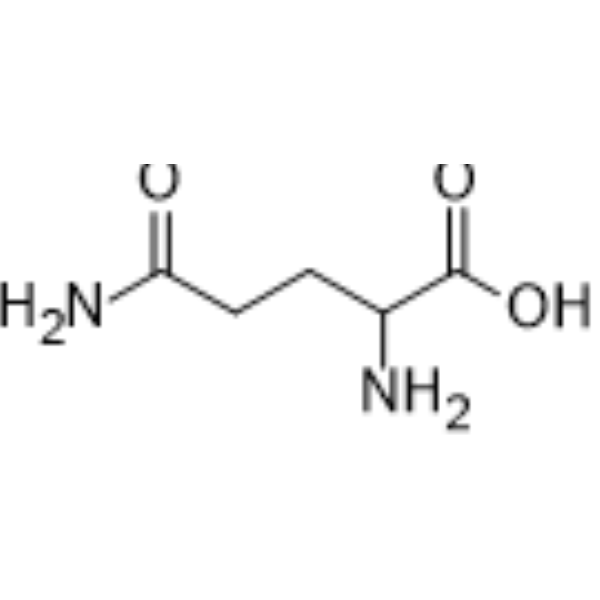
DL-Glutamine ((±)-Glutamine; DL-Gl) is an amino acid metabolite. DL-Glutamine is a plasma metabolic biomarker associated with Treg/Th17 balance in an OVA-induced eosinophilic asthma mouse model. DL-glutamine positively correlates with muscle quality parameters such as muscle water-holding capacity and shear force, and negatively correlates with oxidative stress markers and apoptotic gene expression. DL-Glutamine is associated with periodontal pathogens and oral microbial communities in saliva/serum. DL-Glutamine can be used in research related to asthma, muscle quality, and periodontal disease .
loading...
    loading...
Cat. No.: HY-B1346R
CAS No.: 6899-04-3
Synonyms: (±)-Glutamine (Standard); DL-Gl (Standard)
DL-Glutamine (Standard) ((±)-Glutamine (Standard); DL-Gl (Standard)) is the analytical standard of DL-Glutamine (HY-B1346). This product is intended for research and analytical applications. DL-Glutamine ((±)-Glutamine; DL-Gl) is an amino acid metabolite. DL-Glutamine is a plasma metabolic biomarker associated with Treg/Th17 balance in an OVA-induced eosinophilic asthma mouse model. DL-glutamine positively correlates with muscle quality parameters such as muscle water-holding capacity and shear force, and negatively correlates with oxidative stress markers and apoptotic gene expression. DL-Glutamine is associated with periodontal pathogens and oral microbial communities in saliva/serum. DL-Glutamine can be used in research related to asthma, muscle quality, and periodontal disease .
loading...
    loading...
Cat. No.: HY-B1346S
CAS No.: 1217443-24-7
Synonyms: (±)-Glutamine-13C5,15N2,d10; DL-Gl-13C5,15N2,d10
DL-Glutamine- 13C5, 15N2,d10 ((±)-Glutamine- 13C5, 15N2,d10; DL-Gl- 13C5, 15N2,d10) is the 13C, 15N, d10-labeled DL-Glutamine (HY-B1346). DL-Glutamine ((±)-Glutamine; DL-Gl) is an amino acid metabolite. DL-Glutamine is a plasma metabolic biomarker associated with Treg/Th17 balance in an OVA-induced eosinophilic asthma mouse model. DL-glutamine positively correlates with muscle quality parameters such as muscle water-holding capacity and shear force, and negatively correlates with oxidative stress markers and apoptotic gene expression. DL-Glutamine is associated with periodontal pathogens and oral microbial communities in saliva/serum. DL-Glutamine can be used in research related to asthma, muscle quality, and periodontal disease .
loading...
    loading...
Cat. No.: HY-W154247
CAS No.: 103313-38-8
Target:  

Bacterial

Research Areas:  

Infection

IP6C is a specific inhibitor and phage sensitizer targeting type II Thoeris systems. IP6C competitively binds to histidine in the catalytic pocket of ThsB, blocks the production of the His-ADPR alarm signal and inhibits ThsA activation, thereby relieving bacterial stasis of phage replication. IP6C selectively resensitizes drug-resistant bacteria carrying type II Thoeris systems (such as Pseudomonas aeruginosa) to phage lysis, without affecting other bacteria, and shows no toxicity to mice and human cell lines. IP6C significantly improves the survival rate of infected mice, and can be used to overcome bacterial phage defense mechanisms and study Pseudomonas aeruginosa infections .
Thoeris system: (named after the Egyptian goddess of fertility and protection), is a widespread anti-phage immune defense system in bacteria and archaea. Thoeris system belongs to the "Abortion Infection (Abi)" mechanism of bacteria: when an individual bacterium detects phage invasion, it initiates a suicide program and dies, thereby blocking phage replication and spread, and protecting the surrounding bacterial population from infection.
loading...
    loading...

